Showing posts with label winter cluster. Show all posts

Beekeeper Calendar Series: Winter

Thursday, 11 January 2024

Have you ever wondered what beekeepers do during the winter months? Most often there is very little to be done within the hive once winter starts. That being said, beekeepers spend a significant amount of time planning and preparing for the upcoming spring. Beekeepers also know they must respect the natural rhythms of their colonies during the colder months. Read this week’s blog, along with those that will follow in this series, to learn more about a beekeeper’s calendar during each season.

Beekeeper’s Calendar Series: Winter

The onset of the winter beekeeping season starts after hives have been wrapped and insulated. If all preparation was done well, beekeepers have very little practical hive management to do during the winter months. It is good practice to occasionally check hives, especially after severe weather events to address any potential damage. Other than that, beekeepers should not disturb the winter cluster by opening the hive. This practice acknowledges the importance of allowing the bees to maintain their tightly knit cluster, which serves as a crucial mechanism for conserving warmth and energy during the colder months. Bees will remain clustered throughout the winter but will leave the hive for cleansing flights on warmer days.

ATTTA©2022

There is often a question of whether snow should be removed from hives throughout the winter. Overall, snow removal is deemed unnecessary as snow will provide additional insulation, contributing to the hive’s thermal regulation. It is important that the top entrance remains unobstructed by snow, thereby facilitating proper airflow, but the use of a telescoping cover should address this concern.

One other thing beekeepers should periodically check for is damage caused by skunks and raccoons. Skunks and raccoons start breeding in late winter. They may start ripping plastic and pulling out entrance reducers. Beekeepers should check hives and fix if necessary.

So, what are beekeepers busy doing during the winter months? Mostly, winter is when beekeepers plan for the upcoming spring. Now is the time to build and repair beekeeping equipment. Also, to be ready for spring, beekeepers should order any wooden ware or bees they will need. Ordering these items during winter ensures that beekeepers have everything they need on hand when the spring season commences. Overall, winter serves as a crucial planning and preparation period, allowing beekeepers to potentially grow their operation in the upcoming season.

The other important thing beekeepers will spend their offseason doing is attending meetings, taking various beekeeping courses, and reading new research. All of these things help keep beekeepers educated on what is happening in the industry, as well as knowledgeable about the latest advancements in beekeeping and integrate new, evidence-based, approaches into their own practices.

Beekeepers should attend provincial beekeeping associations annual general meetings. Prince Edward Island, Nova Scotia and New Brunswick all have annual general meetings during the months of January to March. Atlantic beekeepers should consider attending ATTTA’s virtual winter workshop series. All Canadian beekeepers can attend the BeeTech conference presented by the Canadian Honey Council and the Canadian Association for Professional Apiculturists this February. Finally, Atlantic beekeepers should consider enrolling in the Fundamentals of Beekeeping course presented by ATTTA and Dalhousie Extended Learning, which will start this March.

The winter months may appear quiet within the hives, but for beekeepers, these months are still a crucial part in the beekeeper calendar. This time is needed to plan for the upcoming season, and, even during the coldest months of the year, beekeepers still need to check that the hives look good externally. Additionally, winter is a season for education and growth for beekeepers. Engaging in meetings, enrolling in courses, and reading academic research, helps keep beekeepers educated and engaged with their industry. Stay tuned for more insights into a beekeeper's calendar throughout each season in future blogs from ATTTA.

Connecting with ATTTA Specialists

If you’d like to connect with ATTTA specialists or learn more about our program, you can:

visit our website at https://www.perennia.ca/portfolio-items/honey-bees/

Email abyers@perennia.ca

Oh, the Weather Outside is Frightful, but the Cluster is so Delightful!

Thursday, 16 December 2021

With harsh winter weather descending, many of us are turning to inside activities and appreciating the warmth provided by our homes. Honey bees are much the same! In Atlantic Canada, beekeepers have their hives wrapped up and tucked away for the winter, meanwhile the bees within are still busy at work. Unlike most insects, honey bees survive the winter in a state of activity which takes the form of a winter cluster. Read on to learn more about what your winter bees are up to in the cluster during this time spent apart.

Oh, the Weather Outside is Frightful, but the Cluster is so Delightful!

During this time of year, honey bees truly have no place to go. Bee development begins to modify in the late fall when pollen resources start to dwindle. This physiological transition into winter bees is reflected in behavioral differences which serve the colony as their needs change with the season1.

Winter bees have two major tasks. Firstly, with the temperature dropping, bees need to focus on keeping the colony warm via thermoregulation2. The drop in temperature and shorted days which impacts the life of honey bees also mean changes for the plant communities which bees rely upon for protein and brood rearing. In the absence of high-quality forage, the colony will temporarily cease brood production. As a result, the second major task of winter bees is to initiate brood rearing when spring begins to approach. 

Brood rearing will not have initiated yet here in Atlantic Canada, so for now our bees are busy with thermoregulation. A recently published review article likens the thermoregulation of a bee hive to human engineered thermoregulation within a building, where the essential elements are heating, ventilation, and air conditioning3. The winter cluster is vital to thermal regulation of a hive and carries out heating and ventilation functions.

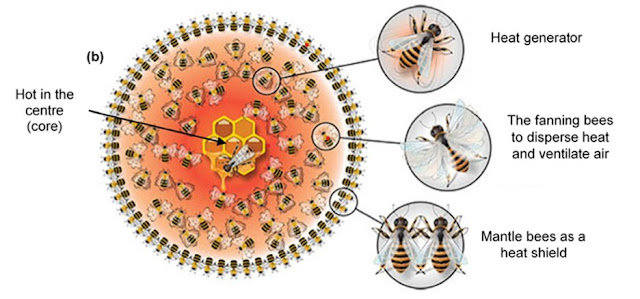
Like summer bees, winter bees practice a division of labor within the cluster to effectively maintain the core temperature around 32-36°C. The cluster is layered in three parts (see Figure 1). The inner circle, outer circle, and “mantle”. The inner circle can be thought of as the central heating system of a building. Here, the bees remain relatively stationary and produce heat through contractions of the thoracic flight muscles- shivering. Surrounding these bees are the ventilators. Ventilator bees move around and fan to distribute the heat produced in the core as well as regulate CO2 levels. The “mantle” bees form the outer layer. They link closely together to create a barrier that keeps the heat within the cluster, much like a layer of insulation around a building. Individual bees take turns in each of these roles, based on the needs of the colony at that time. There are other mechanisms which bees use to maintain hive temperature that are similar to human infrastructure, as well. For example, bees use propolis to seal cracks and crevices in the same way that humans use caulking or other sealants.

Figure 1. Diagram of the layering of winter bees within the cluster. Heat generator bees shiver to produce heat, fanning bees distribute the heat and regulate CO2, and mantle bees contain the heat within the cluster (Jarimi et al. 2020 modified from Purdue Extension 2017).

As beekeepers, it is valuable to understand what is going on in our hives so that we can provide them the best environment possible for their productivity. Through the activities described above, honey bees have adapted to successfully endure winters. However, honey bees did not develop these adaptations in the unique Atlantic Canadian climate nor did they evolve within Langstroth hive boxes. As such, we can take care by doing things such as providing top entrances to support ventilation, wrapping hives to reduce air gaps, providing additional insulation, and being sure to leave plenty of sealed food reserves for the hive to obtain its energy through the long winter months. 


1. Knoll, Stephane, Walter Pinna, Antonio Varcasia, Antonio Scala, and Maria Grazia Cappai. 2020. “The Honey Bee (Apis Mellifera L., 1758) and the Seasonal Adaptation of Productions. Highlights on Summer to Winter Transition and Back to Summer Metabolic Activity. A Review.” Livestock Science 235 (May): 104011. https://doi.org/10.1016/j.livsci.2020.104011.

2. Sammataro, Diana, and Alphonse Avitabile. 2011. The Beekeepers Handbook. 4th ed. Cornell University Press.