Showing posts with label best practice. Show all posts

Spring Cleanup for Beekeepers

Thursday, 13 April 2023

Traveling this week around our region truly demonstrates to me the diversity of climate in eastern Canada.  In NS, the willows are blooming and the Coltsfoot is beginning to come into flower.  Alternatively, on my return to Fredericton, I see hives just starting to peak out from under snow cover.  The importance of this observation is to remind us that beekeeping is very localized.  Any discussion around seasonal activities must be viewed through a local lens.  With this in mind, we will continue our discussion of spring beekeeping endeavors.

Spring Cleanup for Beekeepers

Beekeepers should have a good idea, by now, how winter has treated their bees.  In some areas, there may be opportunities to undertake internal hive inspections. The timing of this is determined by a few things but most important is the ambient temperature.  The main worry with doing inspections too early is resulting damaged brood.  At this time of year, the colonies are relatively small, and the cluster or brood nest size determines how much developing brood can be supported.  If the area of brood exceeds the cluster size, some of the developing bees may be lost due to exposure to cold.  This is called chilled brood and can be natural due to a disproportion in brood area to the size of the colony or because of exposing brood to cold temperatures during hive inspections.

A highly productive queen, producing eggs in excess of what the worker bee populations are able to keep warm, can result in chilled brood.  This is usually found at the peripheries, lateral and bottom areas of the frame.  Although this may effect capped brood it is most often seen in uncapped brood. The symptoms of chilled brood are similar to and may be confused with European Foulbrood.  If in the early season, you find some dead larva around the periphery of a patch of brood, it is more likely to be chilled brood.  So as we go into our hives in the early season, keep inspections brief when temperatures are between 10 – 15C but once temperatures rise, it is safe to undertake full hive inspections.

Over the next few weeks, dead-outs will be identified and removed.  Ensure that empty equipment is managed properly as this can present a biosecurity risk.  Wax moth (both greater and lesser) can cause serious economic losses.  This species will damage wooden equipment and comb.  Although the peak time for wax moth infestation is the height of summer months, empty equipment will be an attractant.  So when removing dead-outs, correct management practices and good equipment storage is necessary.

Figure 1.Spring bottom board cleanup.

Spring is also a time to start going through and culling out old frames.  Best practice is to label the year on your frames in which they entered your operation and removing them after 4 – 5 years.  As equipment ages the background levels of pathogens, such as AFB spores, will increase.  So fresh frames, foundation and comb will mean healthier colonies.  Wooden frames with wax foundation can be burned and plastic components can be sent for recycling.

Honey bees are excellent housekeepers but in the spring, the debris built up over winter may be too much for a growing hive to remove.  So all bottom boards should be cleaned in the spring.  Bottom board debris is a great habitat for certain honey bee pests like small hive beetle and wax moth.  Dirty bottom boards will also hold moisture, which is less than ideal for the bees and rots equipment.
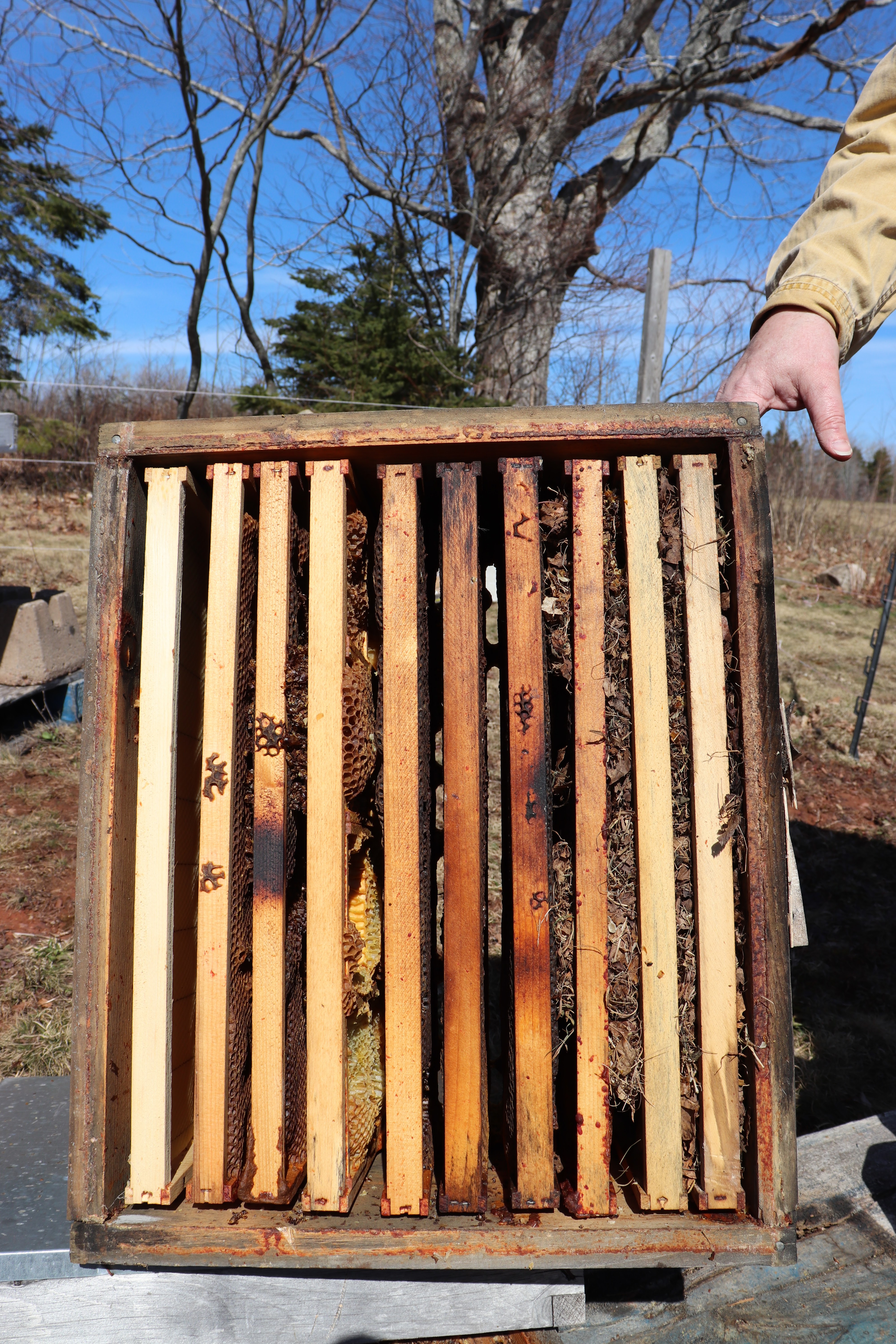
Figure 2. A mouse nest found in a dead-out during spring cleanup. Notice the build up of debris between the bars on the right side of the box.

Spring is also a time to tidy yards, improve fencing, check pallets.  All signs this year, indicate another early start to our beekeeping season.   So take advantage of the improving weather to get ahead with a good spring cleaning.


 Connecting with ATTTA Specialists


If you’d like to connect with ATTTA specialists or learn more about our program, you can:


Optimal Timing of Hive Placement for Wild Blueberry Pollination

Thursday, 23 February 2023

There is a high demand for pollinating honey bee units on wild blueberry fields in Atlantic Canada. Aside from increasing colony numbers, the industry can meet this demand by optimizing the use of existing honey bee units for maximum efficiency during the wild blueberry bloom period. ATTTA field research has been focused on this objective during our last five years of summer field work. One important management decision in regard to pollination services is when to deploy hives for pollination. In this blog, we will discuss our research findings and our suggestion on optimal timing of hive placement.

Optimal Timing of Hive Placement for Wild Blueberry Pollination

Longstanding, conventional practice is to place honey bees for pollination on blueberry fields when bloom reaches 10-20% open flowers. The stocking density recommendation is up to three hives per acre. Hive rotation and sequential loading during blueberry bloom are currently being practiced by a limited number of producers in our region. Sequential loading involves increasing and decreasing stocking densities of honey bee colonies to reflect changes during the bloom period. As the percent of open flowers on a field increase, the theoretical requirement for pollination will increase.  The desired result of this practice is to achieve optimal pollination through enhanced efficiency in the use of honey bee colonies. 

In the 2022 field season, ATTTA studied the impacts of hive placement on pollination success. Using a limited number of trial fields across the Maritime region, we found that deploying hives during early bloom has significantly positive impact on pollination success, measured by fruit set. Figure 1 below demonstrates this impact, where the percent of successful fruit set decreases as the percent bloom at time of hive placement increases. 

Figure 1. Linear relationship between fruit set and percent bloom at time of pollination. Red line indicates negative relationship, grey shading indicates the area between the error lines.

Foraging behaviour of honey bees on wild blueberries is little understood. However, it has been long suggested that honey bees placed on blueberry fields too early in the bloom period may habituate to other floral sources, abandoning the yet unopened blueberry flowers. There are complexities about honey bee behaviour (Abou-Shaara 2014) which indicates that previous thinking about the determent of early placement on honey bees is outweighed by the loss of production when pollination begins late, after 10-20% bloom. ATTTA field work results suggest that after 50% bloom the opportunity for optimized pollination and subsequent fruit set may be significantly lowered. The impact on yield of delayed pollination, and therefore income for the producer, may be significant. 

Another striking result of our field work from 2021-2022 shows a trend of honey bee hives are being placed on fields late into the bloom period. Figure 2 below shows that the average percent bloom when honey bees are place for pollination is 47.12%! This does not support effective pollination, and we urge producers to assess their fields for percent bloom in the upcoming season to determine, more precisely, the optimal time for placement of bees. 

Figure 2. Percent bloom assessed within 24 hours of hives being placed on blueberry fields (n=18) in the 2021-2022 seasons. Whiskers = standard deviation.

Percent bloom can be assessed by counting open and closed flowers on a select stem and applying the following formula. 

% bloom = (open flowers / all flowers) x 100

It is best to count several stems and take the average % bloom for a broader field representation. UMaine Cooperative Extension has further information on how to assess individual wild blueberry fields for pollination requirements. 

Best practice for optimal and efficient hive use may be to place bees at a lower stocking density as blossom is opening, from 1-10% bloom, and increase hives to full stocking density at 25% bloom. It seems that the detriment of possibly placing hives too late in the bloom period outweighs those of placing hives too early. Better too early than too late!

References
Abou-Shaara, H.F. 2014. “The Foraging Behaviour of Honey Bees, Apis Mellifera: A Review.” Veterinární Medicína 59 (1): 1–10. https://doi.org/10.17221/7240-VETMED.


Connecting with ATTTA Specialists


If you’d like to connect with ATTTA specialists or learn more about our program, you can: