Showing posts with label early spring. Show all posts

2025 season outlook – PE

Thursday, 1 May 2025

Continuing with the series on early spring management and an outlook on the 2025 beekeeping season across Atlantic Canada, this week’s blog will discuss early season beekeeping trends across Prince Edward Island. Read this week’s blog to learn the highlights of how PE colonies faired through winter, trends in spring food stores, and how colonies are building up this spring.

2025 season outlook – PE

Across the island early anecdotal reports of colony loss have been variable with beekeepers reporting anywhere between 5-75% colony winter loss. The overall trend is that PE is likely to have a lower winter loss than the previous year, which was a record high for the province at 61%, and the industry is optimistic that this year’s average will be closer to the national 5-year average of 33%. It is still early in the season to confirm the province’s average winter loss, and an official report will be provided later in the season from the Canadian Association of Professional Apiculturists (CAPA) and from the Prince Edward Island provincial apiarist.

It is always important to investigate why colonies were lost during the winter season. Last year the top identified reasons for colony loss in PE included weak colonies in the fall, poor queens, weather, and ineffective varroa control. Anecdotally, beekeepers in PE have reported that weak colonies in the fall and poor queens may be a contributing factor to colony loss this year. The CAPA report will provide the final information on what PE beekeepers have identified as top reasons for colony loss for 2024-2025.

Troy Fraser, president of the Prince Edward Island Beekeepers’ Association, giving an update on behalf of the association at the PEI Spring Workshop last Friday in Charlottetown, PE.

The PE industry has had opportunity this spring to check on colony build up and do early spring activities such as placing Apivar® strips and providing supplemental pollen sources to boost colony production. Anecdotally, beekeepers report that surviving hives have good food stores coming out of winter and minimal spring feeding of fondant or syrup has been required. Overall, PE beekeepers are continuing to check on colony buildup this spring and are getting their plans in place for pollination later this month.

PE beekeepers should be monitoring food stores as they progress through spring and provide feed when needed until there is an abundance of natural pollen and/or nectar available. Additionally, as the number of good beekeeping days starts to increase, beekeepers should be doing monthly monitoring for varroa mites and provide treatment when indicated. For any questions regarding spring management please reach out to the ATTTA team. We wish all Prince Edward Island beekeepers a great start to the 2025 season! 

Connecting with ATTTA Specialists

If you’d like to connect with ATTTA specialists or learn more about our program, you can:

visit our website at https://www.perennia.ca/portfolio-items/honey-bees/

Email attta@perennia.ca


2025 season outlook – NS

Thursday, 24 April 2025

Continuing with the series on early spring management and an outlook on the 2025 beekeeping season across Atlantic Canada, this week’s blog will discuss early season beekeeping trends across Nova Scotia. Although it is early in the Nova Scotia beekeeping season, read this week’s blog to learn the highlights of how NS colonies faired through winter, trends in early spring food stores, and how colonies are building up this spring.

2025 Season Outlook – NS

As the 2025 beekeeping season progresses our team has received anecdotal reports across Nova Scotia of varying winter loss. Some beekeepers within Nova Scotia report unusually high winter loss of colonies, and others have reported average or above average winter loss. It is too early in the season to confirm Nova Scotia’s provincial winter loss, and an official report will be provided later in the season from the Canadian Association of Professional Apiculturists (CAPA) and from the Nova Scotia provincial apiculturist. That being said, the global beekeeping industry is concerned about beekeeping losses reported from United States. US beekeepers report losing 1.6 million honey bee colonies between June 2024 and March 2025. Commercial beekeepers in that country report losing 62% of their colonies, and hobbyist and sideliner beekeepers report losing 51% and 54%, respectively.

Nova Scotia beekeepers should aim to determine the reason behind colony loss by examining dead outs and potentially seeking laboratory testing to determine if any pests and/or disease were the reason for colony loss. Nova Scotia beekeepers have reported that a few of the contributing causes for winter loss include varroa, shrews and weak colonies in the fall. Again, the official report identifying top reasons for colony loss will be provided by CAPA later this season. The ATTTA team is always willing to assist with pest and disease testing on dead outs, and on live colonies throughout the season. We encourage beekeepers to reach out about testing available.

Beekeepers report that surviving hives are generally in good shape with lots of stores and some evidence of early brood rearing. However, there are varying reports of spring dwindle occurring which may mean variation in hive strength for wild blueberry pollination, and less opportunity for early spring splits.

There was good opportunity for beekeepers to place Apivar® strips in early to mid-March with some warmer days across the province. There was also an opportunity for beekeepers to place pollen patties to help boost brood production.

Pollen patty placed in honey bee colony (ATTTA©2021).

A reminder to all Nova Scotia beekeepers to continue checking food stores and provide feed when needed until there is an abundance of natural pollen and/or nectar available. Additionally, during the upcoming season it is important that beekeepers in NS are focused on pest and disease monitoring and management. For any questions regarding spring management and pest/disease monitoring and treatment please reach out to the ATTTA team. We wish all Nova Scotia beekeepers a great start to the 2025 season!

Connecting with ATTTA Specialists

If you’d like to connect with ATTTA specialists or learn more about our program, you can:

visit our website at https://www.perennia.ca/portfolio-items/honey-bees/

Email attta@perennia.ca


How to Care for Colonies in Early Spring (2025 Season Outlook)

Thursday, 10 April 2025

Early spring is an exciting time for beekeepers. Spring marks the start of a new beekeeping season, and for many beekeepers they cannot wait to start working in their apiaries. Across the Atlantic region beekeepers have started to engage in early spring activities, which means assessing how colonies faired during the winter months and supporting colony growth throughout the early beekeeping season. To learn more about supporting colonies in early spring, and for a general update on the outlook of the 2025 beekeeping season in Atlantic Canada, read this week’s blog as part of an ongoing series.

How to Care for Colonies in Early Spring (2025 Season Outlook)

The start of a new beekeeping season is both an exciting and important period of time for Atlantic Canada beekeepers. With the onset of spring, beekeepers are busy assessing winter survival of colonies, and conducting various activities that support colony growth during the early season.

During the earliest part of the beekeeping season, beekeepers aim to minimize opening hives, which can disrupt the winter cluster. However, this does not mean that beekeepers do not have work to do around the apiary. An important late winter to early spring activity is assessing food stores within colonies by hefting hives. Hefting is when a beekeeper will tilt the hive by lifting one side slightly off the ground which allows them to judge the weight of the colony. A colony within a double hive body is at risk of starvation if the hive weighs below 25 kg (55 lbs.). A beekeeper should emergency feed, at the first opportunity, any hives below the critical weight. For emergency feeding, fondant is preferred over sugar syrup because bees will not consume syrup if the temperature is below 10°C. Beekeepers should ensure that they are providing good quality fondant, which means the fondant is produced using an enzyme rather than an acid to invert sucrose (a complex sugar) into simple sugars (fructose and glucose) which are nutritionally available energy sources for bees. Fondants produced using an acid (typical of most recipes for homemade fondant) can increase the amount of a toxin (hydroxymethylfurfural) present within the feed. Good quality commercially available fondants will use enzymatic hydrolysis to produce the fondant.

Beekeeper hefting hive (©ATTTA2023).

For some beekeepers, early spring may be a time when they provide mite treatments. This is typical of Apivar® which requires a 56-day treatment period followed by a 14-day withdrawal period prior to placing honey supers. Beekeepers will want to allow for the full 70-days to occur prior to collecting early honey in May, which is why this treatment is started in early spring.  Beekeepers can take advantage of the first nice day in early spring (ambient temperature greater than 5°C and sunny) to quickly crack open hives and place Apivar® strips.  Beekeepers should remember that the instructions for Apivar® strips require a mid-treatment repositioning and scraping to both reposition the strips in the middle of the cluster and to remove wax and propolis, ensuring maximum contact between bees and the amitraz strips.

Another important early spring activity is providing pollen or pollen supplement (i.e. pollen patties) to increase colony growth during the early spring. Bees use pollen and supplemental sources of protein to rear brood, so providing either pollen or pollen patties will stimulate the colony to start rearing brood. Providing pollen in early spring has been researched by ATTTA and demonstrated to be economically beneficial to support colony growth. It is essential that beekeepers continue providing a pollen source once they begin the activity until either the colony no longer consumes the provided pollen or natural pollen becomes available. This is because once colonies are stimulated to start rearing brood they need enough pollen to support the colony’s growth.

There are some other key considerations for successful spring management. First, there is no rush to unwrap colonies in Atlantic Canada. It is beneficial to keep winter wrapping on until the beekeepers must remove it to gain better access into the colony (towards the end of April). The one winter protective measure that beekeepers do want to remove earlier in the season is shrew guards. Once early pollen becomes available to the bees it is important to remove the shrew guards so that bees foraging for pollen can successfully bring the pollen into the hive without having it knocked off by the shrew guards. Finally, honey bee health should be on a beekeeper’s mind from the very start of the season. This begins with the inspection of dead outs, and determining if any pests and/or diseases were the reason for colony loss. The ATTTA team is always willing to assist with pest and disease testing on dead outs, and on live colonies throughout the season. We encourage beekeepers to reach out about testing available. Pest and disease monitoring should continue throughout the season and always be a top priority for beekeepers. To learn more about inspecting dead outs, ATTTA will be providing an upcoming workshop in partnership with the Nova Scotia Beekeepers’ Association on May 2nd.

The mentioned activities provide a brief highlight of the many tasks beekeepers do in early spring. Continue reading this blog series over the next several weeks to learn updates on the Atlantic beekeeping industry and for a 2025 season outlook across the region.

Connecting with ATTTA Specialists

If you’d like to connect with ATTTA specialists or learn more about our program, you can:

visit our website at https://www.perennia.ca/portfolio-items/honey-bees/

Email attta@perennia.ca


What’s the Buzz with ATTTA 200th Blog Post!

Thursday, 2 May 2024

A milestone is being celebrated by the Atlantic Tech

 Transfer Team for Apiculture with our 200th post of

   “What’s the Buzz with ATTTA”!


Thanks to all of you who following our Blog! Enjoy #200 below

As beekeepers, we are supportive of any initiative which will help either managed or native pollinators.  This support is seemingly reflected in the general population as evidenced by the increasing concern for the environment, broadly, and pollinators specifically.  Therefore, over the past number of years, the awareness of the plight of insects, especially pollinators, has increased.  If this widespread concern over bees had a starting point, that would be the honey bee Colony Collapse Disorder (CCD) crisis which began in 2006.  A syndrome was identified which showed as mysterious high losses of colonies, the reason for which could not be identified.  With reported cases of CCD beginning in Europe, the entire northern hemisphere perceived a bee crisis.  From this point there started a global initiative to…

… Save the Bees!

Spring in Atlantic Canada comes with long awaited warmer temperatures, flowers blooming, bees buzzing!  Attention then turns to the natural environment and a resurgence of the message “save the bees”.  Although most people naturally think of honey bees when hearing this message, it is misdirected to amalgamate all bees together. Firstly, a clear distinction between managed livestock (e.g. honey bees) and wild animals (native bees) must be made.  Both may be worth saving with mutually beneficial practices, but it needs to be recognized that in North America there are over 4000 species of bee1.  So, although bees are important, the general term is unclear considering the many species to which it refers.

Dandelions are a crucial source of early season nectar and pollen for all pollinating insects!

Managed insect pollinators, of which honey bees are one example, are necessary for efficient and successful pollination of 75% of all crops2.  Pollination services directly contributes one in three mouthfuls of all the food humans consume3.  Honey bees, used for pollination, alone, contribute over $7 billion in revenue to Canadian agriculture through increasing yields4.  Globally, it is estimated that nearly ½ million lives are lost annually due to inadequate pollination resulting in decreased food availability5.  Currently in eastern Canada the demand for pollination exceeds the supply resulting in losses of revenue for farmers and direct, negative economic impacts.  These examples highlight a dependency on, and need for, managed pollinators.

Native bees need a separate consideration. The Anthropocene epoch marks the largely negative impact of human activities on all aspects of the planet.  Insects, including bees, are not exempted from this and it has been recognized there is a general decline in many species of bee, moth, wasps6.  Examples of the drivers of this decline are lost and fragmented habitats, direct competition, climate change and pollution.  Some of these challenges of native bees are shared with managed insects, particularly climate change and pollution.  These broad ranging, mainly anthropogenic, challenges have no simple solution but highlight the importance of working towards an improved outcome.

High profile campaigns, like “No Mow May”, are successful in raising awareness of the need to support bees and pollinators (managed and native alike!).  These public movements are also reflected in current, progressive activities of beekeeping and related industries.   As an example, work to protect pollinators and create additional supportive habitat are being undertaken in the Maritime region by beekeepers, wild blueberry producers* and through government funded programs**. Having direct benefit to both managed and native pollinators, these types of programs are an obvious step in the right direction and evidence of a shift towards resilient, sustainable practices.

When it comes to populist style environmental campaigns, cynics and critics put forward suggestions of corporate and industry “greenwashing”, which may often be indistinguishable from authentic Corporate Social Responsibility initiatives.  These same critics may condemn other “save the bees” campaigns as having insincere or naïve motives. Also, the annual news cycle has an appetite for stories which drive traffic to their online platforms by promoting phrases like, “dandelions are junk food for bees” in reference to the May anti-mowing campaign. Although, this statement is an obvious and deliberate misalignment of anthropomorphic terminology and more about headline grabbing than scientific veracity, it should not distract from the big picture. Motivation or authenticity behind the actions is secondary to the message and any campaign which raises awareness of the importance of bees, both to the environment and human wellbeing, is working towards a correct common goal.   Observable and impactful actions, like a lawn full of brightly colored dandelions, although questionable in its actual measurable impact, is still excellent for raising the profile of the problem. So even with dubious motivation, actions can still have a positive result. Sometimes it is necessary to decouple the motivation from the actions which lead to the desired outcome!

A honey bee on a dandelion: a reassuring indicator that bees are able to sustain themselves after a long winter. 


There are no livestock producers more connected to and enthusiastic about supporting the environment than beekeepers.  Honey bees are an important sentinel and, as the most researched and understood insect on the planet, provide insight into broader conservation issues.  Honey bees support food production and therefore have a direct economic and human health impact. They are also necessary for modern, sustainable agriculture.  Native pollinators, which are currently at risk, support the entire ecosystem.  Decreases in population and species of insects, generally, will create trophic cascades which could collapse terrestrial food webs leading to loss of global biodiversity.  So, without question bees are worth saving and a first step in that direction is increased awareness.  All efforts towards a positive common goal are worthwhile and should be encouraged.  Casting light on the challenges faced by pollinators from agrochemicals, loss of habitat, a changing climate, is required.  So let everyone fly the yellow flag of NO MOW MAY as a symbol of support for all native and managed pollinators!


*see guide “Protecting Pollinators from Pesticides – wild blueberry” https://www.perennia.ca/wp-content/uploads/2024/03/P2C_WildBlueberry_Guide_ENG-FINAL.pdf

** E.g. Resilient Agriculture Landscape Program

 References


      1.      Winter, K., Adams, L., Thorp, R., Inouye, D., Day, L., Ascher, J. and Buchmann, S., 2006. Importation of non-native bumble bees into North America: potential consequences of using Bombus terrestris and other non-native bumble bees for greenhouse crop pollination in Canada, Mexico, and the United States.

     2.      Hristov, P., Neov, B., Shumkova, R. and Palova, N., 2020. Significance of apoidea as main pollinators. ecological and economic impact and implications for human nutrition. Diversity, 12(7), p.280.

     3.      Glover, B.J., 2023. Elephants, rainbows, flowers and bees: Interdisciplinary research driven by botanic garden collections. Plants, People, Planet, 5(2), pp.169-177.

    4.      Statistical Overview of the Canadian Honey and Bee Industry and the Economic Contribution of Honey Bee Pollination, 2021, Stats Canada   

     5.      Smith, M.R., Mueller, N.D., Springmann, M., Sulser, T.B., Garibaldi, L.A., Gerber, J., Wiebe, K. and Myers, S.S., 2022. Pollinator Deficits, Food Consumption, and Consequences for Human Health: A Modeling Study. Environmental Health Perspectives, 130(12), p.127003.

     6.      Wagner, D.L., 2020. Insect declines in the Anthropocene. Annual review of entomology, 65, pp.457-480.


Connecting with ATTTA Specialists

If you’d like to connect with ATTTA specialists or learn more about our program, you can:

visit our website at https://www.perennia.ca/portfolio-items/honey-bees/

Email abyers@perennia.ca


Spring Cleanup for Beekeepers

Thursday, 13 April 2023

Traveling this week around our region truly demonstrates to me the diversity of climate in eastern Canada.  In NS, the willows are blooming and the Coltsfoot is beginning to come into flower.  Alternatively, on my return to Fredericton, I see hives just starting to peak out from under snow cover.  The importance of this observation is to remind us that beekeeping is very localized.  Any discussion around seasonal activities must be viewed through a local lens.  With this in mind, we will continue our discussion of spring beekeeping endeavors.

Spring Cleanup for Beekeepers

Beekeepers should have a good idea, by now, how winter has treated their bees.  In some areas, there may be opportunities to undertake internal hive inspections. The timing of this is determined by a few things but most important is the ambient temperature.  The main worry with doing inspections too early is resulting damaged brood.  At this time of year, the colonies are relatively small, and the cluster or brood nest size determines how much developing brood can be supported.  If the area of brood exceeds the cluster size, some of the developing bees may be lost due to exposure to cold.  This is called chilled brood and can be natural due to a disproportion in brood area to the size of the colony or because of exposing brood to cold temperatures during hive inspections.

A highly productive queen, producing eggs in excess of what the worker bee populations are able to keep warm, can result in chilled brood.  This is usually found at the peripheries, lateral and bottom areas of the frame.  Although this may effect capped brood it is most often seen in uncapped brood. The symptoms of chilled brood are similar to and may be confused with European Foulbrood.  If in the early season, you find some dead larva around the periphery of a patch of brood, it is more likely to be chilled brood.  So as we go into our hives in the early season, keep inspections brief when temperatures are between 10 – 15C but once temperatures rise, it is safe to undertake full hive inspections.

Over the next few weeks, dead-outs will be identified and removed.  Ensure that empty equipment is managed properly as this can present a biosecurity risk.  Wax moth (both greater and lesser) can cause serious economic losses.  This species will damage wooden equipment and comb.  Although the peak time for wax moth infestation is the height of summer months, empty equipment will be an attractant.  So when removing dead-outs, correct management practices and good equipment storage is necessary.

Figure 1.Spring bottom board cleanup.

Spring is also a time to start going through and culling out old frames.  Best practice is to label the year on your frames in which they entered your operation and removing them after 4 – 5 years.  As equipment ages the background levels of pathogens, such as AFB spores, will increase.  So fresh frames, foundation and comb will mean healthier colonies.  Wooden frames with wax foundation can be burned and plastic components can be sent for recycling.

Honey bees are excellent housekeepers but in the spring, the debris built up over winter may be too much for a growing hive to remove.  So all bottom boards should be cleaned in the spring.  Bottom board debris is a great habitat for certain honey bee pests like small hive beetle and wax moth.  Dirty bottom boards will also hold moisture, which is less than ideal for the bees and rots equipment.

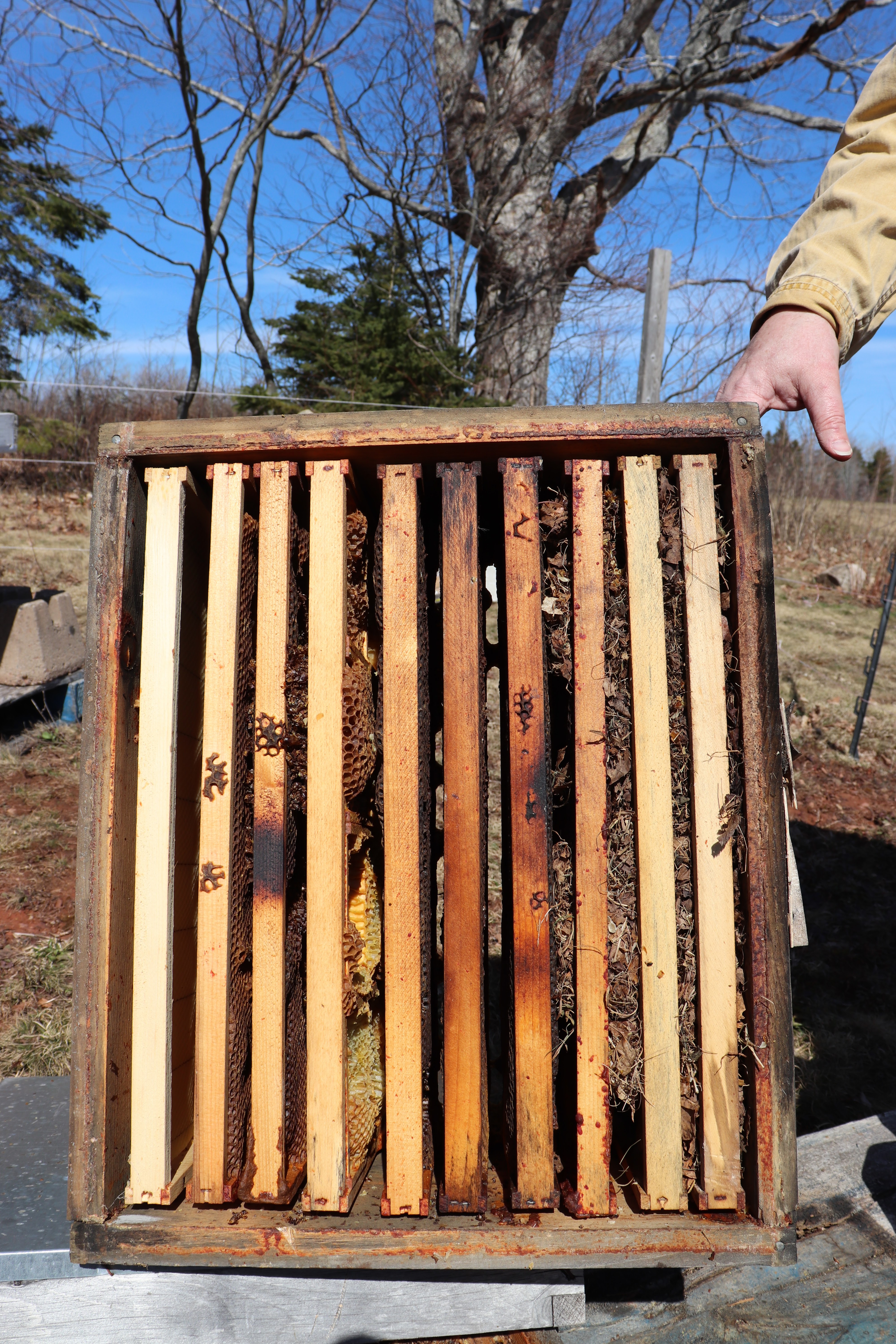
Figure 2. A mouse nest found in a dead-out during spring cleanup. Notice the build up of debris between the bars on the right side of the box.

Spring is also a time to tidy yards, improve fencing, check pallets.  All signs this year, indicate another early start to our beekeeping season.   So take advantage of the improving weather to get ahead with a good spring cleaning.


 Connecting with ATTTA Specialists


If you’d like to connect with ATTTA specialists or learn more about our program, you can:


Spring Preparation

Thursday, 9 March 2023

As discussed in previous blogs, the 2022-2023 winter has been unusual for Atlantic Canada, and uncommonly warm weather may have repercussions for resident honey bees. In this week’s blog, we will discuss spring beekeeping preparations with a focus on the potential implications of warm winter weather on colony management. 

Spring Preparation

The 2022 fall was distinct in Atlantic Canada, with ambient temperatures remaining warm as November progressed. This extended the timeframe during which honey bees could consume and cure sugar syrup for the winter to come. However, as the feeding period eventually ended, sporadic warm days persisted.  This unusual weather created more potential flying days for honey bees than seasonally typical. This means that foragers may have been out flying and expending energy without the reward of nectar to support their energy use. 

It is important, now, to assess the food stores remaining in your colonies. This can be done most easily and efficiently through the heft test. By lifting colonies individually, beekeepers can assess how heavy they are and estimate the remaining food supply. To lift hives, tilt them forward while gripping the bottom board. A luggage scale can also be used for a more precise measure. When food stores of a colony start to dip below 10kgs (20lbs) and there is no impending nectar flow, it is time to consider emergency feeding. An empty, double Langstroth hive, complete with 10 frames and honey bees, weighs around 15kgs (35lbs). Therefore, when an overwintering hive weighs around 25kg, it is time to feed. 

In cold temperatures, less than 10°C, honey bees cannot consume and process liquid sugar syrup. Consequently, feeding below this temperature threshold requires a solid sugar form. Fondant is the most nutritionally available feeding option for a hungry winter colony. Best practice is to buy commercially prepared fondant. If you do choose to make your own, be sure to not overheat the sugar because this can be harmful to bees and lead to digestion issues. Once you begin to feed a colony, continue to monitor them until the nectar flow starts in earnest with the blooming of dandelions. Before this flow, early spring feeding using 1:1 sugar-water syrup can begin when daily temperatures start to exceed 10°C.

Honey bees returning to a wrapped hive with early spring pollen. Remember to take shrew guards off once you see this, so that pollen is not scraped off the legs of returning foragers!

In cold temperatures, less than 10°C, honey bees cannot consume and process liquid sugar syrup. Consequently, feeding below this temperature threshold requires a solid sugar form. Fondant is the most nutritionally available feeding option for a hungry winter colony. Best practice is to buy commercially prepared fondant. If you do choose to make your own, be sure to not overheat the sugar because this can be harmful to bees and lead to digestion issues. Once you begin to feed a colony, continue to monitor them until the nectar flow starts in earnest with the blooming of dandelions. Before this flow, early spring feeding using 1:1 sugar-water syrup can begin when daily temperatures start to exceed 10°C.

Spring varroa mite management is important, as well. Varroa mites are a major issue in beekeeping and led to devastating overwintering losses in 2022 (Ferland, Wilson, and Nasr 2022). Using an integrated pest management approach to keep varroa mite populations low throughout the beekeeping season is the best way to manage mites in honey bee colonies. This begins with monitoring as early as possible in the spring and continuing monthly monitoring throughout the season. When mite levels exceed the economic treatment threshold, treat colonies and test again to ensure the treatment was successful. Alternating management options is important for maintaining miticide integrity and delaying varroa mite resistance to powerful synthetic treatments, such as Apivar®. See the ATTTA factsheet Varroa Mite Management Options for Atlantic Canada for more information. 

So far, ATTTA has heard positive reports from local Atlantic beekeepers checking their colonies. Remember that productive, healthy colonies during the peak summer season are a reflection of diligent management year-round!

References
Ferland, Julie, Geoff Wilson, and Medhat Nasr. 2022. “Canadian Association of Professional Apiculturists Statement on Honey Bee Wintering Losses in Canada (2022).” Canadian Association of Professional Apiculturists.


Fundamentals of Beekeeping!

Registration is open for the Fundamentals of Beekeeping with ATTTA and Dalhousie Extended Learning! Click here to learn more and register. We hope to see you there!


Connecting with ATTTA Specialists


If you’d like to connect with ATTTA specialists or learn more about our program, you can:


Supplemental Spring Protein Feeding

Thursday, 17 March 2022

With days lengthening and temperatures gradually rising, spring is on its way! As beekeepers begin opening colonies in the coming weeks, we will be presented with the decision of whether to provide bees with supplemental feed. To help in this decision, this week’s blog considers the findings of a newly published article from researchers in Alberta examining the benefits of supplemental protein feeding.

Supplemental Spring Protein Feeding

There are many options available for honey bee protein supplements, containing varying amounts of proteins, amino acids, lipids and carbohydrates. Honey bees require all of these nutritional components and get them through foraging on an array of floral resources. When natural forage is sparse or growth demand on a colony is high, these nutrients can be provided through supplemental feeding.

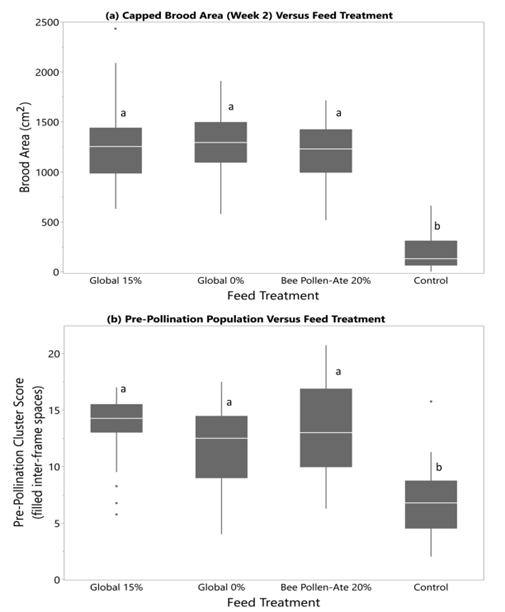
In April and May of 2018-2020, researchers in southern Alberta fed honey bee colonies a variety of commercially available protein supplements*. Regardless of nutritional variation between these supplements, when compared to providing no supplement, all fed colonies demonstrated significant growth.  After only two weeks of feeding, fed colonies had larger adult bee populations and greater brood area. These findings suggest that feeding bees protein supplements in the early spring has the potential to increase colony populations prior to pollination services.


Figure 1. This figure represents the size of honey bee colonies treated with protein supplements in 2019, where the control is no supplement.  Figure A indicates the brood area measured between treatments and controls.  Figure B indicates the cluster score (i.e. size) for the treatment and control groups (Hoover, Ovinge, and Kearns 2022).

Researchers also found varying levels of colony growth based on the environmental surroundings of the tested colonies. Colonies fed differing protein supplements, for example Global 15% versus Healthy Bees, varied less in their brood and adult bee populations when they were also situated in an environment of abundant floral resources. This is in contrast to hives surrounded by poor natural forage, where the difference in colony growth between feeds was more dramatic. Similarly, as the season progressed and natural forage became more abundant everywhere, the difference in colony growth between feed treatments was, again, less pronounced. This suggests that feeding honey bee colonies early in the season and those which are located in landscapes containing poor natural forage will reflect the greatest difference in colony size after supplemental protein feeding.  

The findings in this publication are supportive of results from ATTTA research in 2019. In June of 2019, ATTTA fed honey bee colonies which had just been placed on wild blueberry fields for pollination either 1lb., 2lbs., or 0lbs. of protein substitute. Hive populations were measured before feeding and three weeks after, revealing no significant difference in hive growth between the three feeding options (Olmstead, McCallum, and Shaw 2019). Considering the results of the current research in Alberta, it could be concluded that at the time of the ATTTA feeding trials, there was enough natural forage available that protein substitutes did not make a significant difference on the growth of honey bee colonies. This is further supported by the contents of pollen traps placed in the yards with the tested colonies, revealing a wide array of floral resources.

It could be concluded from the research above that when feeding protein supplement or substitute, the greatest gain is early in the season. Consider the natural forage sources available to your bees. In the early spring or during pollination, if forage is poor, providing supplemental feed to your bees may encourage and enhanced colony growth. 

*Hoover, Shelley E, Lynae P Ovinge, and Jeffery D Kearns. 2022. “Consumption of Supplemental Spring Protein Feeds by Western Honey Bee (Hymenoptera: Apidae) Colonies: Effects on Colony Growth and Pollination Potential.” Edited by David Tarpy. Journal of Economic Entomology, February, toac006. https://doi.org/10.1093/jee/toac006.

Olmstead, Sawyer, Robyn McCallum, and Jillian Shaw. 2019. “Evaluating the Effect of Feeding Pollen Substitute to Honey Bee Colonies Destined for Wild Blueberry Pollination in Colchester County, Nova Scotia.” Atlatntic Tech Transfer Team for Apiculture. https://www.perennia.ca/wp-content/uploads/2019/10/ATTTA-FactSheet-Oct-2019.pdf.


Connecting with ATTTA Specialists


If you’d like to connect with ATTTA specialists or learn more about our program, you can: