Showing posts with label 2022. Show all posts

A Year in Review for Atlantic Beekeepers

Thursday, 9 February 2023

At this year’s Canadian Association of Professional Apiculturists (CAPA) annual general meeting, the provincial apiarists from across the country presented a report to relay pertinent beekeeping information from the year past. In this week’s blog, we will overview the key messages from the Atlantic provinces.

A Year in Review for Atlantic Beekeepers

The provincial reports begin with a basic overview of industry statistics. Figures reported for the Atlantic provinces are summarized in the table below. Registering as a beekeeper is mandatory in New Brunswick and Nova Scotia, but not in Prince Edward Island and Newfoundland. As such, the numbers for these two provinces are based on estimates through the experience of the provincial apiarist. These official reports may be conservative figures, as members of the PEI and NL beekeepers associations speculate there is more than 100 and 200 beekeepers in these provinces, respectively. Regulated beekeeper registration will be valuable to gaining insight into the complete regional the honey bee industry. In reporting on the number of honey bee colonies, the distinction of “honey producing colonies” does not include colonies which are exclusively used for pollination services. New Brunswick has many colonies that are managed as such, which is why both figures have been provided. Honey yields were generally average in the 2022 season across the Atlantic provinces. Winter mortality was also relatively normal, which is remarkable given the average overwintering morality coming out of winter in 2022 was high at 45.5% (Ferland, Wilson, and Nasr 2022).

Unusually high overwintering losses this year were primarily attributed to inadequate Varroa mite control. Prince Edward Island, unfortunately, did suffer from high winter losses and the majority of beekeepers have stated this to be the cause. Provincial apiarist, Cameron Menzies, has gathered that inadequate varroa mite control in the province is due to improper treatment. Beekeepers treating with partial dosages, for example. This is an issue for controlling Varroa mite populations in a honey bee colony but also detrimental for maintaining product efficacy. There is currently concern about the efficacy of Apivar, our primary miticide used in Canadian beekeeping, and treating colonies inconsistently with product label instructions can accelerate mite resistance development. 

Varroa mites are by no means a plague for Prince Edward Island, alone. New Brunswick provincial apiarist, Chris Maund, and Chief Apiary Inspector, Karen Thurlow, have warned that varroa mites are also the most significant honey bee health challenge for New Brunswick beekeepers because of the viruses that they vector, namely chronic bee paralysis and deformed wing virus. As such, they urge beekeepers to increase varroa mite monitoring to monthly and even more frequently in the summertime. All Atlantic beekeepers would be wise to heed this advice.

The good news varroa mite story remains in Newfoundland and Labrador! Newfoundland beekeeping has increased, and beekeepers have successfully managed to maintain their unique varroa-free status. Provincial apiarist, Karen Kennedy, has also reported the province to remain free of American Foulbrood Disease (AFB) and European Foulbrood Disease (EFB). We can all help Newfoundland preserve this disease-free status by respecting the honey bee importation laws. It is illegal to import any honey bees or honey bee products into Newfoundland without proper authorization, which is extremely limited. Bees and bee products cannot be imported to Newfoundland and Labrador for regular beekeeping purposes!

New highway sign to alert travelers of honey be importation laws.

Following regulations regarding honey bee pests and disease is tremendously important for the regional beekeeping industry. Biosecurity in beekeeping cannot be exclusively practiced by a select few producers, but must be practiced by all due to the freedom that is innate to keeping bees. Honey bees can and will travel between apiaries and enter the hives of other beekeepers. Atlantic beekeepers have been doing well to practice regional biosecurity! In 2022, AFB was found in Nova Scotia and PEI, but proper precautions were taken such that the provincial apiarist was notified and able to respond to contain the threat. Likewise, small hive beetle (SHB) was detected in New Brunswick but was managed and the spread contained. 

The final pest that was emphasized in these reports was by the Nova Scotia provincial apiarist, Jason Sproule. Nova Scotia beekeepers reported excessive shrew damage in 2022, and he expects that their impact was even greater. Shrews persist across the Atlantic provinces, and proper measures need to be followed to protect colonies from these predators. For example, overwintering colonies need to be fastened with a shrew guard while honey bees have the potential to be in cluster. 

Looking back at the year past is a great way to improve management for the upcoming beekeeping season. Regular monitoring, ongoing education of pests and disease, and reacting according to best practice will help the Atlantic Provinces maintain healthy and productive honey bee colonies!


Connecting with ATTTA Specialists


If you’d like to connect with ATTTA specialists or learn more about our program, you can:


Report on The Prince Edward Island Beekeepers Association AGM 2022

Thursday, 15 December 2022

The time of year has begun for beekeeper gatherings and meetings. Winter is a great opportunity to connect with the community, reflect on the season past, and start planning for the year to come! This past Saturday, the Prince Edward Island Beekeepers Association held their Annual General Meeting in Charlottetown. ATTTA was pleased to be a part of this lovely event and will reflect on the highlights of the meeting in this week’s blog.

Report on the Prince Edward Island Beekeepers Association AGM 2022

Members of the PEIBA came together this weekend and were joined by guest speakers from across the country. The day began with an informative update from Provincial Apiarist, Cameron Menzies, who provided a snapshot of the PEI beekeeping industry. The growing industry continues to pursue the goal of being self-sufficient for honey bee pollination of wild blueberry fields. Towards this end, the 2022 Pollination Expansion Program approved over $300 thousand year to support beekeepers. Since the program began, the industry has seen 25% hive increase on the island. To fill the existing pollination gap, additional hives are imported primarily from Ontario. Brood inspections by Cameron and his team indicated no signs of biosecurity threats in these colonies. Conditions for pollination were good this year, and the island saw high yields of wild blueberries, the second largest yield to date! This is optimistic for the province, as productive wild blueberry land continues to expand.

Beekeeper Ian Steppler joined the meeting remotely from Alberta, where he produces his popular YouTube Channel, A Canadian Beekeeper’s Blog.  Ian offered insight into techniques to improve apiary sustainability by maintaining a reliable stock of nucleus colonies to replace seasonal losses. The cycle begins by overwintering a collection of healthy nucs to replace winter losses. Next, spring assessments reveal additional unproductive colonies to be replaced and identify prolific colonies which are used to resupply the nuc bank. Ian also discussed his queen production system. Internal queen rearing facilitates rapid nuc production during the beekeeping season, which can then be used to replace weak hives in the fall and provide an abundance of strong nucleus colonies to overwinter. In cyclical fashion, the sustainability of the apiary is supported by an abundance of available nucs to replace dead or failing colonies.

Paul Kelly, from the University of Guelph Honey Bee Research Centre, participated in the meeting as well. Paul emphasized ways that a beekeeping community can move towards self-sufficiency by support from within. Speaking from his experience, Paul discussed how the Ontario industry improved their regional self-sufficiency by reducing overwintering losses, improving queen production techniques, replacing losses internally with hive splits, and overwintering nucs to restore winter hive losses. 

ATTTA provided our team and research updates, as well, as we continue to make our way across the Atlantic Region to join the beekeeping and wild blueberry associations in their annual gatherings. Starting with an encouraging address to association members, President Troy Fraser concluded the event with a constructive business meeting. Overall, it was a successful event and ATTTA looks forward to the coming year for PEI beekeepers!


Connecting with ATTTA Specialists


If you’d like to connect with ATTTA specialists or learn more about our program, you can:


European Foulbrood

Thursday, 26 May 2022


Special Announcements

This week marks a milestone for ATTTAs weekly blog! One hundredth blog post!! Thank you to everyone in the beekeeping community who reads the weekly blog posts, the blog has had nearly 35,000 visits!

Nova Scotian beekeepers can apply to the Blueberry Pollination Expansion Program 2022 -23.  The program is now open! 


Sometimes it can feel like the list of honeybee diseases is never ending, but with the proper control strategies and testing procedures, they can be managed! This week we are focusing on European foulbrood, providing information to help identify and control this disease. We’re also excited to introduce a project, by the Western College of Veterinary Medicine at the University of Saskatchewan, on European foulbrood surveillance.

European Foulbrood

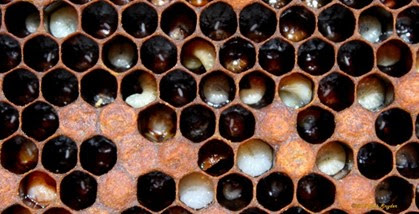
European foulbrood (EFB) is a disease of honeybee brood, caused by the bacteria Melissococcus plutonius. In living larvae, the infections can be seen in the midgut, appearing chalky white instead of the typical yellow-orange. Dead larvae that have been infected by EFB have more distinct symptoms that beekeepers can use to diagnose their bees. The larvae usually die before the cell is capped and can easily be observed. Healthy larvae are white and curled in a “C” shape around the bottom of the cell. Larvae infected with EFB become yellow to brown and are twisted around the cell walls, positioned lengthwise, from the opening to the bottom of the cell. The body cavity darkens and dries into a rubbery scale that can easily be removed from the cell. The death of larvae from EFB will cause a decrease in adult honeybee populations, which will result in reduced colony strength and lower productivity for pollination services or honey production.

Honeybee larvae with EFB symptoms (from www.beeinformed.org)


M. plutonius is parasitic and competes for food in the honeybee larvae midgut. When there is an abundance of food for the colony, the larvae usually show no symptoms of disease, and eventually pupate and develop into adult bees. When food is scarce, larvae are not able to compete with M. plutonius and succumb to infection. Some reasons for food scarcity are prolonged bad weather, movement of colonies to poor forage locations, and having a low ratio of nurse bees to brood. For example, at the beginning of a heavy nectar or pollen flow, when the size of a colony’s brood nest outgrows the capability of the nurse bees for feeding larvae. Therefore, symptoms are typically seen in spring and late summer.

Cultural, physical, and chemical strategies should be used as an integrated pest management (IPM) approach to prevent and control EFB and reduce the impact of this disease. Cultural strategies, such as the selection of hygienic breeding stock and supplementing colonies with food, can help. Routinely replacing comb is an important strategy used for EFB, as it may reduce the amount of M. plutonius present in hives. To learn more about comb rotation, please check out our Comb Rotation Factsheet. Chemical strategies are limited to the metaphylactic use of the antibiotic oxytetracycline (OTC). As this is also an important antibiotic for human health, it can only be purchased with a prescription from a veterinarian.

If you are concerned about your hives and see signs of EFB, it is important to test! The Western College of Veterinary Medicine at the University of Saskatchewan is collecting samples of infected larvae for an ongoing European Foulbrood Disease Surveillance Project. We encourage you to read the project brochure found here for details! If you suspect EFB in your colonies, please do not hesitate to contact ATTTA for more information.  We can supply you with sampling kits and instructions for collection to participate in this project.


Written by John MacDonald, ATTTA Seasonal Apiculturist johnmacdonald@perennia.ca


Connecting with ATTTA Specialists


If you’d like to connect with ATTTA specialists or learn more about our program, you can:


Welcoming our Summer Students!

Thursday, 19 May 2022


This week we are excited to introduce two new members to the team! ATTTA welcomes John MacDonald and Rebecca Campbell, who will be assisting us this year with new and continued research projects. Read on as we introduce our new members as well as some of our plans for the summer, including research on Varroa mite treatment and honeybee pollination of wild blueberry fields. 

Welcoming our Summer Students!

John MacDonald

John currently lives in Pleasant Valley, Nova Scotia, and has completed four years of Dalhousie University’s Plant Science Degree program, with honors, and is working towards certificates in Organic Agriculture and Integrated Pest Management. John is currently working on his thesis project in collaboration with the ATTTA, and Dr. Chris Cutler in the entomology lab at Dalhousie to measure the efficacy of Apivar and ApiLife Var against Varroa mites in commercial beekeeping operations in the Maritime provinces.

Varroa mites are a major issue throughout Canada (excluding Newfoundland), exacerbating the spread of viruses and overwintering losses of honey bees. There is only one reliable chemical treatment, ApiVar, used to control this parasite in Canada, but there has been a rising concern brought to the attention of ATTTA and the Canadian Honey Council (CHC) from beekeepers across Canada that Varroa mites are becoming resistant to ApiVar.

 Alternative control methods for Varroa mites are needed to slow the development of mite resistance to the synthetic treatments. ApiLife Var is a formulation of essential oils, including eucalyptus oil, levomenthol, camphor, and thymol, that was licensed in Canada in 2020. Essential oils have more variability in efficacy than synthetic chemicals, due to environmental conditions, so it is important to test these products in our Maritime climate. To date, no research has been done.

With the cooperation of commercial beekeepers who provide honey bees for blueberry pollination in Nova Scotia, Prince Edward Island, and New Brunswick, John and rest of the team at ATTTA will carry out miticide efficacy testing during the 2022 beekeeping season. This will provide valuable information on Varroa populations that may be resistant to ApiVar and for use of ApiLife Var as an alternative control method.

 Rebecca Campbell

Rebecca is a new member of the team and will be joining us for this year’s wild blueberry and honeybee research. She is 22 and a fifth-year Dalhousie student studying Bio-veterinary Science and hoping to pursue a career in apiculture research. Four years ago, Rebecca moved to Nova Scotia from Ontario. She has been fortunate to meet many new friends and family here and has built a great life. After traveling up and down this province and seeing many beautiful things, she plans to stay in Nova Scotia and make it home.


Our new summer student, Rebecca Campbell.

Rebecca will assist in a continued pollination study, this year measuring the effects of sequential loading and hive rotation on the pollination success of wild blueberry fields. Blueberry farmers all over Atlantic Canada have generously agreed to collaborate with the Atlantic Tech Transfer Team of Apiculture, allowing us to observe over a dozen fields throughout New Brunswick, Nova Scotia, and Prince Edward Island. These fields will be visited multiple times this season to collect data on the growth of the wild blueberry crop regarding sequential loading methods. The overall goal of this trial is to optimize wild blueberry pollination and determine the most beneficial way for sequential loading. During this project, the effect of hive strength on pollination will be observed to gather comprehensive data on how the strength of a hive can affect the pollination of wild blueberry fields. Another project this season will observe honeybees’ nutritional state during wild blueberry pollination. This continued project will look closely at the pollen collected from select hives to determine the species of plants the pollen is being collected from.

By the end of this 2022 season, we will have collected data on multiple projects regarding the honeybee pollination of wild blueberry fields across the Atlantic provinces. This data will help us understand more beneficial methods and techniques for the apiculture and agriculture industries.  


Connecting with ATTTA Specialists


If you’d like to connect with ATTTA specialists or learn more about our program, you can:


News from Newfoundland

Thursday, 12 May 2022


This weekend, the Atlantic Tech Transfer Team for Apiculture (ATTTA) visited Newfoundland to attend and participate in the Newfoundland and Labrador Beekeepers Association (NLBKA) annual general meeting and Growing Together workshop! It was a wonderful opportunity to engage with the beekeeping community and hear updates from the apiculture industry. Read on to learn about what is going on with our beekeepers in Newfoundland!

News from Newfoundland

The beekeeping community in Newfoundland is growing. Every year there are more commercial keepers as well as hobbyists, playing an important role in the industry. Both groups contribute to the growth of apiculture in the province.  Increasingly, Newfoundland’s beekeepers are engaged with the sale of queens and nucleus colonies to other beekeepers, as well as mentoring new entrants. One of the most unique considerations about Newfoundland beekeeping is that there is extremely limited importation of bees to the island. Within a typical beekeeping operation, commercial or otherwise, there is effectively no opportunity to purchase new bees, including queens, from outside of the province. As such, growth is restricted to activities within the province. They are rising to the challenge! For example, commercial overwintering losses have been dropping every year since they began reporting to CAPA in 2018, with only 18.1% losses in 2021.


NLBKA President Rodney Reid speaking at the NLBKA Growing Together meeting.

The reason for strict important legislation is because Newfoundland remains one of the only regions on earth whose honey bees are free of varroa mites. The industry is working hard to keep Newfoundland this way! Despite having no varroa mites, the NLBKA is diligently working to educate beekeepers about varroa mites and to be prepared, should mites arrive. Provincial Apiarist Karen Kennedy announced new legislation which has been developed to protect the industry against a varroa mite infestation. For example, mandatory hive inspections before bee sales and increased penalties for illegal importation activities are proposed. She also announced exciting news that signage has been approved to be placed in high traffic areas to increase awareness that honey bee importation to the province is illegal. It is important for those outside of Newfoundland to know this as well. We can all do our part to help maintain the varroa free status of Newfoundland by not bringing or selling any honey bees to the province.

More exciting news from the meeting was the launch of the new NLBKA brand. Branding is a way to unify an industry and help to get your common message to the public. Check out the NLBKA website to see the new look! Agriculture in the Classroom was highlighted at the meeting as well, with representatives of the NL Federation of Agriculture speaking to the success of this program and displaying contest winning nuc boxes painted by students.


Jars of Newfoundland honey for a honey swap! See a nuc box from Agriculture in the Classroom in the background. 

The beekeepers of Newfoundland and Labrador are a very engaged community, and there is no doubt that the industry will continue to grow. During the visit, ATTTA stopped in at Tuck’s Better Bee Farm in Grand Falls-Windsor for a glimpse into the exciting agrotourism project being developed. This expanding business is just one great example of the growing and dynamic beekeeping industry in Newfoundland.  Continue to follow the ATTTA Buzz Blog to hear more news about NL and the entire regions beekeeping industry.


Connecting with ATTTA Specialists


If you’d like to connect with ATTTA specialists or learn more about our program, you can:


Supplemental Spring Protein Feeding

Thursday, 17 March 2022

With days lengthening and temperatures gradually rising, spring is on its way! As beekeepers begin opening colonies in the coming weeks, we will be presented with the decision of whether to provide bees with supplemental feed. To help in this decision, this week’s blog considers the findings of a newly published article from researchers in Alberta examining the benefits of supplemental protein feeding.

Supplemental Spring Protein Feeding

There are many options available for honey bee protein supplements, containing varying amounts of proteins, amino acids, lipids and carbohydrates. Honey bees require all of these nutritional components and get them through foraging on an array of floral resources. When natural forage is sparse or growth demand on a colony is high, these nutrients can be provided through supplemental feeding.

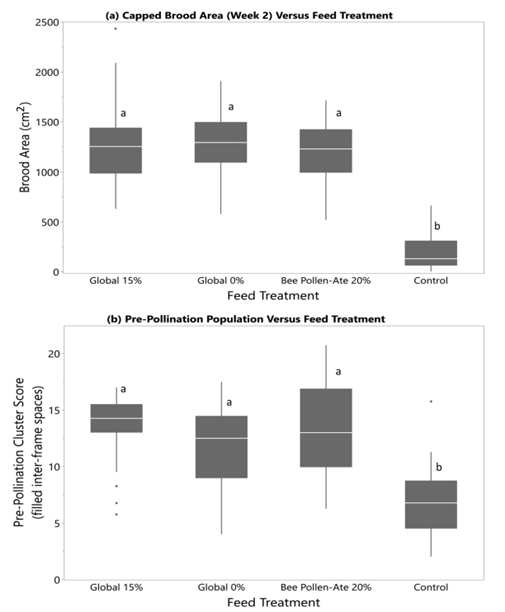
In April and May of 2018-2020, researchers in southern Alberta fed honey bee colonies a variety of commercially available protein supplements*. Regardless of nutritional variation between these supplements, when compared to providing no supplement, all fed colonies demonstrated significant growth.  After only two weeks of feeding, fed colonies had larger adult bee populations and greater brood area. These findings suggest that feeding bees protein supplements in the early spring has the potential to increase colony populations prior to pollination services.


Figure 1. This figure represents the size of honey bee colonies treated with protein supplements in 2019, where the control is no supplement.  Figure A indicates the brood area measured between treatments and controls.  Figure B indicates the cluster score (i.e. size) for the treatment and control groups (Hoover, Ovinge, and Kearns 2022).

Researchers also found varying levels of colony growth based on the environmental surroundings of the tested colonies. Colonies fed differing protein supplements, for example Global 15% versus Healthy Bees, varied less in their brood and adult bee populations when they were also situated in an environment of abundant floral resources. This is in contrast to hives surrounded by poor natural forage, where the difference in colony growth between feeds was more dramatic. Similarly, as the season progressed and natural forage became more abundant everywhere, the difference in colony growth between feed treatments was, again, less pronounced. This suggests that feeding honey bee colonies early in the season and those which are located in landscapes containing poor natural forage will reflect the greatest difference in colony size after supplemental protein feeding.  

The findings in this publication are supportive of results from ATTTA research in 2019. In June of 2019, ATTTA fed honey bee colonies which had just been placed on wild blueberry fields for pollination either 1lb., 2lbs., or 0lbs. of protein substitute. Hive populations were measured before feeding and three weeks after, revealing no significant difference in hive growth between the three feeding options (Olmstead, McCallum, and Shaw 2019). Considering the results of the current research in Alberta, it could be concluded that at the time of the ATTTA feeding trials, there was enough natural forage available that protein substitutes did not make a significant difference on the growth of honey bee colonies. This is further supported by the contents of pollen traps placed in the yards with the tested colonies, revealing a wide array of floral resources.

It could be concluded from the research above that when feeding protein supplement or substitute, the greatest gain is early in the season. Consider the natural forage sources available to your bees. In the early spring or during pollination, if forage is poor, providing supplemental feed to your bees may encourage and enhanced colony growth. 

*Hoover, Shelley E, Lynae P Ovinge, and Jeffery D Kearns. 2022. “Consumption of Supplemental Spring Protein Feeds by Western Honey Bee (Hymenoptera: Apidae) Colonies: Effects on Colony Growth and Pollination Potential.” Edited by David Tarpy. Journal of Economic Entomology, February, toac006. https://doi.org/10.1093/jee/toac006.

Olmstead, Sawyer, Robyn McCallum, and Jillian Shaw. 2019. “Evaluating the Effect of Feeding Pollen Substitute to Honey Bee Colonies Destined for Wild Blueberry Pollination in Colchester County, Nova Scotia.” Atlatntic Tech Transfer Team for Apiculture. https://www.perennia.ca/wp-content/uploads/2019/10/ATTTA-FactSheet-Oct-2019.pdf.


Connecting with ATTTA Specialists


If you’d like to connect with ATTTA specialists or learn more about our program, you can:


Nova Scotia Annual Beekeeper Symposium

Thursday, 3 March 2022

This past weekend, ATTTA was pleased to participate in the Nova Scotia Annual Beekeeper Symposium. The meeting was well attended with many engaging speakers covering a range of topics. Today we invite you to look back on the symposium with us and revisit some of the major themes. 

Nova Scotia Annual Beekeeper Symposium 

The main speaker of the event was Dr. Elemir Simko, a professor of veterinary pathology with the University of Saskatchewan. Dr. Simko spoke on American Foulbrood Disease (AFB) and European Foulbrood Disease (EFB) and presented recent publications related to work on these diseases. One such publication is related to a new approach for monitoring AFB. The current practice for identifying AFB in honey bee populations is at the individual level, by examination of hives and obtaining samples for lab diagnostics. Saskatchewan researchers found evidence that AFB can be monitored at the population level by testing pooled honey samples (Zabrodski et al. 2022). This is a significant finding because it is a less labour intensive and time consuming technique to identify AFB in an apiary, at large. 

Dr. Simko also spoke to the importance of proper management of AFB. Being able to properly identify and treat for AFB is extremely important for beekeepers at all levels of operation. The reason being that bees are not confined to the hives from which they were born and are spatially bound only by the distance they can fly. The reality of beekeeping is that neighboring apiaries inevitably have cross mingling of bees. With this mingling of individual bees comes the mingling of pests and diseases. As such, it is every beekeeper’s responsibility to be able to identify and properly manage AFB not only for your own apiary but for those around you.  

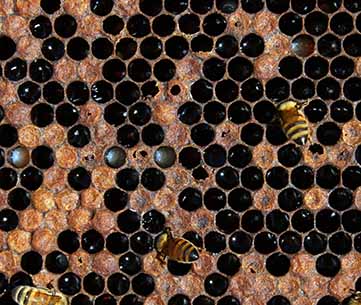
A shotgun brood pattern and sunken brood cappings are non-specific signs of AFB infection within a honey bee colony (photo credit Rob Synder www.beeinformed.org)

Proper management of pests and disease was a reoccurring theme throughout the symposium. Dr. Richardson of the Nova Scotia Veterinary Medical Association emphasized in his talk on antibiotic resistance that is it critical to follow the directions for use on antibiotics to prevent the development of bacterial resistance. He also encouraged all beekeepers to consider developing relationships with a local veterinarian, because a Veterinarian-Client-Patient Relationship is a prerequisite to accessing those antibiotics used for treating bacterial diseases such as AFB.  

Antibiotics are not the only treatment which can lose efficacy due to resistance development. Nova Scotia’s Provincial Apiarist Jason Sproule touched on resistance development as well, in regard to varroa mites, urging beekeepers to follow label instructions and practice integrated pest management. Following instructions on chemical treatments ensures that the treatment will be as effective as possible and ultimately extends the longevity of the product as a management tool. Improper use can create conditions for pests to develop resistance, thereby reducing the effectiveness of a treatment in the short and long term. Integrated pest management practices also improve the longevity of a treatment by implementing a range of methods to manage pests and disease. 

To cover all of the interesting topics and speakers at the event would take a weekend! Meetings are a great way to expand your beekeeping knowledge and get local tips. They are also valuable social experiences to develop relationships within your beekeeping community. As events occur in your own region, we encourage you to attend and hope to see you there!

Zabrodski, Michael W., Jessica E. DeBruyne, Geoff Wilson, Igor Moshynskyy, Mohsen Sharafi, Sarah C. Wood, Ivanna V. Kozii, et al. 2022. “Comparison of Individual Hive and Apiary-Level Sample Types for Spores of Paenibacillus Larvae in Saskatchewan Honey Bee Operations.” Edited by Nicolas Chaline. PLOS ONE 17 (2): e0263602. https://doi.org/10.1371/journal.pone.0263602.


Connecting with ATTTA Specialists


If you’d like to connect with ATTTA specialists or learn more about our program, you can:


New Bees for Newbies

Thursday, 13 January 2022

Winter months are a time for planning in the beekeeper’s calendar. Planning the upcoming season will allow your apiary to run smoother, regardless of how many hives you manage. This is also a great time for someone who has only yet been considering beekeeping to prepare to dive in! Over the next few blogs, we will consider a few points that would be valuable to organize this winter. This week, we will begin with a discussion of ordering bees.

New Bees for Newbies

When spring comes and hives are unwrapped, beekeepers find out how many survived the winter. Overwintering strong hives which have been properly treated, fed, and winterized will be valuable in minimizing overwintering losses. A compelling article from researchers in Switzerland was recently released which further corroborates evidence that proper varroa mite management of winter bees improves colony success in the spring (Julie et al. 2021). Nonetheless it is not uncommon to lose a small percentage of hives to winter stresses. Beekeepers often make up for these loses by replacing colonies in the early spring. 

Unfortunately, a major challenge for the Atlantic Canada beekeeping industry is the lack of early spring queens (Bixby et al. 2019). Virgin queens typically cannot mate until late May or June at the earliest due to the absence of mature drones. Historically, the solution has been to order bees from warmer climates where queen rearing can begin much earlier, such as New Zealand and Hawaii. It is important to place these orders in the winter to ensure that they arrive when you want them. Ordering bees from outside of Canada requires special protocols which must be followed via the Canada Food Inspection Agency. There are also unique protocols for ordering bees from out of province within Canada (see protocols for Maritime provinces below). Rather than taking this on directly, it can be helpful to order imported bees through local bee suppliers who are more familiar with the legal process. 

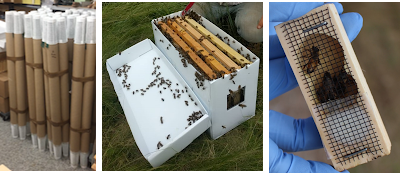
Honey bees ordered from abroad typically come as packages of many bees or a single mated queen. A package generally holds 1-1.5 kg of adult bees as well as a mated queen. A mated queen will arrive with attendant worker bees, who are often removed from the cage before introducing the queen to a hive. Packages and individual queens must be installed into proper hives after transport and you should be prepared to do so when the bees arrive.  

Figure 1. Three common ways to buy bees. From left to right: honey bee packages (source: countryfields.ca), nucleus colony, caged queen.

If you are not anxious to have new bees immediately at the start of spring, buying local nucleus colonies (nucs) and queens is a great way to support the Atlantic beekeeping industry. There are suppliers of local nucs and queens throughout the Atlantic provinces who typically sell between May and July. Provincial beekeeping association websites can be a valuable resource in connecting with reputable providers. Once again, it is recommended that orders be placed early because lists are typically first come, first served and supplies are limited. This is especially true for beekeepers in Newfoundland and Labrador, where honey bee importation is exceptionally restricted!

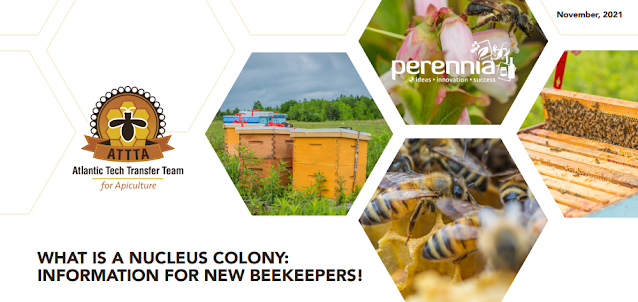
For new beekeepers, nucs are a great way to get started because they already contain the necessary building blocks for starting a new colony- bees and drawn comb! There are some considerations to keep in mind when buying a nucleus colony. A nuc should include a mated queen, frames with drawn comb and food stores, and bees of all life stages. Typically, there are 3-5 frames holding a combination of these resources. For more information on nucs, explore the new ATTTA factsheet “What is a Nucleus Colony: Information for New Beekeepers!”


Bixby, M., M.M. Guarna, S.E. Hoover, and S.F. Pernal. 2019. Canadian Honey Bee Queen Breeders’ Reference Guide. Canadian Association of Professional Apiculturists Publication 55 pp. 

H. Julie, J. Hattendorf, A. Aebi, et al., Compliance with recommended Varroa destructor treatment regimens improves the survival of honey bee colonies over winter, Research in Veterinary Science (2021), https://doi.org/10.1016/ j.rvsc.2021.12.025


Pollinator Education New Video Release! Assessing Hive Strength: Counting Flying Bees Returning to the Hive

Check out our latest video on ATTTA's YouTube Channel about assessing hive strength. This video discusses how to assess hive strength by counting flying bees returning to the hive and the pros and cons of using this method. Watch HERE to learn more!


Connecting with ATTTA Specialists


If you’d like to connect with ATTTA specialists or learn more about our program, you can:


In Anticipation of 2022!

Thursday, 30 December 2021


Connecting with ATTTA Specialists


If you’d like to connect with ATTTA specialists or learn more about our program, you can: