Early spring is an exciting time for beekeepers. Spring marks the start of a new beekeeping season, and for many beekeepers they cannot wait to start working in their apiaries. Across the Atlantic region beekeepers have started to engage in early spring activities, which means assessing how colonies faired during the winter months and supporting colony growth throughout the early beekeeping season. To learn more about supporting colonies in early spring, and for a general update on the outlook of the 2025 beekeeping season in Atlantic Canada, read this week’s blog as part of an ongoing series.
How to Care for Colonies in Early Spring (2025 Season Outlook)
The start of
a new beekeeping season is both an exciting and important period of time for
Atlantic Canada beekeepers. With the onset of spring, beekeepers are busy
assessing winter survival of colonies, and conducting various activities that
support colony growth during the early season.
During the
earliest part of the beekeeping season, beekeepers aim to minimize opening
hives, which can disrupt the winter cluster. However, this does not mean that
beekeepers do not have work to do around the apiary. An important late winter
to early spring activity is assessing food stores
within colonies by hefting hives. Hefting is when a beekeeper will tilt the
hive by lifting one side slightly off the ground which allows them to judge the
weight of the colony. A colony within a double hive body is at risk of
starvation if the hive weighs below 25 kg (55 lbs.). A beekeeper should
emergency feed, at the first opportunity, any hives below the critical weight.
For emergency feeding, fondant is preferred over sugar syrup because bees will not consume
syrup if the temperature is below 10°C. Beekeepers should ensure that they are
providing good quality fondant, which means the fondant is produced
using an enzyme rather than an acid to invert sucrose (a complex sugar) into
simple sugars (fructose and glucose) which are nutritionally available energy
sources for bees. Fondants produced using an acid (typical of most recipes for
homemade fondant) can increase the amount of a toxin (hydroxymethylfurfural)
present within the feed. Good
quality commercially available fondants will use enzymatic hydrolysis to
produce the fondant.

For some
beekeepers, early spring may be a time when they provide mite treatments. This
is typical of Apivar® which requires a 56-day treatment period followed by a
14-day withdrawal period prior to placing honey supers. Beekeepers will want to
allow for the full 70-days to occur prior to collecting early honey in May,
which is why this treatment is started in early spring. Beekeepers can take advantage of the first
nice day in early spring (ambient temperature greater than 5°C and sunny)
to quickly crack open hives and place Apivar® strips. Beekeepers should remember that the
instructions for Apivar® strips require a mid-treatment repositioning and
scraping to both reposition the strips in the middle of the cluster and to
remove wax and propolis, ensuring maximum contact between bees and the amitraz
strips.
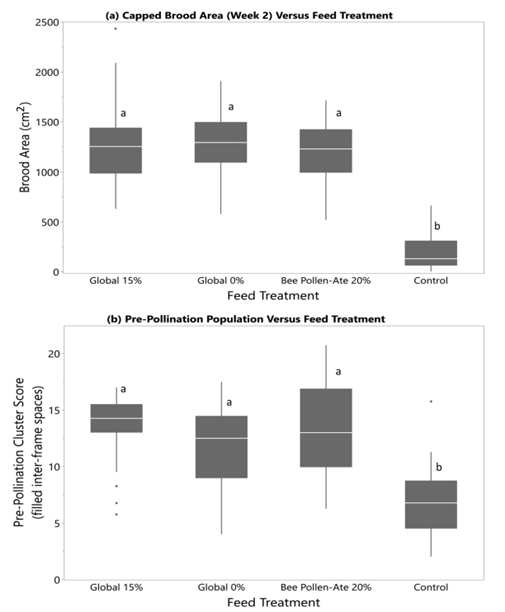
Another important early spring activity is providing pollen or pollen
supplement (i.e. pollen patties) to increase colony growth during the early
spring. Bees use pollen and supplemental sources of protein to rear brood, so
providing either pollen or pollen patties will stimulate the colony to start
rearing brood. Providing pollen in early spring has been researched by ATTTA
and demonstrated to be economically beneficial to support colony growth. It is
essential that beekeepers continue providing a pollen source once they begin
the activity until either the colony no longer consumes the provided pollen or
natural pollen becomes available. This is because once colonies are stimulated
to start rearing brood they need enough pollen to support the colony’s growth.
There are
some other key considerations for successful spring management. First, there is
no rush to unwrap colonies in Atlantic Canada. It is beneficial to keep winter
wrapping on until the beekeepers must remove it to gain better access into the
colony (towards the end of April). The one winter protective measure that
beekeepers do want to remove earlier in the season is shrew guards. Once early
pollen becomes available to the bees it is important to remove the shrew guards
so that bees foraging for pollen can successfully bring the pollen into the
hive without having it knocked off by the shrew guards. Finally, honey bee
health should be on a beekeeper’s mind from the very start of the season. This
begins with the inspection of dead outs, and determining if any pests and/or
diseases were the reason for colony loss. The ATTTA team is always willing to assist
with pest and disease testing on dead outs, and on live colonies throughout the
season. We encourage beekeepers to reach out about testing available. Pest and
disease monitoring should continue throughout the season and always be a top
priority for beekeepers. To learn more about inspecting dead outs, ATTTA will
be providing an upcoming workshop in partnership with the Nova Scotia
Beekeepers’ Association on May 2nd.
The
mentioned activities provide a brief highlight of the many tasks beekeepers do
in early spring. Continue reading this blog series over the next several weeks
to learn updates on the Atlantic beekeeping industry and for a 2025 season
outlook across the region.
Connecting with ATTTA Specialists
If you’d like to connect with ATTTA specialists or learn more about our program, you can:
visit our website at https://www.perennia.ca/portfolio-items/honey-bees/
Email attta@perennia.ca