Showing posts with label American Foulbrood Disease. Show all posts

Product for American Foulbrood Protection Approved for Canada's Honey Bees

Thursday, 18 January 2024

American Foulbrood (AFB) is a highly contagious bacterial brood disease in honey bees. The disease is caused by the bacterium Paenibacillus larvae which produce spores that are viable in the environment for decades. Protecting honey bees from AFB is extremely important and recently a new product has been developed that demonstrates providing some degree of immunity to the disease. The Canadian Food Inspection Agency (CFIA) has conditionally licensed the product, under veterinary supervision, and it is expected to be distributed on a limited basis to commercial beekeepers in Canada starting this Spring. To learn more about AFB, and the potential benefits this new product could provide, read this week’s blog.

Product for American Foulbrood Protection Approved for Canada's Honey Bees

American foulbrood (AFB) is caused by the Paenibacillus larvae bacterium which produce spores that are viable in the environment for decades. Worker bees can transport the spores and spread the disease, but it is the larval stage that shows clinical symptoms of infection. Infected brood usually die at the pre-pupal or pupal stage, severely weakening the colony and eventually killing it. Because of its virulent nature and detrimental effects on honey bee colonies, AFB is classified as a notifiable disease worldwide.

Antibiotics, such as Oxytetracycline, are largely ineffective at eradicating the disease as they are only effective against the vegetative state of the bacteria, which is when bacteria can grow and reproduce. Once a hive shows the clinical symptoms of the disease, the only effective way to eradicate it and prevent the spread of the disease is by burning the equipment, and the colony.

Therefore, it is extremely important to protect honey bees from AFB, and there is now a new product that could help. This product is being called a vaccine in the media and throughout published research. In an original study done by Dickel et al. (2022) the group of researchers demonstrated that the oral administration of an inactivated AFB bacterin to the queen bee is safe and induces some level of protection in the next generation of larvae against AFB infection in a hybrid lab and field study. The suggested delivery of this new product is that the inactive bacteria is mixed into powered sugar and glucose syrup for the worker bees to eat, and their secretions are fed to the queen. Then the next generation of developing bees, produced from the queen, have increased immunity to AFB.

The research trails, funded by Dalan Animal Health, showed between 30% to 50% decrease in AFB infection among colonies that received the product compared to colonies that received the placebo product in the hybrid lab and field study. The researchers fed the queens the product for 8 days in queen cages in the lab, and those queens were released into nucleus hives. Then, 18 days post-queen placement, frames of brood were collected and fed food with a known concentration of AFB spores and assessed for mortality over time in the lab.

It is known that this is an antibody-free immunological response since insects lack antibodies. It is proposed that information about the disease agent is transferred to the next generation with the help of the egg yolk protein Vitellogenin carrying immune elicitors, such as pieces of bacteria. Another proposed mechanism of action is a transfer of mRNA and proteins as well as epigenetic factors. Further research is needed to determine this product’s mechanism of action.

©Dalan Animal Health

This product could be beneficial in protecting honey bees from AFB and decrease the economic impact of the disease. That being said, the efficacy of the product is still largely unproven both from a multitude of research trials, and through beekeeping practices. In Fall 2023, the Canadian Food Inspection Agency (CFIA) conditionally licensed the product, under veterinary supervision, and it is expected to be distributed on a limited basis to commercial beekeepers in Canada starting this Spring. The United States Department of Agriculture (USDA) conditionally licensed the product by Dalan Animal Health back in January 2023. Some key differences exist between having a product licensed by CFIA versus USDA, including the level of efficacy a product must demonstrate. Since there is differences in the standard a product must meet, it is typical that CFIA will license a product after USDA. Both CFIA and USDA only license products that have been proven to be safe for livestock and humans, when following manufacturer instructions.

Although this product could provide multiple benefits to the Canadian honey bee industry, it is important to recognize that beekeepers must still remain vigilant in detecting potential AFB infections. Beekeepers should examine brood for discolored larvae; dead larvae; brood that appears greasy, sunken, or punctured; and poor brood pattern. Additionally, beekeepers should perform the rope test regularly, and especially on any abnormal looking larvae. Finally, if a beekeepers does have reason to suspect an AFB infection this must be reported to the provincial apiculturist immediately.

References

Dickel, F., Bos, N.M.P., Hughes, H., Martín-Hernández, R., Higes, M., Kleiser, A. and Freitak, D., 2022. The oral vaccination with Paenibacillus larvae bacterin can decrease susceptibility to American Foulbrood infection in honey bees—A safety and efficacy study. Frontiers in Veterinary Science, 9.

Connecting with ATTTA Specialists

If you’d like to connect with ATTTA specialists or learn more about our program, you can:

visit our website at https://www.perennia.ca/portfolio-items/honey-bees/

Email abyers@perennia.ca


Antimicrobial Stewardship and Beekeeping

Thursday, 8 September 2022

One of the greatest challenges in beekeeping is managing honey bee pests and disease.  We have a range of medications available to help in this battle.  Since 2017 certain drugs, especially antibiotics, may need to be accessed through a veterinarian via a prescription.  Working with vets is something new to many beekeepers.  This blog contains some information which will be helpful in accessing prescription medications and working with vets.

Antimicrobial Stewardship and Beekeeping

Everyone is aware that certain bacterial infections are becoming resistant to antimicrobial drug treatments.  Due to this phenomenon, there has been a global effort to ensure that medications, significant to human health, are extended in their effectiveness for as long as possible.  This new and more cautious approach to using antimicrobials and antibiotics resulted in a framework document, published in 2017 by the Public Health Agency of Canada*.  This document outlined recommended changes to practices and to the law.

It was determined that preserving the usefulness of antimicrobials for human treatment required a One Health approach to ensuring the correct and ongoing application of important drugs.  Because of the common benefit for humans and animals, especially antibiotics used in agriculture, certain compounds required controlled use.  This control, to preserve their efficacy, falls to medical professionals, typically either doctors or veterinarians. 

There are currently two antibiotics which are important to beekeepers.  One, Fumagilin-B, is for the treatment of Vairimorpha spp (formerly Nosema spp.).  This drug does not fall into the category of being important to human health and therefore does not currently require a prescription for use.  The second antimicrobial used by beekeepers is Oxytetracycline hydrochloride.  In human health this is used to treat a broad range of bacterial infections and in beekeeping this is used to manage American and European Foulbrood disease.  Access to Oxytetracycline hydrochloride (commonly called Oxytet by beekeepers) is controlled by law and must be accessed through a subscription provided by a veterinarian.  This veterinary oversight is outlined by the Canadian Veterinary Medical Association but regulated provincially. So each provincial association will put forward guidelines on how this oversight will be implemented. 

For beekeepers to access Oxytet, they will need to establish what is referred to as a “Veterinary Client Patient Relationship (VCPR).”  Each Canadian province and territory define what a VCPR is and therefor definitions will slightly differ across the country but these are all a variation of the a CVMA statement which reads:

A VCPR exists when all of the following conditions have been met:

1. The veterinarian has assumed the responsibility for making clinical assessments and recommendations regarding the health of the animal(s) and the need for medical treatment,

2. The veterinarian has sufficient knowledge of the animal(s) on which to base the assessment, diagnosis and treatment of the medical condition of the animal(s). This means that the veterinarian has recently seen and is personally acquainted with the keeping and care of the animal(s) by virtue of an examination of the animal(s) or by medically appropriate and timely visits to the premises where the animal(s) are kept.

3. The client has agreed to follow the veterinarian’s recommendations and prescription.

4. The veterinarian is available or has arranged for follow-up evaluation, especially in the event of adverse reactions or failure of the treatment regimen (CVMA, N.D).**

Healthy Honey Bees in a Hive.

Beekeepers must instigate this VCPR by contacting a veterinarian.  The challenge for beekeepers is in finding a local vet who is willing to work with honey bees.  Check with your provincial beekeeping association as they will, in some provinces, post a list of veterinarians willing to treat bees.  Some provinces have a provincial veterinary service which will treat bees.  Otherwise, beekeepers will need to find a private veterinary practice willing to provide this service.  Cost for the consultation and prescription will of course vary from one region and one practice to another.

So beekeepers have a part to play in ensuring we do not return to a pre-antibiotic era with out effective drugs to treat bacterial infections.  It is important to find a vet to work with prior to emergency needs, so speak to other local beekeepers, check with your provincial association or provincial departments of agriculture to find local vets.  Once you find a vet, have a detailed discussion of your needs and how you manage diseases and maintain records.  This is a new experience for both beekeepers and vets so a dialogue will establish this partnership and keep the bees healthy.

*Tackling Antimicrobial Resistance and Antimicrobial Use: A Pan-Canadian Framework for Action https://www.canada.ca/en/health-canada/services/publications/drugs-health-products/tackling-antimicrobial-resistance-use-pan-canadian-framework-action.html

**Canadian Veterinary Medicine Association (N.D.)  VETERINARY OVERSIGHT OF ANTIMICROBIAL USE –A PAN-CANADIAN FRAMEWORK OF PROFESSIONAL STANDARDS FOR VETERINARIANS


Connecting with ATTTA Specialists


If you’d like to connect with ATTTA specialists or learn more about our program, you can:


Nova Scotia Annual Beekeeper Symposium

Thursday, 3 March 2022

This past weekend, ATTTA was pleased to participate in the Nova Scotia Annual Beekeeper Symposium. The meeting was well attended with many engaging speakers covering a range of topics. Today we invite you to look back on the symposium with us and revisit some of the major themes. 

Nova Scotia Annual Beekeeper Symposium 

The main speaker of the event was Dr. Elemir Simko, a professor of veterinary pathology with the University of Saskatchewan. Dr. Simko spoke on American Foulbrood Disease (AFB) and European Foulbrood Disease (EFB) and presented recent publications related to work on these diseases. One such publication is related to a new approach for monitoring AFB. The current practice for identifying AFB in honey bee populations is at the individual level, by examination of hives and obtaining samples for lab diagnostics. Saskatchewan researchers found evidence that AFB can be monitored at the population level by testing pooled honey samples (Zabrodski et al. 2022). This is a significant finding because it is a less labour intensive and time consuming technique to identify AFB in an apiary, at large. 

Dr. Simko also spoke to the importance of proper management of AFB. Being able to properly identify and treat for AFB is extremely important for beekeepers at all levels of operation. The reason being that bees are not confined to the hives from which they were born and are spatially bound only by the distance they can fly. The reality of beekeeping is that neighboring apiaries inevitably have cross mingling of bees. With this mingling of individual bees comes the mingling of pests and diseases. As such, it is every beekeeper’s responsibility to be able to identify and properly manage AFB not only for your own apiary but for those around you.  

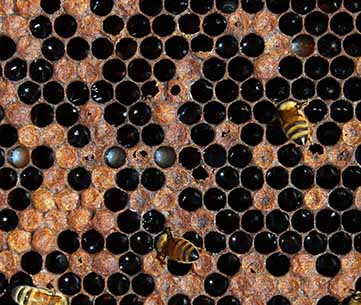
A shotgun brood pattern and sunken brood cappings are non-specific signs of AFB infection within a honey bee colony (photo credit Rob Synder www.beeinformed.org)

Proper management of pests and disease was a reoccurring theme throughout the symposium. Dr. Richardson of the Nova Scotia Veterinary Medical Association emphasized in his talk on antibiotic resistance that is it critical to follow the directions for use on antibiotics to prevent the development of bacterial resistance. He also encouraged all beekeepers to consider developing relationships with a local veterinarian, because a Veterinarian-Client-Patient Relationship is a prerequisite to accessing those antibiotics used for treating bacterial diseases such as AFB.  

Antibiotics are not the only treatment which can lose efficacy due to resistance development. Nova Scotia’s Provincial Apiarist Jason Sproule touched on resistance development as well, in regard to varroa mites, urging beekeepers to follow label instructions and practice integrated pest management. Following instructions on chemical treatments ensures that the treatment will be as effective as possible and ultimately extends the longevity of the product as a management tool. Improper use can create conditions for pests to develop resistance, thereby reducing the effectiveness of a treatment in the short and long term. Integrated pest management practices also improve the longevity of a treatment by implementing a range of methods to manage pests and disease. 

To cover all of the interesting topics and speakers at the event would take a weekend! Meetings are a great way to expand your beekeeping knowledge and get local tips. They are also valuable social experiences to develop relationships within your beekeeping community. As events occur in your own region, we encourage you to attend and hope to see you there!

Zabrodski, Michael W., Jessica E. DeBruyne, Geoff Wilson, Igor Moshynskyy, Mohsen Sharafi, Sarah C. Wood, Ivanna V. Kozii, et al. 2022. “Comparison of Individual Hive and Apiary-Level Sample Types for Spores of Paenibacillus Larvae in Saskatchewan Honey Bee Operations.” Edited by Nicolas Chaline. PLOS ONE 17 (2): e0263602. https://doi.org/10.1371/journal.pone.0263602.


Connecting with ATTTA Specialists


If you’d like to connect with ATTTA specialists or learn more about our program, you can: