Showing posts with label European foulbrood. Show all posts

Antimicrobial Stewardship and Beekeeping

Thursday, 8 September 2022

One of the greatest challenges in beekeeping is managing honey bee pests and disease.  We have a range of medications available to help in this battle.  Since 2017 certain drugs, especially antibiotics, may need to be accessed through a veterinarian via a prescription.  Working with vets is something new to many beekeepers.  This blog contains some information which will be helpful in accessing prescription medications and working with vets.

Antimicrobial Stewardship and Beekeeping

Everyone is aware that certain bacterial infections are becoming resistant to antimicrobial drug treatments.  Due to this phenomenon, there has been a global effort to ensure that medications, significant to human health, are extended in their effectiveness for as long as possible.  This new and more cautious approach to using antimicrobials and antibiotics resulted in a framework document, published in 2017 by the Public Health Agency of Canada*.  This document outlined recommended changes to practices and to the law.

It was determined that preserving the usefulness of antimicrobials for human treatment required a One Health approach to ensuring the correct and ongoing application of important drugs.  Because of the common benefit for humans and animals, especially antibiotics used in agriculture, certain compounds required controlled use.  This control, to preserve their efficacy, falls to medical professionals, typically either doctors or veterinarians. 

There are currently two antibiotics which are important to beekeepers.  One, Fumagilin-B, is for the treatment of Vairimorpha spp (formerly Nosema spp.).  This drug does not fall into the category of being important to human health and therefore does not currently require a prescription for use.  The second antimicrobial used by beekeepers is Oxytetracycline hydrochloride.  In human health this is used to treat a broad range of bacterial infections and in beekeeping this is used to manage American and European Foulbrood disease.  Access to Oxytetracycline hydrochloride (commonly called Oxytet by beekeepers) is controlled by law and must be accessed through a subscription provided by a veterinarian.  This veterinary oversight is outlined by the Canadian Veterinary Medical Association but regulated provincially. So each provincial association will put forward guidelines on how this oversight will be implemented. 

For beekeepers to access Oxytet, they will need to establish what is referred to as a “Veterinary Client Patient Relationship (VCPR).”  Each Canadian province and territory define what a VCPR is and therefor definitions will slightly differ across the country but these are all a variation of the a CVMA statement which reads:

A VCPR exists when all of the following conditions have been met:

1. The veterinarian has assumed the responsibility for making clinical assessments and recommendations regarding the health of the animal(s) and the need for medical treatment,

2. The veterinarian has sufficient knowledge of the animal(s) on which to base the assessment, diagnosis and treatment of the medical condition of the animal(s). This means that the veterinarian has recently seen and is personally acquainted with the keeping and care of the animal(s) by virtue of an examination of the animal(s) or by medically appropriate and timely visits to the premises where the animal(s) are kept.

3. The client has agreed to follow the veterinarian’s recommendations and prescription.

4. The veterinarian is available or has arranged for follow-up evaluation, especially in the event of adverse reactions or failure of the treatment regimen (CVMA, N.D).**

Healthy Honey Bees in a Hive.

Beekeepers must instigate this VCPR by contacting a veterinarian.  The challenge for beekeepers is in finding a local vet who is willing to work with honey bees.  Check with your provincial beekeeping association as they will, in some provinces, post a list of veterinarians willing to treat bees.  Some provinces have a provincial veterinary service which will treat bees.  Otherwise, beekeepers will need to find a private veterinary practice willing to provide this service.  Cost for the consultation and prescription will of course vary from one region and one practice to another.

So beekeepers have a part to play in ensuring we do not return to a pre-antibiotic era with out effective drugs to treat bacterial infections.  It is important to find a vet to work with prior to emergency needs, so speak to other local beekeepers, check with your provincial association or provincial departments of agriculture to find local vets.  Once you find a vet, have a detailed discussion of your needs and how you manage diseases and maintain records.  This is a new experience for both beekeepers and vets so a dialogue will establish this partnership and keep the bees healthy.

*Tackling Antimicrobial Resistance and Antimicrobial Use: A Pan-Canadian Framework for Action https://www.canada.ca/en/health-canada/services/publications/drugs-health-products/tackling-antimicrobial-resistance-use-pan-canadian-framework-action.html

**Canadian Veterinary Medicine Association (N.D.)  VETERINARY OVERSIGHT OF ANTIMICROBIAL USE –A PAN-CANADIAN FRAMEWORK OF PROFESSIONAL STANDARDS FOR VETERINARIANS


Connecting with ATTTA Specialists

If you’d like to connect with ATTTA specialists or learn more about our program, you can:


European Foulbrood

Thursday, 26 May 2022


Special Announcements

This week marks a milestone for ATTTAs weekly blog! One hundredth blog post!! Thank you to everyone in the beekeeping community who reads the weekly blog posts, the blog has had nearly 35,000 visits!

Nova Scotian beekeepers can apply to the Blueberry Pollination Expansion Program 2022 -23.  The program is now open! 


Sometimes it can feel like the list of honeybee diseases is never ending, but with the proper control strategies and testing procedures, they can be managed! This week we are focusing on European foulbrood, providing information to help identify and control this disease. We’re also excited to introduce a project, by the Western College of Veterinary Medicine at the University of Saskatchewan, on European foulbrood surveillance.

European Foulbrood

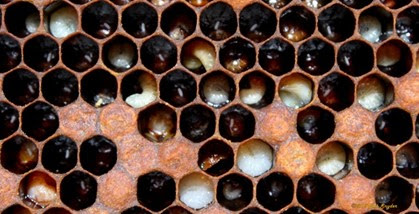
European foulbrood (EFB) is a disease of honeybee brood, caused by the bacteria Melissococcus plutonius. In living larvae, the infections can be seen in the midgut, appearing chalky white instead of the typical yellow-orange. Dead larvae that have been infected by EFB have more distinct symptoms that beekeepers can use to diagnose their bees. The larvae usually die before the cell is capped and can easily be observed. Healthy larvae are white and curled in a “C” shape around the bottom of the cell. Larvae infected with EFB become yellow to brown and are twisted around the cell walls, positioned lengthwise, from the opening to the bottom of the cell. The body cavity darkens and dries into a rubbery scale that can easily be removed from the cell. The death of larvae from EFB will cause a decrease in adult honeybee populations, which will result in reduced colony strength and lower productivity for pollination services or honey production.

Honeybee larvae with EFB symptoms (from www.beeinformed.org)


M. plutonius is parasitic and competes for food in the honeybee larvae midgut. When there is an abundance of food for the colony, the larvae usually show no symptoms of disease, and eventually pupate and develop into adult bees. When food is scarce, larvae are not able to compete with M. plutonius and succumb to infection. Some reasons for food scarcity are prolonged bad weather, movement of colonies to poor forage locations, and having a low ratio of nurse bees to brood. For example, at the beginning of a heavy nectar or pollen flow, when the size of a colony’s brood nest outgrows the capability of the nurse bees for feeding larvae. Therefore, symptoms are typically seen in spring and late summer.

Cultural, physical, and chemical strategies should be used as an integrated pest management (IPM) approach to prevent and control EFB and reduce the impact of this disease. Cultural strategies, such as the selection of hygienic breeding stock and supplementing colonies with food, can help. Routinely replacing comb is an important strategy used for EFB, as it may reduce the amount of M. plutonius present in hives. To learn more about comb rotation, please check out our Comb Rotation Factsheet. Chemical strategies are limited to the metaphylactic use of the antibiotic oxytetracycline (OTC). As this is also an important antibiotic for human health, it can only be purchased with a prescription from a veterinarian.

If you are concerned about your hives and see signs of EFB, it is important to test! The Western College of Veterinary Medicine at the University of Saskatchewan is collecting samples of infected larvae for an ongoing European Foulbrood Disease Surveillance Project. We encourage you to read the project brochure found here for details! If you suspect EFB in your colonies, please do not hesitate to contact ATTTA for more information.  We can supply you with sampling kits and instructions for collection to participate in this project.


Written by John MacDonald, ATTTA Seasonal Apiculturist johnmacdonald@perennia.ca


Connecting with ATTTA Specialists


If you’d like to connect with ATTTA specialists or learn more about our program, you can: