Showing posts with label pollination. Show all posts

Review of the 2026 WBPANS Field Day

Thursday, 25 June 2026

In the Maritimes, wild blueberry production depends on insect pollination and beekeepers play an important role in making that possible. Because honey bees are the main pollinator used in wild blueberry fields, the relationship between blueberry growers and beekeepers is very important to the industry’s success. Events like the WBPANS field day help strengthen that partnership and highlight important work happening in the industry.

Review of the 2026 WBPANS Field Day

June has been an eventful month for the Atlantic Tech Transfer Team for Apiculture! This week on Wednesday June 24th, ATTTA attended the Wild Blueberry Producers Association of Nova Scotia (WBPANS) annual field day in Onslow. This field day provided an opportunity for producers to engage with new products, industry updates, and advanced techniques all related to the wild blueberry industry.

The morning began with registration, followed by an overview of the day’s events. Attendees then travelled to a local producer’s blueberry fields, where, along with blueberry specialist Hugh Lyu (Perennia), the impact of last year’s drought was discussed. This also included a mention of the impacts on wild blueberry production of this spring’s colder than average weather. This set the tone for the group to tour the Wild Blueberry Research Institute, learning about ongoing research projects from Dr. David Percival (Dalhousie University). The morning taught producers and beekeepers more about the current struggles happening in the industry, research on wild blueberry production, and provided the chance to ask questions directly to industry experts.

Figure 1: Peter Swinkels, blueberry producer, (Left) and Hugh Lyu (Right) on a Wild Blueberry Field (ATTTA ©, 2026)

After returning to the main venue, River Breeze Farm, participants spent the rest of the morning viewing trade show exhibits, which featured equipment suppliers, agri-businesses and research groups.  This experience gave attendees the chance to connect directly with service providers and build up an appetite. Lunch was catered by Sizzlers BBQ, which included a delicious wild blueberry crumble for dessert.

Following lunch, opening remarks from the WBPANS president Andrew Dobson, were followed by greetings from The Honourable Greg Morrow, Minister of Agriculture. The Minister recognized both the importance and the challenges of the wild blueberry industry. The WBPANS executive director, Janette McDonald, provided updates on the WBPANS organization. Hugh Lyu delivered an industry overview, discussing struggles producers have faced over the last year, and indicated that there is an optimistic expectation for wild blueberries this year.  It was predicted, looking at the current situation, that the Nova Scotia crop yield may be 30-40 million pounds.

Figure 2: Andrew Dobson, President of the Wild Blueberry Producers Association of Nova Scotia  (ATTTA ©, 2026)

Following the speakers, attendees moved outdoors for field demonstrations, and equipment displays. ATTTA hosted a display which focused on how to set up an electric fence to protect honey bees and bumble bees in areas with high bear pressure. This included how baiting techniques are used to train wildlife about fences, proper grounding for reliable fence performance, and considerations for placing honey bee and bumble bee colonies in wild blueberry fields, including recommended distances between them (100m). These demonstrations highlight to producers the importance of protecting hives, how to reduce wildlife conflicts and how to support pollination for wild blueberries.

Figure 3: ATTTA’s Demonstration of an Electric Fence designed for High-Bear Pressure Areas (in front of the River Breeze Farm)  (ATTTA ©, 2026)

The WBPANS Field Day was another successful event, with help of producers, researchers and industry partners to show support for the industry of which they are part. The turnout was amazing, with 214 people registered for the event! Thank you so much to the Wild Blueberry Producers Association of Nova Scotia for hosting such a great field day!

Written by Kaitlyn Newton, ATTTA Seasonal Apiculturist

Connecting with ATTTA Specialists

If you’d like to connect with ATTTA specialists or learn more about our program, you can:

visit our website at https://www.perennia.ca/portfolio-items/honey-bees/

Email attta@perennia.ca


Looking to the 2026 Pollination Season and Beyond

Thursday, 23 April 2026

The 2026 pollination season is fast approaching. Across the Maritime region, beekeepers are starting to prepare for the movement of thousands of honey bee colonies to wild blueberry fields. This week’s blog post will highlight some of the expectations of the 2026 pollination season and provide key future considerations for beekeepers and wild blueberry growers.

Looking to the 2026 Pollination Season and Beyond

Over the past month or more, beekeepers have been working hard to care for colonies. When weather has permitted, beekeepers have been assessing winter loss, checking food stores, feeding if necessary, and are now starting the process of balancing colonies for the coming pollination season.    Winter losses and spring management will determine the number of colonies available for pollination.  The hope is that the region’s pollination capacity this spring has increased in comparison to last.  Under ideal conditions, around 35,000 Maritime colonies will be sent to wild blueberry pollination for the 2026 season.  Breaking this optimistic goal down by province, Nova Scotia may approach 20,000 colonies for pollination this spring.  New Brunswick is well placed to have 10,000 colonies available, and PEI could approach 5,000 colonies.  These speculative numbers will depend on winter losses and will only be determined after blueberry bloom.

Honey bee pollinating wild blueberry flower (ATTTA©2022).

The demand for wild blueberry pollination remains high across the Maritime region. Last year, New Brunswick imported over 30,000 honey bee colonies to provide pollination services, Prince Edward Island imported nearly 3,500 colonies, and Nova Scotia imported 864 colonies. It is expected that each Maritime province will import an equal, or increased, number of colonies to help meet the pollination demand in 2026. Nova Scotia may extend the Pollination Pilot Project, introduced in 2025, with possibly an expanded number of pollinating colonies permitted to enter the province in 2026. The other two Maritime provinces may have an increase in demand for imported colonies as is often seen when there is confidence in a robust market price for blueberries. This strong demand for pollination units sees blueberry producers increasingly looking outside the region to meet their need for pollination units.  As blueberry producers lean more on imported colonies, as well as non-apis pollinators, the market share held by Maritime beekeepers is worth exploring.

According to a leading business magazine, the Harvard Business Review, in any business, market share is the main determinant for profitability due to economies of scale, market power, and the quality of management.  Market share is simply defined as:

Often the individual sales may be a single company selling a specific product into a larger market, but this can also apply to a market sector.  A relatable example is the report by Stats Canada that, in 2024, lowbush blueberry production was 94,111 metric tons against an overall fruit production for the country of 930,982 metric tons.  This indicates that the lowbush blueberry sector represented a 10.1% market share of overall fruit production in Canada. This sort of model can be applied to other aspects of wild blueberry production and commercial beekeeping.

When looking at pollination for wild blueberries, the market share held by beekeepers has changed over the years.  An interesting example can be found when looking at some statistics from the New Brunswick wild blueberry industry generally and the current Wild Blueberry Pollination Strategy specifically.  As reported in the executive summary of the strategy1,  on average for the period from 2018 – 2023, New Brunswick beekeepers supplied 9,500 colonies out of the total 32,500 used for wild blueberry pollination (29.23% market share).  The projections in the strategy estimate that by 2029, New Brunswick beekeepers will supply 17,000 of the 57,000 honey bee colonies required for wild blueberry pollination.  This would maintain market share at roughly 29.82%.  Currently, when reviewing the estimates of the 2025 season, New Brunswick colonies only made up 9,958 of the 40,300 bee hives used overall.  This is a 24.72% market share. This indicates that New Brunswick beekeepers have lost overall market share and are not matching the trajectory expected to maintain the estimated market share proposed in the pollination strategy.

The circumstances in Nova Scotia and Prince Edward Island differ somewhat from those discussed above.  The planned increase in blueberry production acreage for NB, with more need for pollination services, is not matched by the other two Maritime provinces.  Nonetheless, there is pressure across the industry for production efficiencies, gained in part, through increased yields for existing acreage.  To achieve this increase in yield, more pollination units will be required.  The resulting increased demand for pollination services in Nova Scotia is evidenced by the importation of 864 colonies into the province in 2025 through the Pollination Pilot Project.  The number of colonies imported into NS is likely to only increase for 2026 and into the future.  Even with NS having record breaking hive numbers in the fall of 2025 (approximately 30,000) the importation will decrease the market share of for the provinces beekeepers by an estimated 5 – 7% for this season compared to prior years.  Prince Edward Island has seen a slight downward trend in the number of hives managed in the province for the past several years.  So, if demand remains constant on the Island, market share for the province’s beekeepers will be lost equivalent to the decrease in provincial hive numbers.  

When discussing the pollination market share, it is important to recognize that non-apis pollinators, such as bumble bees and alfalfa leaf cutter bees, are a growing portion of the market. Each year an increasing number of bumble bee quads are being imported into the Maritime region, and, although the specific number of imported quads is not recorded, it is recognized that bumble bees and other managed non-apis pollinators are gaining market share of the pollination industry.  The strong market share of non-apis pollinators can be seen in New Brunswick with the province projecting that by 2029, bumble bees and alfalfa leaf cutter bees will make up 24% of the total pollination capacity.

Globally, the demand for wild blueberries, and, therefore, pollination services, remains high. More acres going into production and increasing production efficiencies will also push demand for pollination of wild blueberries.  Market share is only one consideration, especially as there is still a strong, growing need for honey bee colonies in the region.  With this, comes opportunities for beekeepers and sector growth.  Loss of market share may be inevitable as, in some areas, factors like forage availability, limit growth capacity of commercial beekeepers.  This will mean that the demand cannot be met from within the Maritime region.  Alternatively, the advantages of market share, such as economy of scale and the associated demonstration of the quality of management, should not be ignored.  The other important aspect of market share is market power.  Currently the strong relationship between the Maritime beekeeping and wild blueberry industries is due to local honey bees being a foundational pollination provider.  As the share of the market alters due to importation of honey bee colonies, and with the expanded use of non-apis pollinators, market power may shift.  It is yet to be seen how the 2026 pollination season will unfold but the hope is that local honey bees will perform, as always, to support a successful wild blueberry production season.


1.  1. New Brunswick Wild Blueberry Pollination Strategy (Executive Summary) (2024) https://www2.gnb.ca/content/dam/gnb/Departments/10/pdf/Agriculture/WildBlueberries-BleuetsSauvages/nb-wild-blueberry-pollination-strategy.pdf


Connecting with ATTTA Specialists

If you’d like to connect with ATTTA specialists or learn more about our program, you can:

visit our website at https://www.perennia.ca/portfolio-items/honey-bees/

Email attta@perennia.ca

Review of the Maritime Wild Blueberry Conference

Thursday, 16 April 2026

Last week the Atlantic Tech Transfer Team for Apiculture had the pleasure of attending the Maritime Wild Blueberry Conference in Moncton, NB. This was a joint event between the three Maritime wild blueberry associations: Bleuets New Brunswick Blueberries, Wild Blueberry Producers Association of Nova Scotia and Prince Edward Island Wild Blueberry Growers Association. The event was well attended with over 170 representatives from the three Maritime provinces. To learn the highlights of this event read this week’s blog.

Review of the Maritime Wild Blueberry Conference

On Friday morning, prior to the Maritime Wild Blueberry Conference, the PEI Wild Blueberry Growers Association held their own AGM at the same venue.  Taking advantage of the conference to hold their own business meeting, the PEIWBGA gathered in good numbers in Moncton to review the work of the year past and make plans for the future.  Anyone in attendance realized that the blueberry producers in PEI are resilient and optimistic for the future of their sector. The meeting was led by PEIWBGA’s current president, Benny Nabuurs, and supported by the executive director, JoAnn Pineau, to effectively work through a full agenda.  The meeting was concluded with the presentation of the Pioneer Award.  This is a recognition of the significant contribution to the industry of individuals who through their hard work, leadership and generosity helped build and shape the wild blueberry industry in PEI. The deserving recipients of the 2026 Pioneer Award are Paul Gallant and Rodney McInnis.

The Maritime Wild Blueberry Conference started with an update from each of the presidents of the three Maritime wild blueberry associations. Zach Fisher (Bleuets New Brunswick Blueberries – BNBB), Benny Nabuurs (Prince Edward Island Wild Blueberry Growers Association – PEIWBGA) and Andrew Dobson (Wild Blueberry Producers Association of Nova Scotia – WBPANS) each provided an overview of the associations’ activities and the provinces’ industry.

Donald Arseneault (executive director of Bleuets New Brunswick Blueberries) introducing each of the three Maritime wild blueberry association presidents.

The first presentation of the event was from Patrick O’Neil (Wild Blueberry Association of North America – WBANA) who provided an overview of WBANA’s activities for the past year. The association has been busy marketing the benefits of wild blueberries on a global scale, and working with various partners to spread that message.

Next, Colleen Craig (Wyman’s Director of Marketing) gave a health research update. The health research group is actively supporting numerous studies on the health benefits of wild blueberries, and aims to differentiate the numerous benefits of wild blueberries from cultivated blueberries.

Adriana Yunes (Agriculture Alliance of New Brunswick) discussed the seasonal workforce needs in agriculture. One of the main considerations Adriana highlighted is the benefit of having seasonal workers employed by multiply agriculture commodities to extend their employment season.

Michael Tesfaendrias (Department of Fisheries, Agriculture and Aquaculture) provided a presentation on timing fungicide applications to manage wild blueberry diseases during a sprout year. In particular, Michael highlighted the management of leaf rust disease and powdery mildew.

Sylvain Gadbois (Business Development Officer Department of Fisheries, Agriculture and Aquaculture) discussed two important programs that are available to Canadian farmers – Agri-Invest and Agri-Stability. To learn more about the benefits these investment and insurance programs can provide to wild blueberry growers visit the Government of Canada website.

Kim Lipsett (NB Agriculture Alliance) gave an overview on the structure, priorities and work of the NB Agriculture Alliance. The NB Agriculture Alliance works hard to advocate for the wild blueberry industry, and provides various programs that can be explored in detail on the NBAA website.

Cody Mallette and Ji Ma (Viridian Bioscience Company Ltd.) gave an overview of Viridian Bioscience  Ltd. and discussed the science behind biostimulants which can be used to target plant growth signals, and could be used within the wild blueberry industry in the future.

Janette McDonald (Executive Director of the Wild Blueberry Producers Association of Nova Scotia) concluded day one’s activities.

To start the second day of the conference, JoAnn Pineau (Executive Director of the Prince Edward Island Wild Blueberry Growers Association) welcomed everyone to the second day of presentations. The first presentation of the day was from Gilbert Lavoie (Forest Lavoie Conseil) who provide a global wild blueberry market update. Globally, in 2025, there was 226 million pounds of frozen wild blueberries, which is down from the 10-year average of 298 million pounds. In Canada, for 2025, Quebec had above average wild blueberry production, but the Maritime region had below average production which is linked to severe drought conditions of the 2025 growing season. Currently, the wild blueberry marketing has high export prices and high demand for the premium product, which improves the price paid to producers. Looking forward to the 2026 season, Maritime growers are hoping for higher production volumes and continued high demand for wild blueberries.

The Hon. Pat Finnigan (Minister of the Department of Fisheries, Agriculture and Aquaculture) addressed the industry highlighting that wild blueberries are a healthy, favourable fruit and a significant part of New Brunswick’s agriculture industry. The minister also addressed the impact the 2025 drought had on the wild blueberry industry, but also the beneficial research and technology that is continually being produced within the sector.

Cora Hornbrook (Department of Fisheries, Agriculture and Aquaculture) gave an overview of the Resilient Agriculture Landscape Program and how wild blueberry producers can utilize and benefit from the program.

David Percival (Dalhousie University) discussed current research of his team at Dalhousie which includes wild blueberry disease management and the use of drone technology to apply pest control products. When discussing options for pest control products growers should always check with their processors to ensure that the selected product is on the list of approved agrochemicals.

Kwasi Boakye-Boateng (Future Tech Atlantic) provided a presentation on the Future Tech Atlantic company and discussed their research on soil sensors, which provides real time information for farmers. The hope is that this advanced technology will be researched and utilized for wild blueberry production in the future.

Dr. Andrew Byers (Atlantic Tech Transfer Team for Apiculture) provided a research and extension update on behalf of the ATTTA team. Overall, the team has had a busy winter and is nearing the start of the 2026 field season. One of ATTTA’s projects that was highlighted during the update was their Varroa mite regional survey and amitraz efficacy testing, which will continue for the third and final season this year.

Dr. Craig MacEachern (Dalhousie) discussed research occurring in Dr. Esau’s precision agriculture lab. Dr. MacEachern highlighted the lab’s research on prescription mapping using drone technology, and also his own research on the efficiency and performance of wild blueberry harvesters.

Pattrick Hennessy (Dalhousie) gave an update on new technology in pesticide applications. Patrick discussed the results of field trials for using smart sprayers and machine vision technology to treat various weeds, detect and treat various wild blueberry diseases, and identify wild blueberry growth stages.

Marion Tétégan Simon (Valores) discussed restoring wild blueberries using transplanting services. There is an economic impact of a field with greater than 20% bare land, which is when a growing may want to explore restoring the land.

Dr. Scott White (Dalhousie University) presented on the biology and management of weeds. Scott discussed the biology and treatment options for 2 main weeds of wild blueberries – sheep sorrel and hair fescue.

Michel Melanson (Department of Fisheries, Agriculture and Aquaculture) provide a research update on New Brunswick wild blueberry production fertilizer trials. Wild blueberry fields were split in half, where one side received fertilizer application and the other did not. In a single season there was no observed benefit of using the fertilizer to increase yield, but, in the future, researcher would like to investigate if there is a cumulative benefit of using fertilizer for multiple years.

The final presentation of the meeting was from Andrea Keddy (Koppert) who highlighted the benefits of using bumble bee quads to meet wild blueberry pollination demand. Andrea provided some guidelines for securing and using quad boxes to pollinate.

Donald Arseneault concluded the meeting. This event was a great opportunity for the three maritime industries to network and to share both their challenges and successes within the wild blueberry industry. Thank you to all members of BNBB, WBPANS, and PEIWBG, who helped organize this great event. Also, thank you to all the sponsors of the event, and to those who work to support the wild blueberry industry.

Connecting with ATTTA Specialists

If you’d like to connect with ATTTA specialists or learn more about our program, you can:

visit our website at https://www.perennia.ca/portfolio-items/honey-bees/

Email attta@perennia.ca

Understanding how Wild Blueberry Pollination can Impact Honey Bee Health

Thursday, 9 April 2026

It is frequently discussed within the beekeeping industry if wild blueberry pollination has an impact on honey bee health. In a recent blog “Associated Honey Bee Health Risks of Wild Blueberry Pollination and Migratory Beekeeping Practices” (published March 12, 2026) it was explained how migratory beekeeping practices can promote the spread of pests and diseases which directly impacts the health of colonies during and following pollination. However, other than the spread of pests and diseases, there are additional honey bee health risks related to pollination. Both the transportation of colonies and placement of colonies on various agriculture crops, such as wild blueberries, can add stress to honey bee health, which will be explored in this week’s blog.


Understanding how Wild Blueberry Pollination can Impact Honey Bee Health


Each spring thousands of Maritime colonies travel around the region to pollinate wild blueberries and other agriculture crops. Although pollination is an essential service provided by honey bees it has been questioned by beekeepers and researchers what impacts pollination has on the health of honey bees. To start, it is important that beekeepers understand that the transportation of colonies increases stress on bees. The migratory beekeeping practices discussed in a past blog post (March 12, 2026) have a known impact on the health of honey bees. Transportation can impact bees in a variety of ways such as impacting their ability to thermoregulate the hive, increasing susceptibility to pests and diseases (such as European foulbrood), preventing access to diverse forage sources, and creating physical stress due to the vibrations of transport1. Transportation practices create a less healthy environment for honey bees, and can weaken colonies prior to pollinating crops or returning to their home apiaries. Therefore, beekeepers must mitigate this stressor by sending strong and healthy colonies to pollination, with adequate food stores. Beekeepers can also make their own management decisions regarding the distance they are willing to transport colonies to support colony health.


Once colonies are placed on various agriculture crops there are other health considerations. The availability of nutritional forage while pollinating crops is a key consideration for colonies to remain healthy. In the Maritime region the majority of honey bee colonies are used to pollinate wild blueberries. The ATTTA team investigated the availability of diverse forage by collecting pollen samples from colonies placed on wild blueberry fields over a three-year period. It was found that the diversity and nutritional value of available pollen during wild blueberry pollination is highly dependent on individual field conditions. For example, wild blueberries fields surrounded by a diversity of land use, such as agriculture and residential area, offered a variety of pollen sources to honey bees and greater potential to fulfil their dietary needs, whereas vast blueberry fields surrounded by coniferous forests offered fewer, less varied sources of pollen2. Stocking density of colonies during pollination can also impact the availability of forage, and is something worth discussing between the beekeeper and grower.


Honey bee pollinating wild blueberry flower (ATTTA©2016)


One other health risk associated with pollination practices is exposure to agrochemicals. If fields are treated with pesticides before or during the pollination period honey bees, among other commercial and native pollinators, are at risk of pesticide exposure and associated impacts. Recent research found that various insecticides, herbicides and fungicides are found on wild blueberry fields in Quebec, however, pesticide concentrations found in bee bread and nectar remained below the LD50 for each active ingredient tested3. To help protect honey bees, and other pollinators, from agrochemicals, there should be clear communication between beekeepers and growers regarding the timing and choice of various pesticide applications. Growers should aim to use products with reduced toxicity to bees, and should not apply any agrochemicals immediately before or during the pollination period.


Pollination services are essential to food security, provide needed revenue to beekeepers and provide a service required of wild blueberry production. The use of honey bees for pollination services is vital, however, that does not mean that beekeepers and growers should not recognize and help mitigate the stress pollination can cause for honey bees. It is in the best interest of both the beekeeper and grower to help keep colonies healthy during the pollination period to ensure a sustainable pollination industry year after year.


References

  1. Melicher, D., Wilson, E.S., Bowsher, J.H., Peterson, S.S., Yocum, G.D. and Rinehart, J.P., 2019. Long-distance transportation causes temperature stress in the honey bee, Apis mellifera (Hymenoptera: Apidae). Environmental entomology48(3), pp.691-701.
  2. Atlantic Tech Transfer Team for Apiculture. 2023. Best Management Practices Guide For Honey Bee Pollination of Wild Blueberries in Atlantic Canada.
  3. Quiroga-Arcila, A.M., McCune, F., Fournier, V. and Giovenazzo, P., 2025. Bee-ing a Pollinator: Constraints, Concerns, and Challenges of Lowbush Blueberry Pollination. International Journal of Fruit Science25(1), pp.28-63.

Connecting with ATTTA Specialists

If you’d like to connect with ATTTA specialists or learn more about our program, you can:

visit our website at https://www.perennia.ca/portfolio-items/honey-bees/

Email attta@perennia.ca

Associated Honey Bee Health Risks of Wild Blueberry Pollination and Migratory Beekeeping Practices

Thursday, 12 March 2026

Each spring thousands of honey bee colonies are moved throughout the Maritime region to pollinate wild blueberry fields. For some beekeeping operations, colonies are moved within a relatively short radius of their home apiary pollinating nearby fields. Other operations may move colonies significant distances with colonies migrating across counties and provinces to pollinate wild blueberries. The migratory beekeeping practices that exist within the Maritime region, across Canada and within North American present significant health risks to honey bee colonies, operations and industries. This week’s blog will discuss associated honey bee health risks of migratory pollination practices both within and outside of the Maritime region.

Associated Honey Bee Health Risks of Wild Blueberry Pollination and Migratory Beekeeping Practices

Each Maritime province has unique pollination practices which present various risks to colony health. Within each Maritime province, colonies are migrated throughout the province to pollinate wild blueberries. Nova Scotia has recently allowed for the importation of a strict number of Canadian honey bee colonies originating outside of the province during the time of wild blueberry pollination. For decades prior to 2025, the province did not grant permission for the importation of honey bee colonies, and only Nova Scotian honey bee colonies pollinated wild blueberries. Both New Brunswick and PEI import thousands of colonies each year from across Canada to meet the pollination demand. In 2024, New Brunswick imported 26,737 honey bee colonies. Last season, PEI imported 3,472 honey bee colonies some of which were from British Columbia and were transported across the country traveling throughout most of the Canadian provinces. In addition to honey bee colonies, managed non-Apis pollinators such as bumble bees and alfalfa leafcutting bees are imported from outside provincial boards, and historically outside Canada, to meet the pollination demand.

Demonstration of hive loading equipment in New Brunswick at a wild blueberry pollination beekeeping operation (ATTTA© 2025)

Throughout Canada thousands of colonies are moved to and from various provinces to pollinate wild blueberries among other crops such canola, apples, cranberries, and highbush blueberries. The one exception to interprovincial movement of honey bees is Newfoundland and Labrador as the province does not permit the importation of bees to help maintain their exceptionally unique pest and disease profile, which is free of Varroa mites, American foulbrood, European foulbrood, small hive beetle and wax moth.

Outside of Canada migratory beekeeping practices are prevalent and globally the movement of honey bees and the spread of pests and diseases could have an impact on Canada’s industry including the spread of new pests and diseases into Canada and the availability of approved countries for queen importation. Canada imports queens from European counties, Australia, New Zealand, South American countries, with the majority of queens imported from the United States. The United States has significant migratory beekeeping practices where greater than 2 million colonies follow major bloom cycles for pollination and honey production. Their migratory practices start with almond pollination in February with over 60% of US colonies converging in California in February and March (Bond et al. 2021). From California, bees move to pollinate apples and pears in Washington, blueberries in Maine, and cranberries in Wisconsin (Bond et al. 2021). In summer and fall many colonies move to the Northern Plains for clover honey production, and then these hives are transported to southern states such as Texas, Florida and Georgia to overwinter (Bond et al. 2021).

Biosecurity practices, and the associated risks of various pests and diseases, needs to be evaluated at the level of within an apiary, operation, province, region, country and internationally. As the geographical range expands so does the likelihood of different honey bee pest and disease profiles. Therefore, as the migration distance for pollination increases, so does the risk of transmitting various pests and diseases to other colonies, apiaries, operations, provinces and countries.

When colonies converge in wild blueberry fields, and other pollinated crops, various pests and diseases can spread between colonies of different origin and pests and diseases can be spread to local colonies in the surrounding area. Some of the pests and diseases of concern within the Maritime region include American foulbrood, small hive beetle, high levels of Varroa mites and amitraz-resistant Varroa mites. Additionally, both the Canadian and North American beekeeping industry are remaining vigilant against the introduction of new pests and diseases such as the Tropilaelaps mite which is prevalent in countries in Asia.

Across North America the pollination demand is high and often pollination requirements cannot be met with only local hives. Therefore, there is a continued need to import hives into various regions. Many regions, including the Maritimes, are working towards growing their beekeeping industry to better support pollination demands and reducing reliance on imported hives. In addition to increasing the number of commercial beekeepers and colonies going to pollination it is equally as important that hives are managed to be strong and healthy which will contribute to low winter loss each year. Within Canada each provincial apiculturist helps minimize the risk of spreading pests and diseases by conducting inspections before/after colonies leave/enter the province, and each province also has inspection programs and regulations within province to help minimize the spread of pests and diseases.

Other than the spread of pests and diseases, there are additional honey bee health risks related to pollination. Both the transportation of colonies and placement of colonies on various agriculture crops adds stress to honey bee health. Different crops provide different nutritional value to honey bees and pollination can be linked to reduced nutrients and forage availability for honey bees. Additionally, there may be increased agrochemical exposure while honey bees are placed on pollination crops, which further contributes to poor health. A future blog will further discuss how wild blueberry pollination can have an impact on honey bee health.

References

Bond, J.K., Hitaj, C., Smith, D., Hunt, K., Perez, A. and Ferreira, G., 2021. Honey bees on the move: From pollination to honey production and back.

Connecting with ATTTA Specialists

If you’d like to connect with ATTTA specialists or learn more about our program, you can:

visit our website at https://www.perennia.ca/portfolio-items/honey-bees/

Email attta@perennia.ca

Some thoughts on wild blueberry pollination!

Thursday, 24 July 2025


In order to create fruit, wild blueberries depend heavily on insects, especially honeybees, for pollination. While this relationship for achieving pollination is largely successful, there can be problems. In fact, a lot can go wrong during bloom resulting in less-than-optimal pollination. In this blog, we are going to be talking about some pitfalls, as well as good practices related to wild blueberry pollination.

Some thoughts on wild blueberry pollination!

Eastern Canada’s wild blueberries are a mostly managed lowbush, native species (Vaccinium angustifolium) which produce fruit commercially. The flowers of this species can be difficult to pollinate for some insect species. Tightly clustered and hanging like small bells, blueberry blossoms prefer to only release pollen when buzz pollinated.  This is achieved by bees using a process called sonication to release the pollen as they visit the bloom.  This is best done by bumble bees, with the primary pollinator, honey bees, moving pollen passively as they visit the blossoms collecting nectar.  Thousands of honey bee colonies are brought into our region, for commercial wild blueberry production each season, as their sheer numbers create a tremendous pollination workforce.

Pollination, although perhaps sounding like a simple process, is delicate with multiple steps. In spite of applying managed pollinators to blueberry fields there are factors which may prevent optimal pollination. Signs of things going wrong may include poor fruit set, small berries, delayed ripening, and sometimes whole parts of fields under producing.

Figure 1. honey bee pollinating a wild blueberry plant.

Optimal timing and placement for pollination is a challenge to achieve for both blueberry producers and beekeepers. The timing of blueberry bloom, highly dependent on temperature and sunlight, can shift dramatically depending on the year and location. Bees meanwhile are moved in based on scheduling and availability. If colonies arrive too early, they may undergo nutritive stress or habituate to other floral sources. If placed too late, the optimal bloom window for pollination may be missed. Even with perfect timing, weather can have a detrimental impact on pollination. Rain, cold, and wind will all reduce activity as honey bees do not forage well below 13–15°C3 and during periods of precipitation. 

Hive health and overall strength are important determinants of pollination success. Hives should meet the established pollination standard2 for wild blueberry pollination in the Maritime region.  A lesser understood factor could be transport stress as well as, pests and diseases can leave colonies underperforming.

Agrichemical exposure may also have detrimental impacts on managed pollinators. Most blueberry producers are aware of the potential harm to pollinators and will avoid spraying while bees are on the bloom.  All stakeholders are encouraged to follow best practices and familiarize themselves with guides like “Protecting Pollinators from Pesticides – Wild Blueberry.”  This publication, produce collaboratively between ATTTA and the Pollination Partnership, is available online.

Field access and optimal placement will also impact pollination success. Beekeepers need to access field locations in order to distribute the colonies evenly. Even though honey bees will travel considerable distances to forage, it is best to avoid clustering all the colonies in one area or placing them too far from dense patches of bloom. Better placement equals better coverage which equals better pollination 2

 Another limiting factor in achieving optimal pollination is the supply of bees.  By times, there may not be adequate numbers of managed pollinators. This limitation can be for any managed pollinator including honey bees, bumble bees or alfalfa leafcutter bees. The number of pollination units available varies, due to many factors, seasonally, but the industry is working to increase the supply which has already had positive impact on the availability of pollinators.  It is the strategic goal of the industry to increase the pollination capacity of our region with steps already being taken to secure an adequate supply.

It must be remembered that managed bees are not the only pollinators, with native species like bumble bees and solitary bees, contributing to pollination success. These insects are especially important for pollination during the initial bloom, when temperatures are low, and on poor weather days when honey bees are reluctant to fly. So, properly managed bees as well as native insects play an important role in ensuring consistent and well pollinated fields.

Written by Gregory Dugas, ATTTA Seasonal Apiculturist

                                                    Connecting with ATTTA Specialists

If you’d like to connect with ATTTA specialists or learn more about our program, you can:

visit our website at https://www.perennia.ca/portfolio-items/honey-bees/

Email attta@perennia.ca


References


1.      1. Eaton, L.J. and Nams, V.O., 2012. Honey bee stocking numbers and wild blueberry production in Nova Scotia. Canadian Journal of Plant Science, 92(7), pp.1305-1310.

2.      2. Bennett, A. and A. Byers. 2023. Best Management Practices Guide for Honey Bee Pollination of Wild Blueberries in Atlantic Canada. Atlantic Tech Transfer Team for Apiculture

3.      3. Dugas, G. (2023) Honey Bee and Bumble Bee Pollination, ATTTA Buzz, 13 July.

Measuring Pollination Success of Wild Blueberries

Thursday, 3 July 2025

The overall goal of pollination for wild blueberry producers is berry production. Therefore, wild blueberry producers rent honey bee colonies and purchase bumblebee colonies to ensure sufficient pollination of their crops. Many practices are used to ensure that there are enough pollinators present in the crop, such as stocking density, timing, and location of hive placement. Producers can follow these practices, but there are many factors that can affect pollination success, such as adequate weather for the flight of pollinators or for plants producing nectar. It may be difficult to ensure adequate pollination of a crop, but there are many ways to assess a crop to determine pollination success.

Measuring Pollination Success of Wild Blueberries

Successful compatible pollen transfer from the anther of one flower to the stigma of another flower leads to germination and fertilization. Pollen transferred between flowers of the same clone, also known as self-crossing, and between different species can be incompatible [3]. Therefore, a flower receiving only incompatible pollen will have lower germination and fertilization rates, which results in reduced seed and berry formation. If there is successful pollination, there are many ways to tell how efficient or successful the pollination event was.

Observing visitations by insects is one way to assess pollination success, where if an insect has visited the flower, then there is a possibility of a pollination event. There are considerations to this method though because not every visit results in successful pollination. There could be insect cheaters which will feed on nectar and pollen resources, but do not exhibit the proper structure or behavior to pollinate [5]. Also, the pollen that is carried by insects may be incompatible to the observed flower [3]. Therefore, pollinator frequency, effectiveness, and efficiency are all different when considering pollination [6].

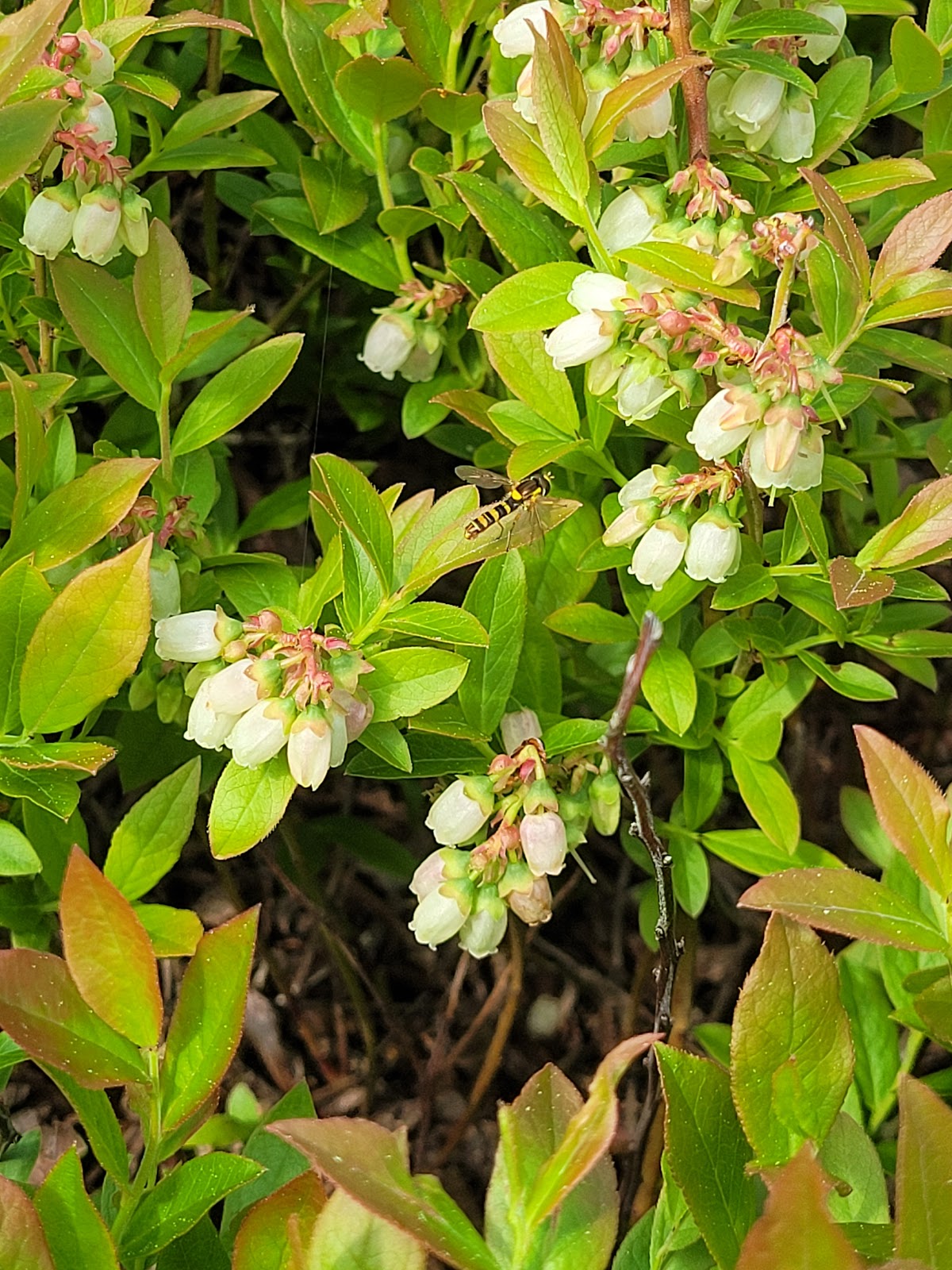
Hoverfly foraging on wild blueberry flowers (John MacDonald ©, 2024)

Some characteristics of a pollinated flower will change to prevent insect visitation of a flower that has already been successfully pollinated. This will ensure flowers that have not yet been pollinated will receive more visitors. One method is the pedal drop of flowers, where a pollinated flower will drop its pedals within a few days of being pollinated [4]. Another method which humans cannot see is color change, where ultraviolet color attracts insects and after successful pollination this color will fade [9]. Nectar and pollen production will also be reduced after successful pollination, which reduces the incentive for insects to visit the flower as well [2].

When a flower is successfully pollinated, germination commences, with the growth of a pollen tube from the surface of the stigma to the ovules, at the base of the female part of the flower. With the help of dyes and fluorescent microscopy, pollen tube formation can be observed. Methodologies for preparing flowers to observe pollen tube growth vary widely. Common methods typically include collecting flowers and removing the style, or the female reproductive part of the flower. The flower material is then placed in a solution to soften the tissues, rinsed to remove the solution, and dyed to darken the pollen tubes to make them visible. The material is then pressed flat onto a slide to view using florescence microscopy [8,10]. This method is more advanced than the others and requires supplies and equipment that may not be easily accessible. 

Fertilization occurs after germination, which can be assessed by both seed and berry formation. Seeds that have been successfully fertilized are also known as viable seeds. Fertilized and unfertilized seeds can be differentiated by size and color, where a fertilized seed is large and dark brown to red colored and an unfertilized seed is small and pale colored [1]. Successfully fertilized seeds will sprout uniformly when planted in a growing medium. Therefore, seeds can be placed in media to induce growth and then germination rates, or the ratio of sprouted to unsprouted seeds can be evaluated to show fertilization success. One consideration with this kind of test is to ensure that there is not a dormancy response in the seed that requires vernalization or scarification to allow growth [1].  

Seed growth also elicits berry formation, so berry size is another indication of pollination success. A very small berry that drops from the plant while the stigma is still attached, also known as a pinhead berry, can suggest that the flower was not successfully pollinated. The number of berries per plant can be an indication of pollination success, with large numbers indicating good pollination. Also, if a berry has more seeds, this suggests that many ovules were successfully fertilized, resulting in a larger berry [7,10]. Therefore, the size of berries and the number of seeds can also be indications of successful pollination. Another way to measuring pollination success is fruit set. This can be done by counting the number of flowers after bloom has commenced and then comparing the number of flowers to the number of fruit that successfully form after bloom [3,7,10].

Fertilized and unfertilized wild blueberry seeds (ATTTA ©, 2024)

Using yield as an indicator for pollination success should be done carefully because there are many factors that could affect yield from the point of pollination until the berry is ready to be harvested [6]. This includes, but is not limited to, disease and pest pressures, water availability, and unfavorable weather conditions. Measuring pollination success is important to ensure the pollinator used, environmental conditions, and other management practices are ideal for the most effective pollination. Please read upcoming pollination blogs on bee structure and behavior.

Written by John MacDonald, ATTTA Seasonal Apiculturist

Connecting with ATTTA Specialists

If you’d like to connect with ATTTA specialists or learn more about our program, you can:

visit our website at https://www.perennia.ca/portfolio-items/honey-bees/

Email attta@perennia.ca

References:

[1] Castro, C., Olarte, Y., Rache, L., and Pacheco, J. 2012. ‘Development of a germination protocol for blueberry seeds (Vaccinium meridionale Swartz)’, Agronomia Colombiana, 30(2):196-203.

[2] Cromie, J., Ternest, J.J., Komatz, A.P., Adunola, P.M., Azevedo, C., Mallinger, R.E., and Munoz, P.R. 2024. ‘Genotypic variation in blueberry flower morphology and nectar reward content affects pollinator attraction in a diverse breeding population’, BMC Plant Biology, 24:814.

[3] Dogterom, M.H., Winston, M.L., and Mukai, A. 2000. ‘Effect of pollen load size and source (self, outcross) on seed and fruit production in highbush blueberry cv. 'Bluecrop' (Vaccinium corymbosum; Ericaceae)’, American Journal of Botany, 87(11): 1584-1591.

[4] Drummond, F.A. 2020. ‘Wild blueberry fruit drop: a consequence of seed set?’, Agronomy, 10:939.

[5] King, C., Ballantyne, G. and Willmer, P.G. 2013. ‘Why flower visitation is a poor proxy for pollination: measuring single-visit pollen deposition, with implications for pollination networks and conservation’, Methods in Ecology and Evolution 2013, 4: 811–818.

[6] Ne’eman, G., Jurgens, A., Newstrom-Lloyd, L., Potts, S.G., and Dafni, A. 2009. ‘A framework for comparing pollinator performance: effectiveness and efficiency’, Biological Reviews, 2009:1-15.

[7] Noone, R.E., Doucet, S.E., and Jones, P.L. 2022. ‘Pollination ecology of lowbush blueberry (Vaccinium angustifolium Aiton) in an island ecosystem’, Canadian Journal of Plant Science, 102(3).

[8] Noormets, M. and Olson, R. 2005. ‘Observations on the gynoecial pathway for pollen tube growth in sweet lowbush blueberry (Vaccinium angustifolium Ait.)’, Journal of Applied Botany and Food Quality, 80:6-13.  

[9] Schulte, A.J., Mail, M., Hahn, L.A., and Barthlott, W. 2019. ‘Ultraviolet patterns of flowers revealed in polymer replica – caused by surface architecture’, Beilstein Journal of Nanotechnology, 10(1):459-466.

[10] Stavert, J.R., Bailey, C., Kirkland, L., and Rader, R. 2020. ‘Pollen tube growth from multiple pollinator visits more accurately quantifes pollinator performance and plant reproduction’, Scientific Reports, 10:16958.