
The overall goal of pollination for wild blueberry producers is berry production. Therefore, wild blueberry producers rent honey bee colonies and purchase bumblebee colonies to ensure sufficient pollination of their crops. Many practices are used to ensure that there are enough pollinators present in the crop, such as stocking density, timing, and location of hive placement. Producers can follow these practices, but there are many factors that can affect pollination success, such as adequate weather for the flight of pollinators or for plants producing nectar. It may be difficult to ensure adequate pollination of a crop, but there are many ways to assess a crop to determine pollination success.
Measuring Pollination Success of Wild Blueberries
Successful compatible pollen transfer from the anther of one
flower to the stigma of another flower leads to germination and fertilization. Pollen
transferred between flowers of the same clone, also known as self-crossing, and
between different species can be incompatible [3]. Therefore, a flower
receiving only incompatible pollen will have lower germination and fertilization
rates, which results in reduced seed and berry formation. If there is
successful pollination, there are many ways to tell how efficient or successful
the pollination event was.
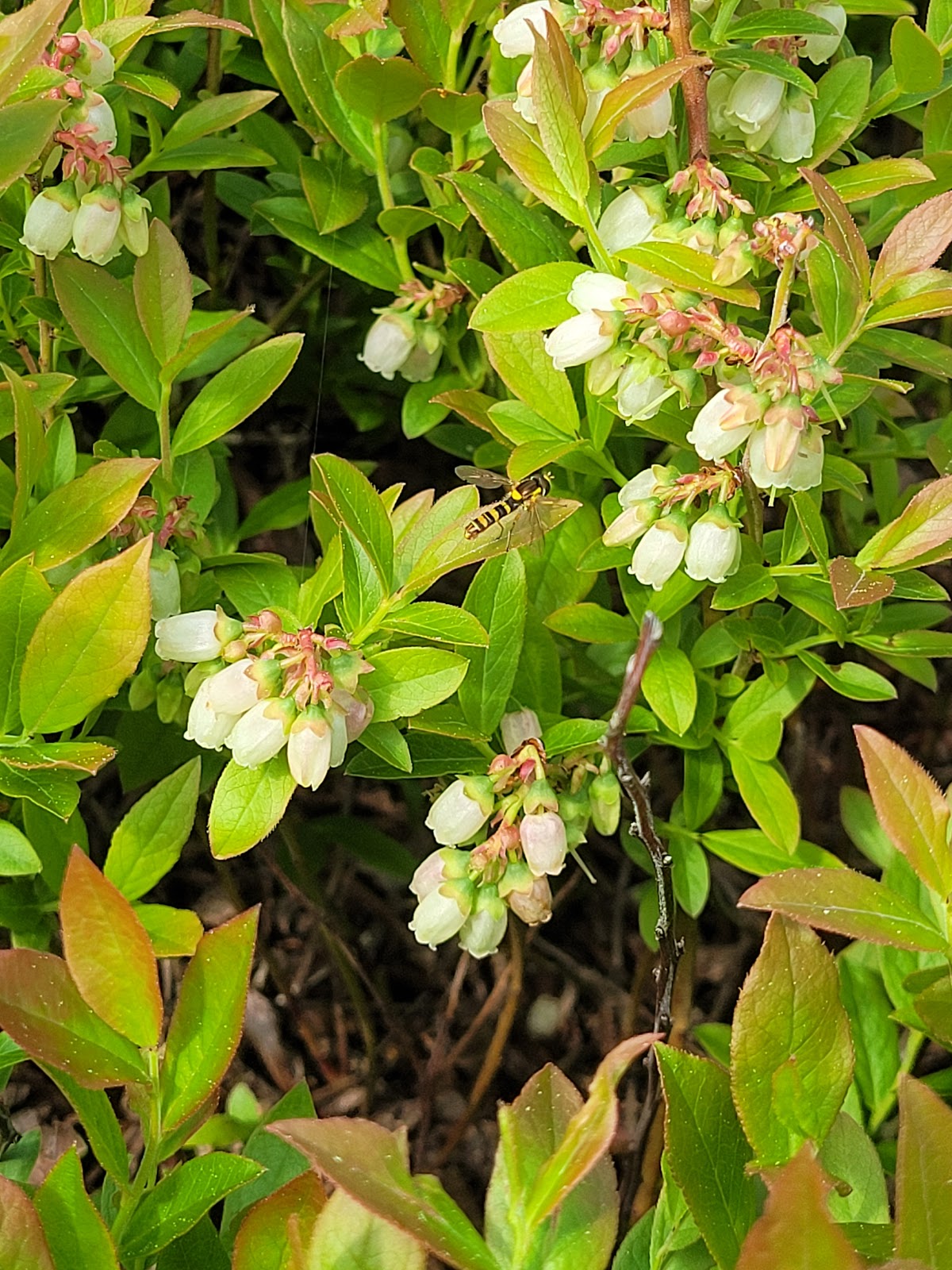
Observing visitations by insects is one way to assess
pollination success, where if an insect has visited the flower, then there is a
possibility of a pollination event. There are considerations to this method
though because not every visit results in successful pollination. There could
be insect cheaters which will feed on nectar and pollen resources, but do not
exhibit the proper structure or behavior to pollinate [5]. Also, the pollen
that is carried by insects may be incompatible to the observed flower [3].
Therefore, pollinator frequency, effectiveness, and efficiency are all
different when considering pollination [6].
Some characteristics of a pollinated flower will change to
prevent insect visitation of a flower that has already been successfully
pollinated. This will ensure flowers that have not yet been pollinated will
receive more visitors. One method is the pedal drop of flowers, where a
pollinated flower will drop its pedals within a few days of being pollinated [4].
Another method which humans cannot see is color change, where ultraviolet color
attracts insects and after successful pollination this color will fade [9].
Nectar and pollen production will also be reduced after successful pollination,
which reduces the incentive for insects to visit the flower as well [2].
When a flower is successfully pollinated, germination
commences, with the growth of a pollen tube from the surface of the stigma to
the ovules, at the base of the female part of the flower. With the help of dyes
and fluorescent microscopy, pollen tube formation can be observed. Methodologies
for preparing flowers to observe pollen tube growth vary widely. Common methods
typically include collecting flowers and removing the style, or the female
reproductive part of the flower. The flower material is then placed in a
solution to soften the tissues, rinsed to remove the solution, and dyed to
darken the pollen tubes to make them visible. The material is then pressed flat
onto a slide to view using florescence microscopy [8,10]. This method is more
advanced than the others and requires supplies and equipment that may not be
easily accessible.
Fertilization occurs after germination, which can be assessed
by both seed and berry formation. Seeds that have been successfully fertilized are
also known as viable seeds. Fertilized and unfertilized seeds can be differentiated
by size and color, where a fertilized seed is large and dark brown to red colored
and an unfertilized seed is small and pale colored [1]. Successfully fertilized
seeds will sprout uniformly when planted in a growing medium. Therefore, seeds
can be placed in media to induce growth and then germination rates, or the
ratio of sprouted to unsprouted seeds can be evaluated to show fertilization
success. One consideration with this kind of test is to ensure that there is
not a dormancy response in the seed that requires vernalization or
scarification to allow growth [1].
Seed growth also elicits berry formation, so berry size is
another indication of pollination success. A very small berry that drops from
the plant while the stigma is still attached, also known as a pinhead berry, can
suggest that the flower was not successfully pollinated. The number of berries
per plant can be an indication of pollination success, with large numbers
indicating good pollination. Also, if a berry has more seeds, this suggests
that many ovules were successfully fertilized, resulting in a larger berry [7,10].
Therefore, the size of berries and the number of seeds can also be indications
of successful pollination. Another way to measuring pollination success is
fruit set. This can be done by counting the number of flowers after bloom has
commenced and then comparing the number of flowers to the number of fruit that
successfully form after bloom [3,7,10].

Using yield as an indicator for pollination success should
be done carefully because there are many factors that could affect yield from
the point of pollination until the berry is ready to be harvested [6]. This
includes, but is not limited to, disease and pest pressures, water
availability, and unfavorable weather conditions. Measuring pollination success
is important to ensure the pollinator used, environmental conditions, and other
management practices are ideal for the most effective pollination. Please read upcoming
pollination blogs on bee structure and behavior.
Written by John MacDonald, ATTTA Seasonal Apiculturist
Connecting with ATTTA Specialists
If you’d like to connect with ATTTA specialists or learn more about our program, you can:
visit our website at https://www.perennia.ca/portfolio-items/honey-bees/
Email attta@perennia.ca
References:
[1] Castro, C., Olarte, Y., Rache, L., and Pacheco, J. 2012.
‘Development of a germination protocol for blueberry seeds (Vaccinium
meridionale Swartz)’, Agronomia Colombiana, 30(2):196-203.
[2] Cromie, J., Ternest, J.J., Komatz, A.P., Adunola, P.M.,
Azevedo, C., Mallinger, R.E., and Munoz, P.R. 2024. ‘Genotypic variation in
blueberry flower morphology and nectar reward content affects pollinator
attraction in a diverse breeding population’, BMC Plant Biology, 24:814.
[3] Dogterom, M.H., Winston, M.L., and Mukai, A. 2000. ‘Effect
of pollen load size and source (self, outcross) on seed and fruit production in
highbush blueberry cv. 'Bluecrop' (Vaccinium corymbosum; Ericaceae)’,
American Journal of Botany, 87(11): 1584-1591.
[4] Drummond, F.A. 2020. ‘Wild blueberry fruit drop: a
consequence of seed set?’, Agronomy, 10:939.
[5] King, C., Ballantyne, G. and Willmer, P.G. 2013. ‘Why
flower visitation is a poor proxy for pollination: measuring single-visit
pollen deposition, with implications for pollination networks and conservation’,
Methods in Ecology and Evolution 2013, 4: 811–818.
[6] Ne’eman, G., Jurgens, A., Newstrom-Lloyd, L., Potts, S.G.,
and Dafni, A. 2009. ‘A framework for comparing pollinator performance:
effectiveness and efficiency’, Biological Reviews, 2009:1-15.
[7] Noone, R.E., Doucet, S.E., and Jones, P.L. 2022. ‘Pollination
ecology of lowbush blueberry (Vaccinium angustifolium Aiton) in an
island ecosystem’, Canadian Journal of Plant Science, 102(3).
[8] Noormets, M. and Olson, R. 2005. ‘Observations on the
gynoecial pathway for pollen tube growth in sweet lowbush blueberry (Vaccinium
angustifolium Ait.)’, Journal of Applied Botany and Food Quality, 80:6-13.
[9] Schulte, A.J., Mail, M., Hahn, L.A., and Barthlott, W.
2019. ‘Ultraviolet patterns of flowers revealed in polymer replica – caused by
surface architecture’, Beilstein Journal of Nanotechnology, 10(1):459-466.
[10] Stavert, J.R., Bailey, C., Kirkland, L., and Rader, R. 2020.
‘Pollen tube growth from multiple pollinator visits more accurately quantifes
pollinator performance and plant reproduction’, Scientific Reports, 10:16958.

