Showing posts with label flowers. Show all posts

Measuring Pollination Success of Wild Blueberries

Thursday, 3 July 2025

The overall goal of pollination for wild blueberry producers is berry production. Therefore, wild blueberry producers rent honey bee colonies and purchase bumblebee colonies to ensure sufficient pollination of their crops. Many practices are used to ensure that there are enough pollinators present in the crop, such as stocking density, timing, and location of hive placement. Producers can follow these practices, but there are many factors that can affect pollination success, such as adequate weather for the flight of pollinators or for plants producing nectar. It may be difficult to ensure adequate pollination of a crop, but there are many ways to assess a crop to determine pollination success.

Measuring Pollination Success of Wild Blueberries

Successful compatible pollen transfer from the anther of one flower to the stigma of another flower leads to germination and fertilization. Pollen transferred between flowers of the same clone, also known as self-crossing, and between different species can be incompatible [3]. Therefore, a flower receiving only incompatible pollen will have lower germination and fertilization rates, which results in reduced seed and berry formation. If there is successful pollination, there are many ways to tell how efficient or successful the pollination event was.

Observing visitations by insects is one way to assess pollination success, where if an insect has visited the flower, then there is a possibility of a pollination event. There are considerations to this method though because not every visit results in successful pollination. There could be insect cheaters which will feed on nectar and pollen resources, but do not exhibit the proper structure or behavior to pollinate [5]. Also, the pollen that is carried by insects may be incompatible to the observed flower [3]. Therefore, pollinator frequency, effectiveness, and efficiency are all different when considering pollination [6].
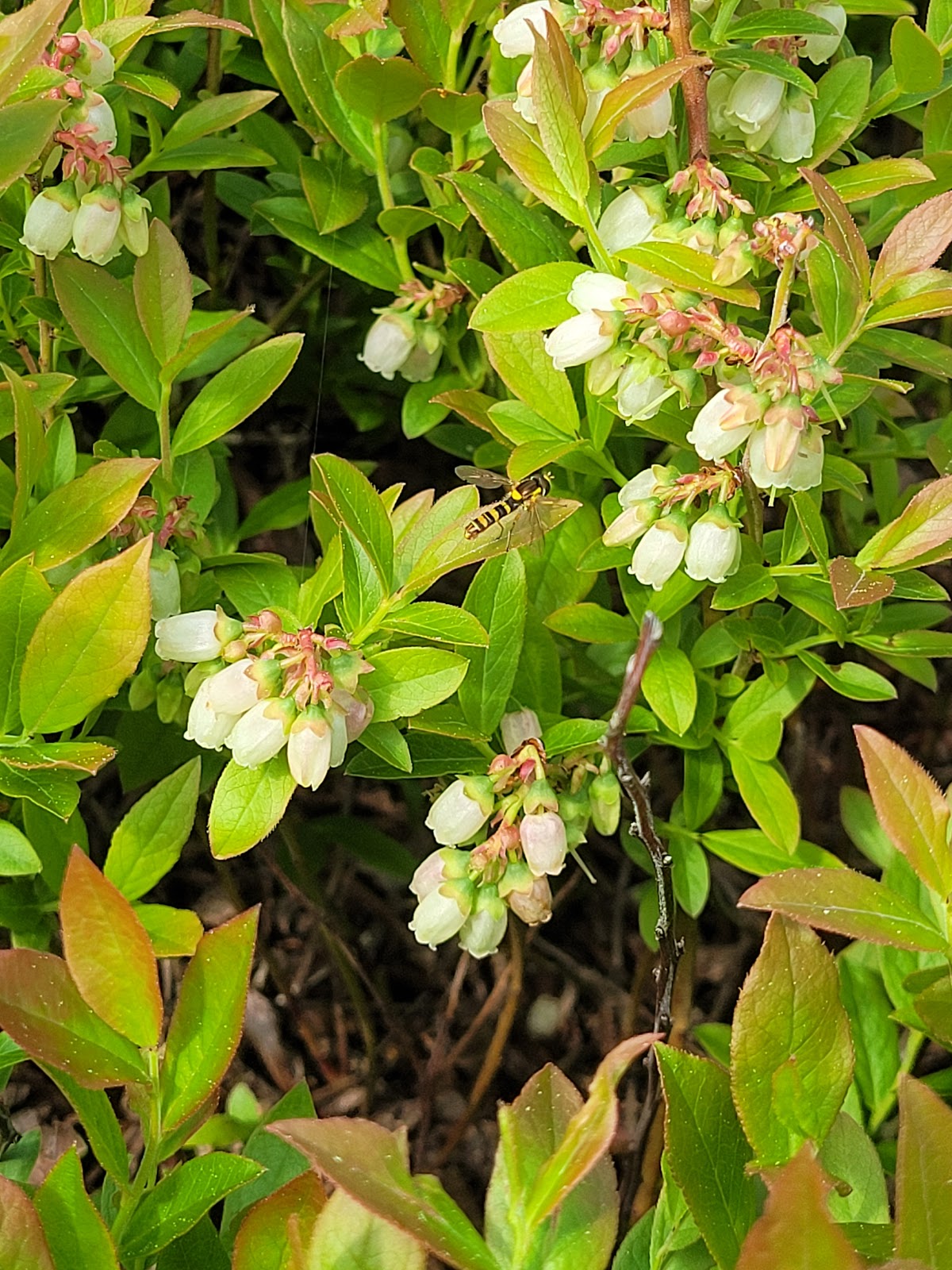
Hoverfly foraging on wild blueberry flowers (John MacDonald ©, 2024)

Some characteristics of a pollinated flower will change to prevent insect visitation of a flower that has already been successfully pollinated. This will ensure flowers that have not yet been pollinated will receive more visitors. One method is the pedal drop of flowers, where a pollinated flower will drop its pedals within a few days of being pollinated [4]. Another method which humans cannot see is color change, where ultraviolet color attracts insects and after successful pollination this color will fade [9]. Nectar and pollen production will also be reduced after successful pollination, which reduces the incentive for insects to visit the flower as well [2].

When a flower is successfully pollinated, germination commences, with the growth of a pollen tube from the surface of the stigma to the ovules, at the base of the female part of the flower. With the help of dyes and fluorescent microscopy, pollen tube formation can be observed. Methodologies for preparing flowers to observe pollen tube growth vary widely. Common methods typically include collecting flowers and removing the style, or the female reproductive part of the flower. The flower material is then placed in a solution to soften the tissues, rinsed to remove the solution, and dyed to darken the pollen tubes to make them visible. The material is then pressed flat onto a slide to view using florescence microscopy [8,10]. This method is more advanced than the others and requires supplies and equipment that may not be easily accessible. 

Fertilization occurs after germination, which can be assessed by both seed and berry formation. Seeds that have been successfully fertilized are also known as viable seeds. Fertilized and unfertilized seeds can be differentiated by size and color, where a fertilized seed is large and dark brown to red colored and an unfertilized seed is small and pale colored [1]. Successfully fertilized seeds will sprout uniformly when planted in a growing medium. Therefore, seeds can be placed in media to induce growth and then germination rates, or the ratio of sprouted to unsprouted seeds can be evaluated to show fertilization success. One consideration with this kind of test is to ensure that there is not a dormancy response in the seed that requires vernalization or scarification to allow growth [1].  

Seed growth also elicits berry formation, so berry size is another indication of pollination success. A very small berry that drops from the plant while the stigma is still attached, also known as a pinhead berry, can suggest that the flower was not successfully pollinated. The number of berries per plant can be an indication of pollination success, with large numbers indicating good pollination. Also, if a berry has more seeds, this suggests that many ovules were successfully fertilized, resulting in a larger berry [7,10]. Therefore, the size of berries and the number of seeds can also be indications of successful pollination. Another way to measuring pollination success is fruit set. This can be done by counting the number of flowers after bloom has commenced and then comparing the number of flowers to the number of fruit that successfully form after bloom [3,7,10].

Fertilized and unfertilized wild blueberry seeds (ATTTA ©, 2024)

Using yield as an indicator for pollination success should be done carefully because there are many factors that could affect yield from the point of pollination until the berry is ready to be harvested [6]. This includes, but is not limited to, disease and pest pressures, water availability, and unfavorable weather conditions. Measuring pollination success is important to ensure the pollinator used, environmental conditions, and other management practices are ideal for the most effective pollination. Please read upcoming pollination blogs on bee structure and behavior.

Written by John MacDonald, ATTTA Seasonal Apiculturist

Connecting with ATTTA Specialists

If you’d like to connect with ATTTA specialists or learn more about our program, you can:

visit our website at https://www.perennia.ca/portfolio-items/honey-bees/

Email attta@perennia.ca

References:

[1] Castro, C., Olarte, Y., Rache, L., and Pacheco, J. 2012. ‘Development of a germination protocol for blueberry seeds (Vaccinium meridionale Swartz)’, Agronomia Colombiana, 30(2):196-203.

[2] Cromie, J., Ternest, J.J., Komatz, A.P., Adunola, P.M., Azevedo, C., Mallinger, R.E., and Munoz, P.R. 2024. ‘Genotypic variation in blueberry flower morphology and nectar reward content affects pollinator attraction in a diverse breeding population’, BMC Plant Biology, 24:814.

[3] Dogterom, M.H., Winston, M.L., and Mukai, A. 2000. ‘Effect of pollen load size and source (self, outcross) on seed and fruit production in highbush blueberry cv. 'Bluecrop' (Vaccinium corymbosum; Ericaceae)’, American Journal of Botany, 87(11): 1584-1591.

[4] Drummond, F.A. 2020. ‘Wild blueberry fruit drop: a consequence of seed set?’, Agronomy, 10:939.

[5] King, C., Ballantyne, G. and Willmer, P.G. 2013. ‘Why flower visitation is a poor proxy for pollination: measuring single-visit pollen deposition, with implications for pollination networks and conservation’, Methods in Ecology and Evolution 2013, 4: 811–818.

[6] Ne’eman, G., Jurgens, A., Newstrom-Lloyd, L., Potts, S.G., and Dafni, A. 2009. ‘A framework for comparing pollinator performance: effectiveness and efficiency’, Biological Reviews, 2009:1-15.

[7] Noone, R.E., Doucet, S.E., and Jones, P.L. 2022. ‘Pollination ecology of lowbush blueberry (Vaccinium angustifolium Aiton) in an island ecosystem’, Canadian Journal of Plant Science, 102(3).

[8] Noormets, M. and Olson, R. 2005. ‘Observations on the gynoecial pathway for pollen tube growth in sweet lowbush blueberry (Vaccinium angustifolium Ait.)’, Journal of Applied Botany and Food Quality, 80:6-13.  

[9] Schulte, A.J., Mail, M., Hahn, L.A., and Barthlott, W. 2019. ‘Ultraviolet patterns of flowers revealed in polymer replica – caused by surface architecture’, Beilstein Journal of Nanotechnology, 10(1):459-466.

[10] Stavert, J.R., Bailey, C., Kirkland, L., and Rader, R. 2020. ‘Pollen tube growth from multiple pollinator visits more accurately quantifes pollinator performance and plant reproduction’, Scientific Reports, 10:16958.

Pollination of Wild Blueberries

Thursday, 7 July 2022

Atlantic Canada is known for its delicious, locally grown wild blueberries. However, growing blueberries can be complicated, and relies on pollinating insects such as honey bees. In this blog, we will discuss wild blueberry flowers and how they are pollinated. We will also give a quick update on ATTTA’s wild blueberry research and the next steps in one of our exciting projects. 

Pollination of Wild Blueberries

Each individual wild blueberry plant is called a clone and can grow to around knee height. The leaves are overt and oval-shaped with smooth edges. The flowers grow in clusters and the corolla (petals) take on a bell shape with greenish-white or pinkish coloring. Protected inside the flower are multiple stamens containing anthers that hold pollen (male reproductive cells). At the base of the flower are the ovary and ovules. Extending out of the flower is the style that ends at the stigma. Due to the shape of the flower, wind is not considered a pollinating factor.  This means insects are the only way pollination can occur.

Figure 1: Diagram of cross-section wild blueberry flower in bloom (Image: Drummond, 2019)

Figure 2: Honeybee on wild blueberry flower (ATTTA©2022)

During the wild blueberry bloom in warm months of May and June, the stigma responds to movement created by attracted insects causing the anthers to release pollen. Therefore, when a honey bee or bumble bee visits a flower, released pollen attaches to their body hairs to be transported to subsequent flowers they visit. This transport is essential as it distributes male reproductive cells from one individual blueberry plant to another.  This allows for the reproduction of the plant and the forming of fruit. After an individual flower has reached the end of its blooming period, the petals fall off, leaving the green ovary and ovules. If pollinated adequately, the process of fruit set will begin as the ovary matures into seeded fruit. It starts with bloating of the ovary as a small, round, white-green fruit, ripening to a dusted blue shortly afterwards. 

Figure 3. Fruit set after successful pollination and resulting from the swelling of the ovary, immature fruit is shown as well as one ripe blue berry (ATTTA©2022)

Pollination is key to fruit set on wild blueberries, making it essential to have an abundance of pollinators on blueberry fields. Here in Atlantic Canada, honey bees and bumble bees are commonly tasked with this critical job. Managed honey bee colonies are easily added to fields, bringing an abundance of pollinating capacity. Colonies brought in should be appropriately strong and ideally provide at least one forager bee per square yard (Drummond. 2002). This will, among other factors, help determine the stocking density of honeybee colonies needed for individual fields.  

Honey bees provide adequate numbers to pollinate multiple blueberry flowers and have small bodies that can get inside the bell-shaped flower and shake the pollen loose. Managed or native bumble bees are phenomenal and unique pollinators, as well. Their size and buzzing ability effectively shake out pollen and distribute large quantities from one clone to another. Their extra-long tongues allow them to access and pollinate some of the more closed-off flowers that honey bees may not be able to reach. They are also more resilient to pollinating across a broader range of weather conditions. In spite of being less efficient individually, honey bees have the sheer numbers to pollinate many flowers.

Now that the fruit is beginning to develop on blueberry fields, the Atlantic Tech Transfer Team for Apiculture will be continuing with one of our ongoing pollination projects. In May, we visited wild blueberry fields in NB, NS, and PE to assess honeybee hive strength and percent bloom.  In the upcoming weeks, we will return to these fields and evaluate the number of open blooms which have transformed into fruit.  This determination is called fruit set and is an indication of pollination success. This measure in addition to others, such as number of berries at harvest, fruit weight and seed counts, allows us to evaluate the impact that honey bees have ultimately on the final yield.  Stay tuned for updates on this work as the season progresses! 

Written by Rebecca Campbell, ATTTA Summer Research Assistant rcampbell@perennia.ca


References
Drummond, F.A. 2019. Over-informed on IPM - Episode 006: Wild Blueberries and Their Wild Pollinators. University of New Hampshire. https://extension.unh.edu/blog/2019/05/over-informed-ipm-episode-006-wild-blueberries-their-wild-pollinators.
Drummond, F.A. 2002. Honeybees and blueberry pollination. University of Maine Coop. Ext. Wild Blueberry Bulletin No. 629.


Connecting with ATTTA Specialists


If you’d like to connect with ATTTA specialists or learn more about our program, you can:


visit our website at https://www.perennia.ca/portfolio-items/honey-bees/


Email abyers@perennia.ca


Planting for the Bees

Thursday, 23 June 2022

It is always lovely to see your garden admired by honeybees in the summer, buzzing around collecting the pollen and nectar. It is even nicer to see honeybees pollinating our orchards and field crops. Beyond the garden, managed honey bees are an agricultural necessity here in Atlantic Canada, pollinating everything from blueberry fields to apple orchards. However, many crops that are bee-pollinated only blossom for short periods and cannot sustain honey bees year-round. In this blog, we explore how beekeepers and non-beekeepers alike can support local honey bee populations by providing floral forage throughout the season.

Planting for the Bees

Nutritionally it is essential for bees to collect pollen and nectar from a variety of plants. It can be challenging for beekeepers to find suitable areas for hives that will fulfill both the type and quantity of blooming flowers that the bees need to stay healthy. Creating a garden design that will be in bloom from spring to fall is beneficial for foraging honey bees. The plants you choose to incorporate can be of any flowering variety, but consider native plants to provide a dependable and healthy ecosystem. There are many native trees and bushes such as maples, red-osier dogwood, ash trees, cherry, or oak. There are also many flowering plants, such as butterfly weed, common milkweed, bee borage, canola, lupine, fireweed, and so many more. For more ideas, visit the Atlantic Rhododendron and Horticultural Society website. This website includes a descriptive Excel table which lists over a hundred plants and when they bloom on the Atlantic coast. In addition to growing a variety of flowering plants, planting in clusters instead of spread-out patterns can make foraging more efficient for the bees. These flowering gardens will attract more than just honeybees. Also, consider adding old logs or rock piles as nesting features to support wild pollinators!

While it is valuable to plant new gardens for honey bee foraging, it is also good to consider the management of the wild flowers that are already present. Managed and wild growth is often controlled by mowing, which eliminates blooms, nesting resources, and pollinators' natural habitats. Depending on the time of mowing, the blades can also eliminate individual pollinators that may be present. Managing where and when you mow is an excellent course to ensure that foragers aren’t eliminated and get optimum use out of the plants which are present. Leaving patches unmowed and trimming as close to the roadside as possible can help. Leaving areas unmowed for as long as possible while plants are in bloom allows foragers to use up resources and then move onto new habitat.


Sustaining the health of our honeybees is growing more challenging as natural habitats are lost. Planting pollination gardens and managing native plants can help. The more flowers planted, the more food it provides, and the better the bees eat. When the bees are healthier, they are more equipped to fight off harmful pests and diseases, such as Varroa mites. This is why it is so important to consider planting for the bees. 

Written by Rebecca Campbell, ATTTA Summer Research Assistant rcampbell@perennia.ca


Connecting with ATTTA Specialists


If you’d like to connect with ATTTA specialists or learn more about our program, you can:


Developing Your Own Floral Calendar

Thursday, 20 May 2021

Briefly interrupting the queen raising series that began in last week’s blog, this week’s blog continues and concludes the short series on floral calendars that was introduced a few weeks ago. In blog #44 we highlighted the practical value of floral calendars and how they are used in understanding the availability of floral resources on the landscape to support both native and managed pollinators. In this blog, we are revisiting how floral calendars can be used as an informative beekeeping tool and how you can work towards creating your own floral calendar for your specific beekeeping area.

Many floral resources are useable and beneficial to both native and managed pollinators, but some floral plant species provide greater resources to foraging bees than others. By identifying and incorporating these good quality floral blooms on the landscape, we can offer support not only to our own bees, but also to the native pollinators that share these floral resources with our managed honey bees. 

Developing Your Own Floral Calendar

A floral calendar is a valuable beekeeping tool, and as with any tool, is most effectively used when it has been carefully calibrated to suit the specific purpose and environment for which it is being employed. To review from blog #44, a floral calendar is essentially a time table for floral blooms in a specific area. Making a floral calendar takes some time and fine-tuning, but it can be well worth the time if developed accurately. A well-developed floral calendar is a compilation of observations that are used to determine the approximate bloom timings and durations of important nectar and pollen plants. The accuracy of these observations ultimately determines the practical value of the floral calendar. Some of the key types of observations that go into the development of a floral calendar include:

  • Seasonal changes in flowering vegetation
  • Foraging behavior of bees
  • Interactions between floral blooms and bees

Making a floral calendar begins by simply spending some time making and recording observations within these three categories. Considering the general flying distances of foraging honey bees, observations can be made in a radius of approximately 3km in all directions from the hive(s):

  • Throughout the seasons, record what flowering plant species are present within this radius and take note of the timing of their blooming and how long they remain in bloom with available nectar and pollen.
  • Make observations throughout the seasons regarding if/how bees interact with these plant species. Are the bees collecting pollen? Nectar? Are there many bees consistently visiting the plant species? What types of bees are foraging from these flowers; native pollinators and/or managed honey bees?
  • Monitor and record changes in hive food stores while making the above plant and bee foraging observations. Does the quantity of food stores in the hive fluctuate? When and at what capacity? Does the timing of these changes correlate with the timing of any particular changes observed in floral blooms?

By reviewing the details and timings of these observations, connections can be made to determine which floral species’ blooms provide bees with the best foraging resources. Compiling and organizing these observations in the format of a floral calendar helps beekeepers to more accurately anticipate and track nectar flow and dearth periods throughout the season and plan beekeeping activities accordingly. Making a floral calendar takes time, so remember, it is okay to start small and build up records of observations over time!


Floral Resources in the Atlantic Canada Region

Through the information provided by a well-developed floral calendar, high quality/quantity resource producing plant species can be identified and then incorporated into the landscape to increase the forage value of the area for managed and native bees. As highlighted in blog #44, there are some pre-developed floral calendars available that are also useful in identifying what plant species produce good foraging resources for bees and what types of environmental conditions they are able to thrive in. ‘Honey & Pollen Plants for Canada’s Beekeepers: An Annotated Electronic Floral Calendar’ is a great resource for beekeepers and is available ONLINE.

Based on information provided by this resource, some examples of high-quality bee forage plants that are suitable for various environmental conditions in Atlantic Canada include:

  • Phacelia
  • Hyssop
  • Tickseed
  • Vervain
  • Boneset
  • Vetch

Beyond their value to foraging pollinators, it is also a good idea to consider some other plant characteristics before planting, such as:

  • Ease of establishment
  • Tendency to become weedy
  • Perennial vs. annual

Over time, a landscape can be transformed into a resource paradise for managed and native bees!


Connecting with ATTTA Specialists


If you’d like to connect with ATTTA specialists or learn more about our program, you can:


Floral Calendars as a Tool for Beekeepers

Thursday, 22 April 2021

This week’s blog begins a short series on understanding and supporting the needs of both native and managed pollinators in our region through floral resources. Floral calendars are an excellent tool for beekeepers and provide information on the flowers that provide for bees. Knowing what is blooming when and where can help beekeepers better understand colony dynamics throughout the beekeeping season and better manage their hives accordingly. Keep reading to learn more about why floral calendars are beneficial to beekeepers!

There are many information sources available on floral resources for bees including both books and online sources. In this week’s blog, we feature an online floral calendar that can be used by beekeepers in every province across Canada. As spring progresses, more and more flowers will be popping up to show off their lovely blooms and we are so ready for it! Keep following along to learn how you can use this floral calendar to identify what flowers are pollinator favorites in your region.

Floral Calendars as a Tool for Beekeepers

It is well known by beekeepers that beekeeping follows seasonal cycles, and that seasonal weather impacts the bees and beekeeping activities in each season, especially when considering the availability of pollen and nectar sources. The amount of food available in a colony is a strong determining factor of brood production and therefor also colony population, which ultimately determines the overall productiveness of a colony. Knowing when pollen and nectar are available in a particular region is valuable knowledge to have as a beekeeper. Floral calendars provide this valuable knowledge to beekeepers and often include specific information regarding:

  • What floral resources are available to bees and other pollinators in a specific region
  • Which floral resources are preferred by bees and other pollinators
  • When the floral resources bloom and for how long
  • Yearly cycles in nectar flow and pollen availability.

With this information, beekeepers can use this as a consideration when choosing an ideal apiary location based on specific operation goals. If high honey yield is the goal, placing hives in an area where there is an abundance of high nectar producing blooms or moving hives to follow nectar flows would help achieve this objective. Floral calendars can also assist in determining an optimal time for harvesting honey based on the specific nectar flow cycles of the flowers present in the area. If the goal is more focused on early spring buildup and colony growth, it would be beneficial to place hives in an area where with flowers that supply an abundance of pollen resources to support brood rearing. Beekeepers can also use information from floral calendars to provide floral resources for bees around an existing apiary by planting flowers that will effectively support the resource requirements of the hive(s).

Once there is an understanding of the floral resource availability throughout the beekeeping season in a given area, beekeepers can also use this information to anticipate a resource dearth according to what floral plants are present. Certain flowers bloom at certain times and, depending on the floral diversity of the area, the beekeeper may choose to provide colonies with supplementary food sources when there is a gap in the natural availability from floral sources.


Honey & Pollen Plants for Canada’s Beekeepers: An Annotated Electronic Floral Calendar *

“Honey & Pollen Plants for Canada’s Beekeepers: An Annotated Electronic Floral Calendar” is an online floral calendar made specifically for beekeepers in Canada. This resource allows beekeepers (and anyone else that is interested) to determine which plants bloom where and when, and what the value of each listed plant is in terms of providing resources for bees. Plants can be easily searched by common or scientific name, by season, and/or by region.

This calendar was originally developed with funding from Ontario Ministry of Agriculture and Food in 2013 for Ontario beekeepers, and was later expanded to include resources for beekeepers in every Canadian province. It provides information relevant to pollinators on over 260 honey and nectar producing plants that grow across Canada, along with photos to aid in plant identification.

“This resource was created by the Canadian Pollination Initiative (NSERC-CANPOLIN) with financial support from the Ontario Ministry of Agriculture and Rural Affairs and the University if Guelph through the Knowledge Translation and Transfer (KTT) program. Seeds of Diversity is generously hosting the website” *


* Honey & Pollen Plants for Canada’s Beekeepers: An Annotated Electronic Floral Calendar 


Connecting with ATTTA Specialists


If you’d like to connect with ATTTA specialists or learn more about our program, you can: