Showing posts with label pollinators. Show all posts

Planting for the Bees

Thursday, 23 June 2022

It is always lovely to see your garden admired by honeybees in the summer, buzzing around collecting the pollen and nectar. It is even nicer to see honeybees pollinating our orchards and field crops. Beyond the garden, managed honey bees are an agricultural necessity here in Atlantic Canada, pollinating everything from blueberry fields to apple orchards. However, many crops that are bee-pollinated only blossom for short periods and cannot sustain honey bees year-round. In this blog, we explore how beekeepers and non-beekeepers alike can support local honey bee populations by providing floral forage throughout the season.

Planting for the Bees

Nutritionally it is essential for bees to collect pollen and nectar from a variety of plants. It can be challenging for beekeepers to find suitable areas for hives that will fulfill both the type and quantity of blooming flowers that the bees need to stay healthy. Creating a garden design that will be in bloom from spring to fall is beneficial for foraging honey bees. The plants you choose to incorporate can be of any flowering variety, but consider native plants to provide a dependable and healthy ecosystem. There are many native trees and bushes such as maples, red-osier dogwood, ash trees, cherry, or oak. There are also many flowering plants, such as butterfly weed, common milkweed, bee borage, canola, lupine, fireweed, and so many more. For more ideas, visit the Atlantic Rhododendron and Horticultural Society website. This website includes a descriptive Excel table which lists over a hundred plants and when they bloom on the Atlantic coast. In addition to growing a variety of flowering plants, planting in clusters instead of spread-out patterns can make foraging more efficient for the bees. These flowering gardens will attract more than just honeybees. Also, consider adding old logs or rock piles as nesting features to support wild pollinators!

While it is valuable to plant new gardens for honey bee foraging, it is also good to consider the management of the wild flowers that are already present. Managed and wild growth is often controlled by mowing, which eliminates blooms, nesting resources, and pollinators' natural habitats. Depending on the time of mowing, the blades can also eliminate individual pollinators that may be present. Managing where and when you mow is an excellent course to ensure that foragers aren’t eliminated and get optimum use out of the plants which are present. Leaving patches unmowed and trimming as close to the roadside as possible can help. Leaving areas unmowed for as long as possible while plants are in bloom allows foragers to use up resources and then move onto new habitat.


Sustaining the health of our honeybees is growing more challenging as natural habitats are lost. Planting pollination gardens and managing native plants can help. The more flowers planted, the more food it provides, and the better the bees eat. When the bees are healthier, they are more equipped to fight off harmful pests and diseases, such as Varroa mites. This is why it is so important to consider planting for the bees. 

Written by Rebecca Campbell, ATTTA Summer Research Assistant rcampbell@perennia.ca


Connecting with ATTTA Specialists

If you’d like to connect with ATTTA specialists or learn more about our program, you can:


Pollination Services

Thursday, 27 January 2022

In 2020, wild blueberries were Canada’s greatest fruit export with an export value of $312 million (Agriculture and Agri-Food Canada 2021)! This was the result of 71,290 metric tons of wild blueberries, of which the Maritime provinces produced 52% and Quebec 48%. Wild blueberries are an economically valuable crop for the Maritimes and are closely linked to the honey bee industry because blueberry flowers rely on insects for pollination. As such, beekeepers and wild blueberry producers are key partners in eastern Canada. The season for pollination may seem far away, but now is a good time to start organizing pollination services! 

Pollination Services

Regionally, the demand for pollination by honeybees is greater than 50,000 colonies and projected to increase. This represents over $8 million per year in income to Atlantic beekeepers. If you are a beekeeper not already engaged in pollination, consider diversifying your operation through pollination services. Sending bees to blueberry fields is hard work, but it is an important service made easier through thoughtful planning. 

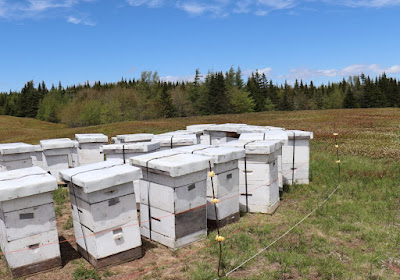
Always a valuable resource, Atlantic provincial beekeeping associations can help beekeepers and blueberry producers connect to establish a pollination partnership. Essentially, beekeepers transport their hives to blueberry fields by night when the fields are ready for pollination, around late May or early June. Hives remain on the fields for the duration of bloom and then are retrieved by the beekeeper. Producers typically pay per hive and there is no minimum number of hives that you need to get started! When you do begin, it is a good practice for beekeepers and blueberry producers to agree upon a contract prior to pollination season. Some aspects to consider are the number of colonies required, timing of hive placement and removal, who will be responsible for bear fencing, location for access, and details concerning agrochemical use. The Nova Scotia Beekeepers Association has a sample pollination contract which can be a good place to start.

Another critical point of the contract is establishing a hive strength standard. Optimal hive strength for pollination is a subject which is important to the industry and has not been wholly agreed upon. The NS Beekeepers Association and NB Beekeeper’s Association both offer slightly different provincial minimum hive strength standards for pollination and the Canadian Association of Professional Apiculturists (CAPA) presents yet another. To get to the bottom of this, ATTTA is currently researching hive strength for wild blueberry pollination so that we might be able to establish a uniform hive strength standard and means of assessment across Atlantic Canada for optimal wild blueberry pollination. For more information on measuring hive strength, watch our video on the ATTTA YouTube Channel entitled Bees and Blueberries in Atlantic Canada – the Hive Strength Standard. 

Hive strength can be measured in multiple ways. Elements of the hive which are often quantified are number of bees, amount of brood, and hive bodies. The trickiest of these to measure is the number of bees within a given hive. Common methods of estimating the population of a honey bee colony are counting full frames of bees, seams of bees, or flying bees. 

ATTTA collected data from blueberry fields in NB and NS this past summer to evaluate these methods as they relate to pollination success. Our latest video in our Pollination Education series discusses the reliability of counting flying bees returning to the hive as a means of measuring hive strength. Our findings suggest that this is not a reliable method of measuring hive strength in Atlantic Canada, and that cool ambient air temperature skews the results of this method further. For a more detailed account of these results watch the video Assessing Hive Strength: Counting Flying Bees Returning to the Hive. 

Stay tuned for more results about optimal hive strength for blueberry pollination and, if you aren’t engaged already, consider adding pollination services to your beekeeping repertoire!


A Guide for Managing Bees for Crop Pollination (1999) Canadian Association of Professional Apiculturists.

Evaluating the Strength of Honey Bee Hives for Wild Blueberry Pollination. New Brunswick Agriculture Aquaculture and Fisheries, Wild Blueberry Factsheet B.4.0.

Honey Bees and Blueberry Pollination, Fact Sheet No. 629, UMaine Extension No. 2079. 2002. 

Statistical Overview of the Canadian Fruit Industry 2020. Agriculture and Agri-Food Canada. June 2021. 


Connecting with ATTTA Specialists


If you’d like to connect with ATTTA specialists or learn more about our program, you can:


New Bees for Newbies

Thursday, 13 January 2022

Winter months are a time for planning in the beekeeper’s calendar. Planning the upcoming season will allow your apiary to run smoother, regardless of how many hives you manage. This is also a great time for someone who has only yet been considering beekeeping to prepare to dive in! Over the next few blogs, we will consider a few points that would be valuable to organize this winter. This week, we will begin with a discussion of ordering bees.

New Bees for Newbies

When spring comes and hives are unwrapped, beekeepers find out how many survived the winter. Overwintering strong hives which have been properly treated, fed, and winterized will be valuable in minimizing overwintering losses. A compelling article from researchers in Switzerland was recently released which further corroborates evidence that proper varroa mite management of winter bees improves colony success in the spring (Julie et al. 2021). Nonetheless it is not uncommon to lose a small percentage of hives to winter stresses. Beekeepers often make up for these loses by replacing colonies in the early spring. 

Unfortunately, a major challenge for the Atlantic Canada beekeeping industry is the lack of early spring queens (Bixby et al. 2019). Virgin queens typically cannot mate until late May or June at the earliest due to the absence of mature drones. Historically, the solution has been to order bees from warmer climates where queen rearing can begin much earlier, such as New Zealand and Hawaii. It is important to place these orders in the winter to ensure that they arrive when you want them. Ordering bees from outside of Canada requires special protocols which must be followed via the Canada Food Inspection Agency. There are also unique protocols for ordering bees from out of province within Canada (see protocols for Maritime provinces below). Rather than taking this on directly, it can be helpful to order imported bees through local bee suppliers who are more familiar with the legal process. 

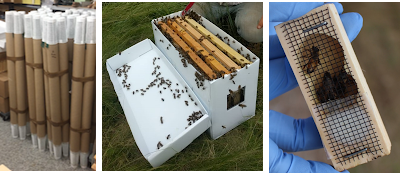
Honey bees ordered from abroad typically come as packages of many bees or a single mated queen. A package generally holds 1-1.5 kg of adult bees as well as a mated queen. A mated queen will arrive with attendant worker bees, who are often removed from the cage before introducing the queen to a hive. Packages and individual queens must be installed into proper hives after transport and you should be prepared to do so when the bees arrive.  

Figure 1. Three common ways to buy bees. From left to right: honey bee packages (source: countryfields.ca), nucleus colony, caged queen.

If you are not anxious to have new bees immediately at the start of spring, buying local nucleus colonies (nucs) and queens is a great way to support the Atlantic beekeeping industry. There are suppliers of local nucs and queens throughout the Atlantic provinces who typically sell between May and July. Provincial beekeeping association websites can be a valuable resource in connecting with reputable providers. Once again, it is recommended that orders be placed early because lists are typically first come, first served and supplies are limited. This is especially true for beekeepers in Newfoundland and Labrador, where honey bee importation is exceptionally restricted!

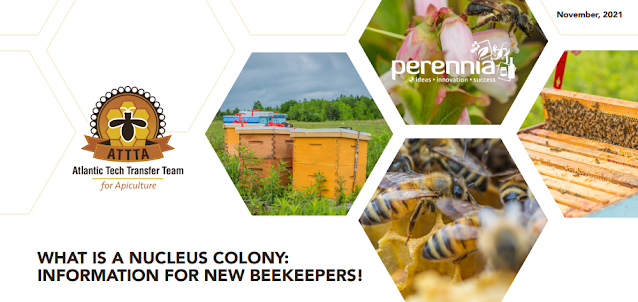
For new beekeepers, nucs are a great way to get started because they already contain the necessary building blocks for starting a new colony- bees and drawn comb! There are some considerations to keep in mind when buying a nucleus colony. A nuc should include a mated queen, frames with drawn comb and food stores, and bees of all life stages. Typically, there are 3-5 frames holding a combination of these resources. For more information on nucs, explore the new ATTTA factsheet “What is a Nucleus Colony: Information for New Beekeepers!”


Bixby, M., M.M. Guarna, S.E. Hoover, and S.F. Pernal. 2019. Canadian Honey Bee Queen Breeders’ Reference Guide. Canadian Association of Professional Apiculturists Publication 55 pp. 

H. Julie, J. Hattendorf, A. Aebi, et al., Compliance with recommended Varroa destructor treatment regimens improves the survival of honey bee colonies over winter, Research in Veterinary Science (2021), https://doi.org/10.1016/ j.rvsc.2021.12.025


Pollinator Education New Video Release! Assessing Hive Strength: Counting Flying Bees Returning to the Hive

Check out our latest video on ATTTA's YouTube Channel about assessing hive strength. This video discusses how to assess hive strength by counting flying bees returning to the hive and the pros and cons of using this method. Watch HERE to learn more!


Connecting with ATTTA Specialists


If you’d like to connect with ATTTA specialists or learn more about our program, you can: