Showing posts with label new beekeepers. Show all posts

Daphne's Bees

Thursday, 24 March 2022

This week we are delighted to announce the release of a new honey bee book written by Atlantic beekeeper, Catherine Dempsey! Read on to learn more about this lovely book and the unique context in which it was written. We have also prepared a new factsheet to help beginning beekeepers understand basic beekeeping equipment. This will soon be made available on the ATTTA website alongside our additional factsheets and extension materials! 

Daphne’s Bees

Catherine Dempsey keeps bees in Flatrock, Newfoundland, by the edge of the Atlantic Ocean. On the island of Newfoundland, beekeeping comes with distinct challenges and advantages. To start, the island is infamous for unpredictable weather patterns and has a shortened beekeeping season, even when compared to the relatively short season of the Maritime provinces. Nonetheless, the industry is growing steadily and in 2020 Provincial Apiarist Karen Kennedy estimated there was around 100 Newfoundland beekeepers including both hobbyist and commercial operators. 

Most unique about Newfoundland beekeeping is that the island remains free of many pests which are common worldwide including Varroa mites, small hive beetle, honey bee tracheal mite, and greater wax moth! This is an advantage that comes with challenge and responsibility. To maintain this status, the government passed legislation in 1985 to limit the importation of honey bees into the province, granting exceptions extremely rarely and under strict protocols. As such, all growth in the Newfoundland beekeeping industry must come from within. Luckily, the island has highly motivated beekeepers including Catherine. Daphne’s Bee’s is a beautiful narrative alongside vibrant artwork to tell the story of a grandmother and granddaughter on a beekeeping journey. It is both youthful and educational to start budding beekeepers on the right path! 

Nouvelle Vidéo YouTube! - Évaluer la vigueur de la ruche - Compter le nombre d’abeilles qui retournent à la ruche

L’industrie de la pollinisation au Canada atlantique est en grande partie une collaboration entre les apiculteurs et les producteurs de bleuets sauvages. Les services de pollinisation sont les plus efficaces lorsque la vigueur des ruches est optimale pour la pollinisation, c’est ce que l’ETTACA présente dans sa série de vidéos sur l’éducation à la pollinisation. Il existe des standards de vigueur établis pour les ruches au Canada atlantique et les environs, et ceux-ci sont présentés dans notre vidéo intitulée Les abeilles et les bleuets sauvages au Canada atlantique – les standards de vigueur des ruches pour la pollinisation. La vigueur de la ruche peut être mesurée de plusieurs façon et il n’y a pas de protocole établi pour l’ensemble de l’industrie de la pollinisation au Canada atlantique. Dans cette vidéo, nous présentons une méthode de mesure de vigueur de la ruche, qui consiste à compter le nombre d’abeilles en vol qui retournent à la ruche. Dans notre évaluation de cette méthode, nous soulignons qu’elle est fiable seulement lorsque les conditions de vol des abeilles domestiques sont optimales. L’inspection de l’intérieur des ruches demeure une méthode d’évaluation plus précise de la vigueur des ruches au Canada atlantique. 


Connecting with ATTTA Specialists

If you’d like to connect with ATTTA specialists or learn more about our program, you can:


Frame Assembly

Thursday, 3 February 2022

In today’s blog, we will be discussing another important piece of hive equipment to prepare for the coming season - frames! Frames of some variety have become essential to modern day beekeeping. Removable frames allow for hive inspections which are valuable for pest and disease monitoring and, in Canada, are the law in beekeeping. Today, join us in assembling a deep frame, to fit the deep Langstroth hive body we assembled previously. 

Frame Assembly

When organizing frames for the upcoming season, you first must ask yourself what kind of frame you would like. Frames for Langstroth hives come in different sizes and materials. Shallow frames fit shallow supers, medium frames fit medium supers, etc. Frames can be wooden or plastic. In Atlantic Canada, it is most typical for frames to be wooden with either plastic or wax foundation in the midrib. Frames which are one piece and completely plastic are also available but, anecdotally, less hardy. Frames can be bought assembled with foundation in place, unassembled, or you can start from scratch. Today, we are assembling a wooden frame which is intended for wax foundation. 

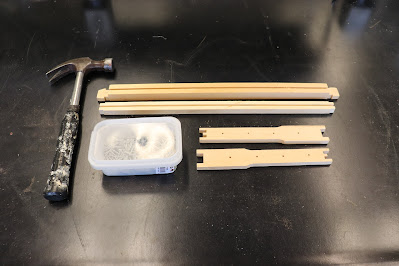
In all building projects, it is best to start by gathering the necessary materials. We have the top bar, bottom bar, and two side bars. It is good practice to use wire to support wax foundation in a frame. The three holes in the side bars will be used to add wire to the frame after it is assembled (see Figure 1). Plastic foundation does not require this additional support and, therefore, such frames do not need these extra holes. Our top and bottom bars both have a mid-groove to fit the foundation into place. Last, we have one-inch galvanized nails, and a hammer to fasten our pieces together. An optional but useful extra tool is a knife or a razor blade.

Figure 1. Materials for assembling a frame. A hammer, 1-inch galvanized nails, top bar, bottom bar, and two side bars. 

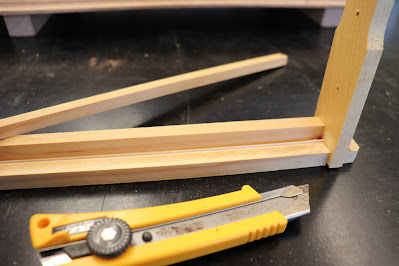
In addition to a groove, our top bar also has a piece called a cleat or wedge (see Figure 2). The wooden cleat is a removable piece that can be detached either before or after assembly. It can be sliced off with a razor blade or snapped off by hand. Either way, it is recommended to afterwards use a razor blade to clean up the edge of the top bar. This will make it easier to ultimately slide the wax foundation into place. 


Figure 2. Wooden cleat removed from completed frame. The razor bade will clean up the uneven break along the top bar.

Side bars have a distinct top and bottom, and the top is the wider end. To assemble the frame, press the top of the side bars into the top bar, and press the bottom bar into bottom of the side bars. The top width ensures that there is proper bee space between frames for bees to move about the hive and build comb. It does not extend all the way to the bottom to prevent the frame from being totally propolized and for ease of movement for the bees within. An unassembled frame should square up easily. 

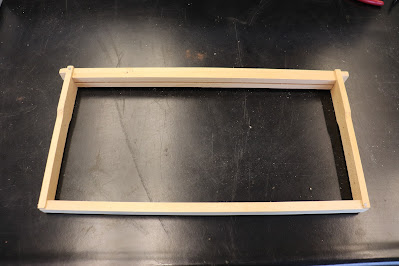
The final step is to secure the pieces together with nails (Figure 3). We used one nail in each corner. As a matter of preference, two nails are on one side and two are on the other. The nails are oriented perpendicular to the top bar make the frame sturdier in cases when you occasionally pry the top bar up with your hive tool to free the frame from sticky propolis and wax. 

Figure 3. Assembled deep frame. Includes four nails, two are hammered into the back and cannot be seen in this photo. 

The frame is now assembled, and next week we will add our wire and wax foundation to make it complete! This week we have some additional announcements!


Canadian Beekeeping Minutes

ATTTA has a new edition to our Canadian Beekeeping Minutes YouTube series! Click here to get tips on how to light your smoker!


Atlantic Beekeeping Survey

ATTTA and Dalhousie have created an educational survey to help us fully understand the needs and wants of Atlantic beekeepers, including future beekeepers! The survey is brief, and we are greatly appreciative to all participants. Take the survey here! Thank you to those who have!


Connecting with ATTTA Specialists


If you’d like to connect with ATTTA specialists or learn more about our program, you can:


New Bees for Newbies

Thursday, 13 January 2022

Winter months are a time for planning in the beekeeper’s calendar. Planning the upcoming season will allow your apiary to run smoother, regardless of how many hives you manage. This is also a great time for someone who has only yet been considering beekeeping to prepare to dive in! Over the next few blogs, we will consider a few points that would be valuable to organize this winter. This week, we will begin with a discussion of ordering bees.

New Bees for Newbies

When spring comes and hives are unwrapped, beekeepers find out how many survived the winter. Overwintering strong hives which have been properly treated, fed, and winterized will be valuable in minimizing overwintering losses. A compelling article from researchers in Switzerland was recently released which further corroborates evidence that proper varroa mite management of winter bees improves colony success in the spring (Julie et al. 2021). Nonetheless it is not uncommon to lose a small percentage of hives to winter stresses. Beekeepers often make up for these loses by replacing colonies in the early spring. 

Unfortunately, a major challenge for the Atlantic Canada beekeeping industry is the lack of early spring queens (Bixby et al. 2019). Virgin queens typically cannot mate until late May or June at the earliest due to the absence of mature drones. Historically, the solution has been to order bees from warmer climates where queen rearing can begin much earlier, such as New Zealand and Hawaii. It is important to place these orders in the winter to ensure that they arrive when you want them. Ordering bees from outside of Canada requires special protocols which must be followed via the Canada Food Inspection Agency. There are also unique protocols for ordering bees from out of province within Canada (see protocols for Maritime provinces below). Rather than taking this on directly, it can be helpful to order imported bees through local bee suppliers who are more familiar with the legal process. 

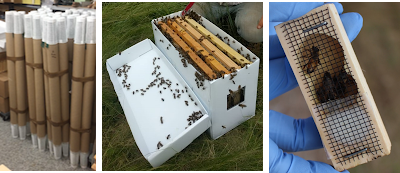
Honey bees ordered from abroad typically come as packages of many bees or a single mated queen. A package generally holds 1-1.5 kg of adult bees as well as a mated queen. A mated queen will arrive with attendant worker bees, who are often removed from the cage before introducing the queen to a hive. Packages and individual queens must be installed into proper hives after transport and you should be prepared to do so when the bees arrive.  

Figure 1. Three common ways to buy bees. From left to right: honey bee packages (source: countryfields.ca), nucleus colony, caged queen.

If you are not anxious to have new bees immediately at the start of spring, buying local nucleus colonies (nucs) and queens is a great way to support the Atlantic beekeeping industry. There are suppliers of local nucs and queens throughout the Atlantic provinces who typically sell between May and July. Provincial beekeeping association websites can be a valuable resource in connecting with reputable providers. Once again, it is recommended that orders be placed early because lists are typically first come, first served and supplies are limited. This is especially true for beekeepers in Newfoundland and Labrador, where honey bee importation is exceptionally restricted!

For new beekeepers, nucs are a great way to get started because they already contain the necessary building blocks for starting a new colony- bees and drawn comb! There are some considerations to keep in mind when buying a nucleus colony. A nuc should include a mated queen, frames with drawn comb and food stores, and bees of all life stages. Typically, there are 3-5 frames holding a combination of these resources. For more information on nucs, explore the new ATTTA factsheet “What is a Nucleus Colony: Information for New Beekeepers!


Bixby, M., M.M. Guarna, S.E. Hoover, and S.F. Pernal. 2019. Canadian Honey Bee Queen Breeders’ Reference Guide. Canadian Association of Professional Apiculturists Publication 55 pp. 

H. Julie, J. Hattendorf, A. Aebi, et al., Compliance with recommended Varroa destructor treatment regimens improves the survival of honey bee colonies over winter, Research in Veterinary Science (2021), https://doi.org/10.1016/ j.rvsc.2021.12.025


Pollinator Education New Video Release! Assessing Hive Strength: Counting Flying Bees Returning to the Hive

Check out our latest video on ATTTA's YouTube Channel about assessing hive strength. This video discusses how to assess hive strength by counting flying bees returning to the hive and the pros and cons of using this method. Watch HERE to learn more!


Connecting with ATTTA Specialists


If you’d like to connect with ATTTA specialists or learn more about our program, you can: