Showing posts with label Nucleus colonies. Show all posts

Overwintering in Polyurethane Hives

Thursday, 12 January 2023

In Atlantic Canada, honey bees (and beekeepers!) endure long winters. Many of us wrap and winterize standard Langstroth hive bodies with different insulating materials to help colonies survive the cold winter months. However, what if it was possible to house our bees using a more insulating material all the time? Beekeepers currently have additional options and a choice of technologically advanced materials for housing colonies. One such novel material is polyurethane honey bee hives.

Overwintering in polyurethane hives

Polyurethane hives are an alternative to traditional, wooden Langstroth bee hives. Similar to Langstroth hives, polyurethane hives use standard size, removable frames in vertically stacking bodies. They are advantageous because of their lightweight, insulating walls. High insulation value offers potential to support honey bee colonies kept in cold climates. During the winter, colonies are primarily focused on regulating cluster temperature at around 34-35°C. This is an energy demanding task, at a time during which foraging for food resources is not possible. Supporting colonies with insulation can reduce energy needs, much like insulating a home reduces heating costs. This can extend food stores, which is a great relief in the spring when beekeepers are anxiously awaiting the first nectar bearing flowers.

Researchers in Maryland recently performed a study to compare the overwintering capacity of polyurethane hives with standard, soft-wood Langstroth hives (Alburaki and Corona 2022). Eighteen double deep, 10-frame hives, evenly divided between polyurethane and wooden, were standardized for bees and food stores before the winter period from December to March. Sensors were placed within each hive to monitor temperature and humidity, not of the honey bee cluster, but of the surrounding hive cavity.  Polyurethane hives maintained significantly higher internal temperatures than wooden Langstroth hives, as well as less drastic temperature oscillation between day and night. Polyurethane hives had an average temperature of approximately 10.20°C, compared to unwrapped, wooden hives at 9.73°C. During the monitoring period, outdoor apiary temperatures ranged from -10 to 20°C, with an average of 0°C.  

Another challenge for honey bees in the winter is maintaining optimal hive humidity. Polyurethane hives maintained an average humidity more preferable to honey bees at 52.05%, compared to 63.50% average humidity within wooden hives. Polyurethane hives have vents in the top and bottom that provide valuable airflow. Comparatively, the wooden hives revealed a wider range of humidity between night and day, demonstrating wood’s propensity to absorb moisture during cold, nighttime temperatures and then release moisture as the day warms. Such oscillation of internal conditions may cause honey bees to use more energy to maintain an optimal environment, thereby consuming more food. 

It is important to recognize that the Langstroth hives in this study were not winterized. In preparation of long, cold winters it is typical for Atlantic beekeepers to insulate hives to some capacity, whether it is a foam board between the inner and outer cover or bubble-wrap around the outside hive body. Though this study does not provide insight as to the advantage of polyurethane hives compared to wrapped, insulated Langstroth hives, it does present a modern option for overwintering colonies. Polyurethane hives may be an alternative technique for northern beekeeping, in which external wrapping during the winter is not necessary. 

Ben Cornect’s nuc yard. Polyurethane nucs are organized as six per pallet. ©ATTTA

At the Atlantic Bee Tour this summer in Nova Scotia, we saw an example of one beekeeper who is already taking advantage of the high insulating properties of polyurethane bee hives. Ben Cornect showed beekeepers his nuc yard, where he has begun successful experimentation with overwintering nucs in polyurethane hives! As innovation in beekeeping continues, it is worthwhile to consider your own operation and how new technologies might serve your beekeeping goals. 


References

Mohamed Alburaki & Miguel Corona (2022) Polyurethane honey bee hives provide better winter insulation than wooden hives, Journal of Apicultural Research, 61:2, 190-196, DOI: 10.1080/00218839.2021.1999578


Connecting with ATTTA Specialists


If you’d like to connect with ATTTA specialists or learn more about our program, you can:


New Bees for Newbies

Thursday, 13 January 2022

Winter months are a time for planning in the beekeeper’s calendar. Planning the upcoming season will allow your apiary to run smoother, regardless of how many hives you manage. This is also a great time for someone who has only yet been considering beekeeping to prepare to dive in! Over the next few blogs, we will consider a few points that would be valuable to organize this winter. This week, we will begin with a discussion of ordering bees.

New Bees for Newbies

When spring comes and hives are unwrapped, beekeepers find out how many survived the winter. Overwintering strong hives which have been properly treated, fed, and winterized will be valuable in minimizing overwintering losses. A compelling article from researchers in Switzerland was recently released which further corroborates evidence that proper varroa mite management of winter bees improves colony success in the spring (Julie et al. 2021). Nonetheless it is not uncommon to lose a small percentage of hives to winter stresses. Beekeepers often make up for these loses by replacing colonies in the early spring. 

Unfortunately, a major challenge for the Atlantic Canada beekeeping industry is the lack of early spring queens (Bixby et al. 2019). Virgin queens typically cannot mate until late May or June at the earliest due to the absence of mature drones. Historically, the solution has been to order bees from warmer climates where queen rearing can begin much earlier, such as New Zealand and Hawaii. It is important to place these orders in the winter to ensure that they arrive when you want them. Ordering bees from outside of Canada requires special protocols which must be followed via the Canada Food Inspection Agency. There are also unique protocols for ordering bees from out of province within Canada (see protocols for Maritime provinces below). Rather than taking this on directly, it can be helpful to order imported bees through local bee suppliers who are more familiar with the legal process. 

Honey bees ordered from abroad typically come as packages of many bees or a single mated queen. A package generally holds 1-1.5 kg of adult bees as well as a mated queen. A mated queen will arrive with attendant worker bees, who are often removed from the cage before introducing the queen to a hive. Packages and individual queens must be installed into proper hives after transport and you should be prepared to do so when the bees arrive.  

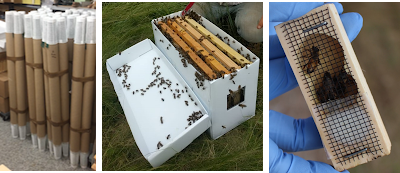
Figure 1. Three common ways to buy bees. From left to right: honey bee packages (source: countryfields.ca), nucleus colony, caged queen.

If you are not anxious to have new bees immediately at the start of spring, buying local nucleus colonies (nucs) and queens is a great way to support the Atlantic beekeeping industry. There are suppliers of local nucs and queens throughout the Atlantic provinces who typically sell between May and July. Provincial beekeeping association websites can be a valuable resource in connecting with reputable providers. Once again, it is recommended that orders be placed early because lists are typically first come, first served and supplies are limited. This is especially true for beekeepers in Newfoundland and Labrador, where honey bee importation is exceptionally restricted!

For new beekeepers, nucs are a great way to get started because they already contain the necessary building blocks for starting a new colony- bees and drawn comb! There are some considerations to keep in mind when buying a nucleus colony. A nuc should include a mated queen, frames with drawn comb and food stores, and bees of all life stages. Typically, there are 3-5 frames holding a combination of these resources. For more information on nucs, explore the new ATTTA factsheet “What is a Nucleus Colony: Information for New Beekeepers!


Bixby, M., M.M. Guarna, S.E. Hoover, and S.F. Pernal. 2019. Canadian Honey Bee Queen Breeders’ Reference Guide. Canadian Association of Professional Apiculturists Publication 55 pp. 

H. Julie, J. Hattendorf, A. Aebi, et al., Compliance with recommended Varroa destructor treatment regimens improves the survival of honey bee colonies over winter, Research in Veterinary Science (2021), https://doi.org/10.1016/ j.rvsc.2021.12.025


Pollinator Education New Video Release! Assessing Hive Strength: Counting Flying Bees Returning to the Hive

Check out our latest video on ATTTA's YouTube Channel about assessing hive strength. This video discusses how to assess hive strength by counting flying bees returning to the hive and the pros and cons of using this method. Watch HERE to learn more!


Connecting with ATTTA Specialists


If you’d like to connect with ATTTA specialists or learn more about our program, you can: