Showing posts with label pollination services. Show all posts

Summary of ATTTA Summer Field Work 2025

Thursday, 18 September 2025

The Atlantic Tech Transfer Team for Apiculture has been busy this past summer conducting research in apiaries, wild blueberry fields and within our own lab facilities. This past season our team consisted of Dr. Andrew Byers (senior apiculturist and program lead), Kayla Gaudet (full-time apiculturist), and 3 seasonal apiculturist (John MacDonald, Greg Dugas and Kaitlyn Newton). Our projects have largely focused on supporting the pollination industry and on honey bee health. Read this week’s blog for a brief summary of our main projects from summer 2025. We will be providing more in-depth reports on various projects throughout the coming months.

Summary of ATTTA Summer Field Work 2025

ATTTA Regional Varroa Mite Survey

For the second season, ATTTA is conducting a regional varroa mite survey to assess temporal trends in mite levels and to assess the efficacy of amitraz (active ingredient in Apivar® - a synthetic miticide). The year the survey consisted of 23 beekeepers (9 in Nova Scotia, 7 in New Brunswick and 7 on Prince Edward Island). Our team aims to include as many commercial beekeepers representing the 3 Maritime provinces as possible, and we often reach out to more beekeepers than reflected by those who are able to participate. These beekeepers represent a significant portion of Maritime beekeeping operations, and are all commercial beekeepers who provide pollination services.

Mature female varroa mite (Varroa destructor) under a microscope (40x magnification).

The survey is intended to broadly sample across the Maritime region. Those who participate have been asked to provide ATTTA with 3 to 6 samples of approximately 300 honey bees 3 times throughout this beekeeping season (prior to pollination, after pollination and late season). The survey has several main goals, including determine Varroa mite levels across the region at three important time points during the current season; collect Varroa mites for miticide efficacy testing; establish temporal measurements for annual comparison of Varroa burden for the Maritime region; and create a stored bank of samples for possible future testing. We will be reporting on the results of ATTTA’s varroa mite survey in the coming weeks.

Pollination Efficiencies for Wild Blueberry Production

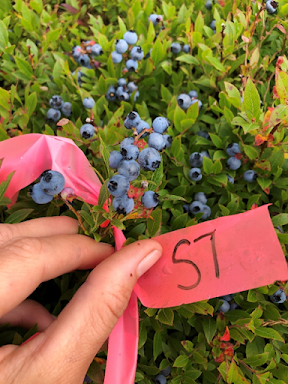
ATTTA has a continued goal of supporting the wild blueberry pollination industry. This year ATTTA had a couple of continued projects that focused on assessing wild blueberry bloom, and the requirements of pollination units. The first project involved assessing wild blueberry bloom during the months of May and June. The aim of this project is the creation of a growing degree day bloom model, using local weather stations, to better predict the timing for placement of pollination units. This improved model will also include the endodormancy and ecodormancy requirements of the wild blueberry plant to establish a starting point for GDD modeling.  This was the third and final year of data collection for this collaborative project with Dalhousie University and ATTTA.  

ATTTA seasonal apiculturist, John MacDonald, conducting bloom counts in wild blueberry field.

The second project involved assessments of sprout year fields. The goal of the project is to assess how early in the year floral and leaf buds can be distinguished, and how early accurate bud counts can be achieved. This will help to determine the crop year floral density as a predictor of pollination requirements. The hope is to support blueberry producers and beekeepers through a better understanding of bloom as one component of a predictive model determining the demand for pollination services. 

Queen Production and Training

Last summer the ATTTA team started to resume producing queens for research purposes. For the past two summers our team has focused on building up colony numbers, as any queen producer knows it takes an abundance of bees and resources to raise queens. Following the return of bees from wild blueberry pollination in late June, the team did several rounds of grafting queens using the cloake board method (see previous blog “Cloake Board Method” published on August 29, 2024) and produced a number of mated queens to use within their own operation. The goal for next year will be to continue to grow colony numbers in order to support enough queen production to create a queen bank. The idea of mass banking queens through the winter in a queen bank is a high-interest topic among beekeepers in the Maritimes, and is key component to supporting early season local queens.

ATTTA 2025 mated queen.

In addition to ATTTA’s own steps towards queen production, the team organized and hosted queen production training, taught by guest instructor Alison Van Alten, to help support a sustainable queen production industry within the Maritime region. There was a total of 12 students who successfully completed this training. Feedback from those who participated in the course has been consistently and highly positive.

Bumble Bee Captive Breeding and Overwintering

The final project to discuss is ATTTA’s work involving captive breeding, housing and overwintering Bombus impatiens. As a continuation from last year’s trials, the ATTTA team captively bred Bombus impatiens queens on a weekly basis throughout July and August. After mating, queens were cared for daily in ATTTA’s indoor facility. Each queen was kept in a temperature-controlled environment and fed both pollen and sugar water. The team also exposed each queen to the needed conditions to stimulate her to start producing brood. These conditions included a small amount of carbon dioxide exposure and a low temperature environment for a period of time. The intention of the project is to now manage these queens into the winter months. Overall, this project allows the team to gain a deeper insight into these important pollinators and to better support producers relying on insect pollination.

Bombus impatiens (common eastern bumble bee) on pollen

Continue reading our blog on a weekly basis as we report on the results of the various projects for 2025!

Connecting with ATTTA Specialists

If you’d like to connect with ATTTA specialists or learn more about our program, you can:

visit our website at https://www.perennia.ca/portfolio-items/honey-bees/

Email attta@perennia.ca

Report on Meetings with PEI Beekeepers and PEI Wild Blueberry Growers’ Association Information Day

Thursday, 23 January 2025

The Atlantic Tech Transfer Team for Apiculture has recently organized/attended a couple of industry events on Prince Edward Island. Last Friday, January 17th, the team held a drop-in clinic for PEI beekeepers and other interested industry representatives/partners, which provided an opportunity for PEI beekeepers to discuss a range of important topics with our team. Then, on January 22nd, ATTTA attended the PEI Wild Blueberry Growers’ Association information day, which provided a series of industry updates regarding the wild blueberry industry. To learn more about these industry events read this week’s blog.

Report on Meetings with PEI Beekeepers and PEI Wild Blueberry Growers’ Association Information Day

The ATTTA team recently held a drop-in clinic for PEI beekeepers at the Charlottetown Library Learning Centre. The clinic took place on January 17th, and it provided an opportunity for PEI beekeepers to come meet with ATTTA, ask our team questions about Maritime beekeeping, discuss future learning and research opportunities, and to learn more about the ATTTA program including upcoming training/research the team is providing for the industry. A wide range of important discussions took place between ATTTA, the PEI provincial apiarist, and the group of PEI beekeepers who stopped by the clinic. The group covered topics such as winter protection of hives, beekeeping equipment availability in PEI, Maritime queen production, overwintering colonies, climate impacts to beekeeping, pollination supply/demand, 2024 honey production, protecting pollinators from agri-chemicals and upcoming industry events. We would like to thank all beekeepers and industry representatives who participated in this event.

On January 22nd, ATTTA attended the PEI Wild Blueberry Growers’ Association (PEIWBGA) information day in Charlottetown, PE. The event was well attended by association members and industry representatives, with over 50 in-person attendees. The event started with a welcome from the association president, Benny Nabuurs. Following that, the provincial apiarist, Cameron Menzies, provided an extension report on the wild blueberry industry. The 2024 wild blueberry yield was slightly below average at 20.5M lbs. harvested across the island, with a 5-year average of 21.3M lbs. In 2024, there was 6250 acres harvested in PEI, with an average harvest of 2880 lbs. of wild blueberries per acre. There was an estimated 9800 hives used for pollination services on PEI this past season (both PEI colonies and Canadian imported colonies), which provided an average stocking density of 1.5 hives per acre. The average hive rental price on the island was $226 this past season, which is comparable to 2023 ($225).

PEI provincial apiarist, Cameron Menzies, presenting at the PEI Wild Blueberry Growers’ Association information day in Charlottetown, PE (2025).

Menzies discussed various contributing factors to what makes a good or bad year for wild blueberry production, including crop protection during the winter months (snow cover), investment in land clearing, pollination supply, pollination weather, and the amount of mature wild blueberry fields. Overall, 2024 was a good year for pollination. However, the industry did experience inconsistent yields across the province. Weather may be a significant contributing factor to the below average yield in 2024. This is partly due to weather experienced during the 2023 growing season, which included record high temperatures during the month of July, and above average precipitation throughout the 2023 growing season. Research indicates that extended periods of high temperatures (air temperature is greater than 25C and leaf temperature is greater than 28C) can impact wild blueberry plant development. Increased amounts of rainfall lead to increased disease pressure, and disrupts plant phenology and development (delayed tip dieback and lack of fruit bud set). The mentioned weather conditions can impact sprout year fields, which directly affects the following year’s crop. Additionally, during the winter of 2023/2024 the amount of snow cover to protect wild blueberries was below average, which could have caused damage to plants and impacted the 2024 crop.

Menzies also discussed pest monitoring occurring on the island, including blueberry maggot, spotted wing drosophila, and cranberry fruit worm. Finally, the presentation concluded with a summary of various funding programs available to PEI growers, including the Agriculture Resiliency program, Alternative Land Use Services (ALUS) program, Agriculture Stewardship program, and the Pollination Expansion sub-program.

Next, Ahmad Khan (Nova Scotia Department of Agriculture) discussed the PEI wild blueberry cost of production study. The study has incorporated both variable and fixed costs associated with wild blueberry production, and can be used to determine the cost of production for low to high yielding fields. The model developed from this study is expected to be available to PEI growers at some point during 2025.

Gilbert Lavoie (Forest Lavoie Conseil) provided a wild blueberry market report. Wild blueberry production was below average in 2024 for North America (286M lbs. versus 301M lbs. ten-year average). Wild blueberry inventories are down in 2024 and are decreasing at a good pace. Lavoie also highlighted current importing and exporting quantities of wild blueberries between the United States and Canada. In 2024, Canada exported 23M lbs. of frozen product to the US, and an additional 11M lbs. of fresh product to US processing plans. In comparison, the US exported 13M. lbs. of frozen product to Canada, and an additional 20M lbs. of fresh product to Canadian processing plans.

Next, the team from Stiletto (Jenna Evans, Cailee Mousek, and Rosalynd Mitchell) presented on their PEI wild blueberry industry economic impact study. The full report will be provided to the PEIWBGA, and it will include a summary of various direct impacts to the industry (ex. on farm jobs), indirect impacts (ex. jobs in wild blueberry supply chain), induced impacts (ex. distribution of worker income), spin-off impacts (ex. events/activities outside of production and processing), and future impacts. The Stiletto team also had attendees participate in an activity where they were asked to identify the biggest challenges and opportunities of the wild blueberry industry.

The final presentation of the day was from Rob Dover (Fresh Media) who discussed the PEI wild blueberry brand awareness plan. Dover explained how PEI wild blueberries can better promote their product, including the development of a brand, the use of social media, promoting value added products, partnerships with other associations and reputable health organizations, community involvement and signature wild blueberry events.

Thank you to all members of PEIWBGA who helped organize this great event. Also, thank you to all those who work to support the wild blueberry industry of PEI.

Connecting with ATTTA Specialists

If you’d like to connect with ATTTA specialists or learn more about our program, you can:

visit our website at https://www.perennia.ca/portfolio-items/honey-bees/

Email attta@perennia.ca

What Beekeepers Should Consider about Electric Fencing

Thursday, 4 April 2024

In Atlantic Canada, there are multiple pests that threaten the safety of honey bee colonies. One major pest that beekeepers often stress about is bears, which will destroy equipment and eat honey and bees. An electric fence around an apiary is the most effective way to prevent a bear attack. Read this week’s blog to learn some key considerations for electric fencing.

What Beekeepers Should Consider about Electric Fencing

Bears present a significant threat to honey bee colonies across Atlantic Canada, with the exception of Prince Edward Island, which lacks a bear population. To safeguard apiaries from bear attacks, beekeepers often rely on electric fencing as a primary defense measure.

Ensuring the effectiveness of an electric fence requires proper installation and regular maintenance. Adequate grounding is crucial, particularly in environments like blueberry fields where the soil is typically sandy. To function properly, the ground must contain sufficient moisture to conduct electricity. Grounding rods should be buried at least 3 feet deep to ensure optimal performance. Otherwise, during drought conditions, beekeepers might need to moisten the area around the electric fencing to sustain conductivity.

ATTTA©2022

Unlike humans, bears are not instinctively aware of the danger posed by electric fences. Therefore, it is essential to bait new fences to train bears to avoid them. Baiting methods such as bacon strips or cans of tuna attached to wires can effectively teach bears to steer clear of the charged fence.

Another key consideration is that when hives are rented for pollination, the grower and the beekeeper need to determine who is to be responsible for installing and maintaining the fence. Addressing colony protection in pollination contracts ensures that both parties are aware of their obligations.

For new beekeepers, there is a cost-benefit analysis that should be considered before purchasing an electric fence. A new beekeeper should weigh both the cost of installing an electric fence and the current value of their colonies. If the cost of purchasing a fence is significantly higher than the value of their colonies, it may not make economic sense to invest in a fence. However, if the beekeeper anticipates expanding their operation in the near future, then buying a fence is likely a good investment. Conversely, if a beekeeper's colonies are valued higher than the cost of a fence, it would be unwise to put their operation at risk by not protecting their colonies, especially in an area with a high bear population.

Finally, when selecting a charger for an electric fence, it is essential to consider various options. The key factor to prioritize is the power output of the charger. For optimal bear deterrence, the charger should output a minimum of 1 joule. Other factors come into play when choosing a charger. Solar-powered chargers, while more expensive, require less frequent checks. On the other hand, battery-powered chargers are more budget-friendly, but it is essential for beekeepers or growers to ensure that the batteries are consistently fully charged. Opting for a 12-volt (2 joules stored) solar-powered charger is advisable, as it maintains a reliable charge and delivers sufficient shock to discourage bears from returning. Alternatively, a 9-volt (less than 1 joule stored) D cell battery-powered charger is a common choice, but it may not provide the necessary shock to deter bears, and the batteries need regular replacement. A third option is a fencer that can be plugged into a home power grid. This option is only possible if the apiary is located near a home or farm building to which the beekeeper has power access. Finally, a good fence tester is a helpful tool to determine the fence is working properly during each apiary visit.

For more information about electric fencing please reach out to ATTTA.


Connecting with ATTTA Specialists

If you’d like to connect with ATTTA specialists or learn more about our program, you can:

visit our website at https://www.perennia.ca/portfolio-items/honey-bees/

Email abyers@perennia.ca


Optimal Timing of Hive Placement for Wild Blueberry Pollination

Thursday, 23 February 2023

There is a high demand for pollinating honey bee units on wild blueberry fields in Atlantic Canada. Aside from increasing colony numbers, the industry can meet this demand by optimizing the use of existing honey bee units for maximum efficiency during the wild blueberry bloom period. ATTTA field research has been focused on this objective during our last five years of summer field work. One important management decision in regard to pollination services is when to deploy hives for pollination. In this blog, we will discuss our research findings and our suggestion on optimal timing of hive placement.

Optimal Timing of Hive Placement for Wild Blueberry Pollination

Longstanding, conventional practice is to place honey bees for pollination on blueberry fields when bloom reaches 10-20% open flowers. The stocking density recommendation is up to three hives per acre. Hive rotation and sequential loading during blueberry bloom are currently being practiced by a limited number of producers in our region. Sequential loading involves increasing and decreasing stocking densities of honey bee colonies to reflect changes during the bloom period. As the percent of open flowers on a field increase, the theoretical requirement for pollination will increase.  The desired result of this practice is to achieve optimal pollination through enhanced efficiency in the use of honey bee colonies. 

In the 2022 field season, ATTTA studied the impacts of hive placement on pollination success. Using a limited number of trial fields across the Maritime region, we found that deploying hives during early bloom has significantly positive impact on pollination success, measured by fruit set. Figure 1 below demonstrates this impact, where the percent of successful fruit set decreases as the percent bloom at time of hive placement increases. 

Figure 1. Linear relationship between fruit set and percent bloom at time of pollination. Red line indicates negative relationship, grey shading indicates the area between the error lines.

Foraging behaviour of honey bees on wild blueberries is little understood. However, it has been long suggested that honey bees placed on blueberry fields too early in the bloom period may habituate to other floral sources, abandoning the yet unopened blueberry flowers. There are complexities about honey bee behaviour (Abou-Shaara 2014) which indicates that previous thinking about the determent of early placement on honey bees is outweighed by the loss of production when pollination begins late, after 10-20% bloom. ATTTA field work results suggest that after 50% bloom the opportunity for optimized pollination and subsequent fruit set may be significantly lowered. The impact on yield of delayed pollination, and therefore income for the producer, may be significant. 

Another striking result of our field work from 2021-2022 shows a trend of honey bee hives are being placed on fields late into the bloom period. Figure 2 below shows that the average percent bloom when honey bees are place for pollination is 47.12%! This does not support effective pollination, and we urge producers to assess their fields for percent bloom in the upcoming season to determine, more precisely, the optimal time for placement of bees. 

Figure 2. Percent bloom assessed within 24 hours of hives being placed on blueberry fields (n=18) in the 2021-2022 seasons. Whiskers = standard deviation.

Percent bloom can be assessed by counting open and closed flowers on a select stem and applying the following formula. 

% bloom = (open flowers / all flowers) x 100

It is best to count several stems and take the average % bloom for a broader field representation. UMaine Cooperative Extension has further information on how to assess individual wild blueberry fields for pollination requirements

Best practice for optimal and efficient hive use may be to place bees at a lower stocking density as blossom is opening, from 1-10% bloom, and increase hives to full stocking density at 25% bloom. It seems that the detriment of possibly placing hives too late in the bloom period outweighs those of placing hives too early. Better too early than too late!

References
Abou-Shaara, H.F. 2014. “The Foraging Behaviour of Honey Bees, Apis Mellifera: A Review.” Veterinární Medicína 59 (1): 1–10. https://doi.org/10.17221/7240-VETMED.


Connecting with ATTTA Specialists


If you’d like to connect with ATTTA specialists or learn more about our program, you can:


ATTTA Summer Update

Thursday, 18 August 2022

It is that time of year! The beekeeping season is buzzing along, and the Atlantic Tech Transfer Team for Apiculture has been seizing every moment! For our field work, we are largely focused on three projects which span across the Maritime provinces. Read on for a glimpse into our major projects this summer and how they are progressing.

ATTTA Summer Update

Optimizing Wild Blueberry Pollination

This year, 2022, marks the final year of ATTTA’s five-year study regarding the optimization of wild blueberry pollination by honey bees. This season, we have eight research plots in wild blueberry fields in Nova Scotia, New Brunswick, and Prince Edward Island. We first visited these fields in May and early June, when honey bee hives were placed for pollination. At this time, we assessed the hives for strength and assessed the percent bloom on the fields. After the hives had been removed and pollinated flowers were beginning to develop into berries, we returned to the fields to assess what percent of flowers were successfully pollinated and appeared as unripe, green fruit set. Now, we are in the midst of returning to each field a final time to assess the percentage of ripe berries that are developed and ready for harvest! We also assess these berries in the lab for weight and seed count.


Wild blueberry stem marked for plant assessments (ATTTA©2022).

The aim of the research is to evaluate the effect of moving hives during pollination on blueberry fruit set and determining the optimal timing of placing honey bee for wild blueberry pollination.


Efficacy of Apivar® and Api Life Var® against Varroa destructor in eastern Canada

This summer, we are travelling through the Maritimes, collecting honey bee samples, in order to test the efficacy of Apivar® and Api Life Var® on Varroa mites. Starting at the end of July, we visited nine apiaries to collect samples of honey bees and their associated varroa mites for miticide testing. We brought the samples to our lab, treated the bees, and assessed the varroa populations effected by the treatments. This week, we began our second round of assessments, in which we return to the same apiaries for another collection of bees and mites to sample for treatment.

The aim of this project is to assess the efficacy of Apivar® (amitraz) against Varroa destructor in honey bee colonies in NB, NS, and PE; determine the efficacy of Api Life Var® against Varroa destructor in honey bee colonies in NB, NS, and PE.

Overwintering Queen Bank Trial

As a second year of pilot work, our overwintering queen bank trial has received additional funding and supported from Nova Scotia Beekeepers Association. We are working towards overwintering two hives with multiple queens banked within. In preparation for this, we completed two rounds of queen rearing at the end of June and early July. We are also growing strong colonies to eventually transform into our queen banks in the fall. In the spring, we will see how many queens survived the winter in the banks and measure the viability of those overwintered queens.


Worker bees on drawn out queen cups (ATTTA©2022).

The aim of this project is to determine the feasibility of mass queen overwintering outdoors in the Maritime region by evaluating the success of two different queen bank configurations.

Throughout the fall and winter, we will be able to assess the data that we collect in our summer field work. We look forward to sharing our findings at various honey bee and wild blueberry association meetings as well as here in our blog.

Connecting with ATTTA Specialists


If you’d like to connect with ATTTA specialists or learn more about our program, you can:


Hive Placement for Wild Blueberry Pollination

Thursday, 14 April 2022

This week, we will continue our discussion of wild blueberry pollination using honey bees. After stocking density, another consideration for wild blueberry producers is hive placement. It is important to have hives placed in an accessible location for beekeepers, and beyond that there are questions of spacing for maximum pollination. Today we will discuss hive placement on wild blueberry fields for optimal pollination services.

Hive Placement for Wild Blueberry Pollination

ATTTA began research in the 2021 field season to measure the distance that honey bees will successfully pollinate blueberry blooms in proximity to their hive. Our assessment included five points, the first of which was in the blueberry field near the recently placed hives.  From this point we continued across the field in a “W” shaped pattern to cover approximately +150m across the breadth of the field. At each of five field locations, we assessed 200 blueberry stems to establish the percent fruit set, percent of harvestable berries, and the berry weight over the course of three visits. 

In the ten fields we visited in both Nova Scotia and New Brunswick, we found no statistically significant difference in percent fruit set, harvestable berries, nor berry weight based on the distance of the sample location from the hives. This suggests that at a minimum of 150m from their hives, honey bees will evenly pollinate all blooms. Given these results, wild blueberry flowers should be consistently pollinated across a field if hives are placed in 300m increments.

Figure 1. Sampling sites (A – E) in the trial fields (n = 10) for three plant assessments. A) Fruit set as percent of bloom at all five field sampling sites. B) Fruit at harvest as a percent of blossom for all five field sampling sites. C) Final berry weight in grams just prior to harvest at all five There was no significant difference (p > 0.05) seen between any of the site locations across the three plant assessments.

Published research papers have also demonstrated that distance is not a limiting factor in successful honey bee pollination on wild blueberry fields, within the range of study. A simulation comparing the pollination services of honey bees, bumble bees, and solitary bees on fields in Maine demonstrated that unlike bumble bees and solitary bees, the distance of a honey bee hive from blueberry blooms did not significantly effect fruit set (Qu and Drummond 2018). In the simulation, bumble bee and solitary bee populations both showed reduced pollination activity, measured by fruit set, as the insects had to travel further from their hives and nests to pollinate clones. Honey bee foraging behavior is thought to play a role in this observation. When a foraging honey bee finds a source of nectar or pollen, she will return to the hive to tell other foragers about this source. In what is called the waggle dance, individual bees are able to provide other foragers with directions to this desirable location. As such, far away forage can be revisited multiple times and a honey bee colony can efficiently explore a large area (Tereshko and Loengarov 2005)

Given that our results did not reach a limit of successful pollination, it is possible that honey bees will pollinate wild blueberry blooms beyond 150m from the hive. They can certainly be found at greater distances from their hives. An early study of honey bee pollination on wild blueberry fields in Quebec found that honey bee densities in a field did not begin to significantly drop until the hives were beyond 3km from the location in question (Aras, De Oliveira, and Savoie 1996). Before this point, honey bee density was measured to be well over 10 per 2m2

The results of our research and relevant publications suggests that honey bees are steady pollinators in wild blueberry fields. Our results reflect that hive placement every 300 meters should provide consistent pollination throughout a field. Stay tuned for more as we carry on with our pollination series in a discussion of hive strength for pollination in a subsequent blog.


Aras, Philippe, Domingos De Oliveira, and Lorraine Savoie. 1996. “Effect of a Honey Bee (Hymenoptera: Apidae) Gradient on the Pollination and Yield of Lowbush Blueberry.” Journal of Economic Entomology 89 (5): 1080–83. https://doi.org/10.1093/jee/89.5.1080.

Qu, Hongchun, and Frank Drummond. 2018. “Simulation-Based Modeling of Wild Blueberry Pollination.” Computers and Electronics in Agriculture 144 (January): 94–101. https://doi.org/10.1016/j.compag.2017.11.003.

Tereshko, Valery, and Andreas Loengarov. 2005. “Collective Decision-Making in Honey Bee Foraging Dynamics,” 8.


Connecting with ATTTA Specialists


If you’d like to connect with ATTTA specialists or learn more about our program, you can:


Pollination Services

Thursday, 27 January 2022

In 2020, wild blueberries were Canada’s greatest fruit export with an export value of $312 million (Agriculture and Agri-Food Canada 2021)! This was the result of 71,290 metric tons of wild blueberries, of which the Maritime provinces produced 52% and Quebec 48%. Wild blueberries are an economically valuable crop for the Maritimes and are closely linked to the honey bee industry because blueberry flowers rely on insects for pollination. As such, beekeepers and wild blueberry producers are key partners in eastern Canada. The season for pollination may seem far away, but now is a good time to start organizing pollination services! 

Pollination Services

Regionally, the demand for pollination by honeybees is greater than 50,000 colonies and projected to increase. This represents over $8 million per year in income to Atlantic beekeepers. If you are a beekeeper not already engaged in pollination, consider diversifying your operation through pollination services. Sending bees to blueberry fields is hard work, but it is an important service made easier through thoughtful planning. 

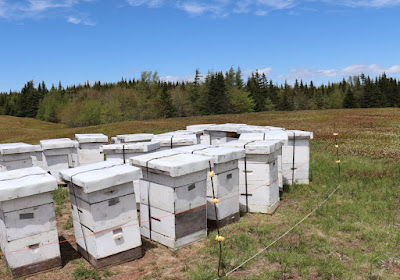
Always a valuable resource, Atlantic provincial beekeeping associations can help beekeepers and blueberry producers connect to establish a pollination partnership. Essentially, beekeepers transport their hives to blueberry fields by night when the fields are ready for pollination, around late May or early June. Hives remain on the fields for the duration of bloom and then are retrieved by the beekeeper. Producers typically pay per hive and there is no minimum number of hives that you need to get started! When you do begin, it is a good practice for beekeepers and blueberry producers to agree upon a contract prior to pollination season. Some aspects to consider are the number of colonies required, timing of hive placement and removal, who will be responsible for bear fencing, location for access, and details concerning agrochemical use. The Nova Scotia Beekeepers Association has a sample pollination contract which can be a good place to start.

Another critical point of the contract is establishing a hive strength standard. Optimal hive strength for pollination is a subject which is important to the industry and has not been wholly agreed upon. The NS Beekeepers Association and NB Beekeeper’s Association both offer slightly different provincial minimum hive strength standards for pollination and the Canadian Association of Professional Apiculturists (CAPA) presents yet another. To get to the bottom of this, ATTTA is currently researching hive strength for wild blueberry pollination so that we might be able to establish a uniform hive strength standard and means of assessment across Atlantic Canada for optimal wild blueberry pollination. For more information on measuring hive strength, watch our video on the ATTTA YouTube Channel entitled Bees and Blueberries in Atlantic Canada – the Hive Strength Standard

Hive strength can be measured in multiple ways. Elements of the hive which are often quantified are number of bees, amount of brood, and hive bodies. The trickiest of these to measure is the number of bees within a given hive. Common methods of estimating the population of a honey bee colony are counting full frames of bees, seams of bees, or flying bees. 

ATTTA collected data from blueberry fields in NB and NS this past summer to evaluate these methods as they relate to pollination success. Our latest video in our Pollination Education series discusses the reliability of counting flying bees returning to the hive as a means of measuring hive strength. Our findings suggest that this is not a reliable method of measuring hive strength in Atlantic Canada, and that cool ambient air temperature skews the results of this method further. For a more detailed account of these results watch the video Assessing Hive Strength: Counting Flying Bees Returning to the Hive

Stay tuned for more results about optimal hive strength for blueberry pollination and, if you aren’t engaged already, consider adding pollination services to your beekeeping repertoire!


A Guide for Managing Bees for Crop Pollination (1999) Canadian Association of Professional Apiculturists.

Evaluating the Strength of Honey Bee Hives for Wild Blueberry Pollination. New Brunswick Agriculture Aquaculture and Fisheries, Wild Blueberry Factsheet B.4.0.

Honey Bees and Blueberry Pollination, Fact Sheet No. 629, UMaine Extension No. 2079. 2002. 

Statistical Overview of the Canadian Fruit Industry 2020. Agriculture and Agri-Food Canada. June 2021. 


Connecting with ATTTA Specialists


If you’d like to connect with ATTTA specialists or learn more about our program, you can: