Showing posts with label blueberry field. Show all posts

Black Bear Field Safety

Thursday, 20 June 2024

The focus of this blog is for individuals working in high-risk environments such as  blueberry fields or apiaries. When out in the field, one thing to keep in mind is to watch out for Bears! Black Bears can be found in many areas, and being prepared for an encounter is crucial for field safety. Black bears (Ursus americanus), are the only bear species in Atlantic Canada. The focus on this blog will be understanding bear behavior.

Black Bear Field Safety

Understanding bear body language is vital for staying safe in their presence. Some key behaviors to watch for are listed below.


Standing on Hind Legs: When a bear stands on its hind legs it is usually curious and trying to get a better view or taking a smell of its surroundings. This is not an necessarily an aggressive posture but a way for the bear to better understand it’s surroundings.


Blowing and Snorting: Bears often blow air forcefully through their nostrils or make snorting sounds when they are agitated or want to communicate their discomfort. This can be a warning sign to back off and give it more space. 


Huffing: Low huffing noises are another indication that the bear is nervous or feels threatened. It may also pop its jaws or clack its teeth together. These are clear signs that the bear is uncomfortable with your presence. 


Yawning and Salivating: Excessive yawning, salivating, or drooling can indicate stress. A bear displaying these behaviors may be feeling cornered or threatened. 


Paw Swatting: When a bear slaps the ground or swats with its paws, it is signaling that it is ready to defend itself. This is a more aggressive posture, indicating that the bear wants you to leave. Best thing to do is leave the area while keeping an eye on the bear.


Ears Laid Back: If a bear’s ears are laid back against its head, it is showing signs of aggression. This, coupled with growling or other aggressive vocalizations, means the bear is extremely uncomfortable and potentially ready to charge. 


Bluff Charging: Bears might move side to side or make short, false charges toward you. Bluff charges are meant to intimidate and scare you off rather than result in a physical attack. For this stand your ground make yourself bigger and prepare your bear spray, but do not run. 


Full Charge: In rare cases, a bear may commit to a full charge. This can be extremely dangerous. If you have bear spray this is when you would consider using it.


Understanding these behaviors can help you make the best decisions in the case of an incident, so you know when you are in danger or when a bear is simply just curious. There are other ways to mitigate the risks from a bear attack


Black bears in the woods © Parks Canada / Lynn and Donna Rogers


When working in the field, taking steps to minimize the risk of a bear encounters is key. Begin by avoid snacking and eating in the field. If you must eat, do it in your vehicle and when done make sure all the food scraps are stored away inside your vehicle to avoid lingering smells. Carry a bear alarm and bear spray, this equipment might just save your life. A bear alarm is the first step when encountering a bear and bear spray is a last resort but what is bear spray? Bear spray is a more potent form of pepper spray designed specifically to deter aggressive bears. It contains capsaicin, which is the active component in chili peppers, which can cause temporary blindness, difficulty breathing, and discomfort. To avoid scaring bears when working out in the field do not stay quiet. Make noise by talking loudly or clapping your hands.

Understanding black bear behavior and taking preventative measures can reduce the risk of an encounter and increase the chance of a positive outcome if you run into one in the wild. When working in the field always remember to keep an eye out for bears and carry a bear alarm, bear spray and never work alone.

Written by Gregory Dugas, ATTTA Seasonal Apiculturist

References

Parks Canada. (n.d.). Ours noir (black bear). Retrieved June 19, 2024, from https://parks.canada.ca/docs/v-g/oursnoir-blackbear/page4 

Boonman-Berson, S., Turnhout, E., & Carolan, M. (2016). Common sensing: Human-black bear cohabitation practices in Colorado. Geoforum, 74Common sensing: Human-black bear cohabitation practices in Colorado - ScienceDirect

 Parks Canada. (n.d.). Ours noir (black bear). Retrieved June 19, 2024, from https://parks.canada.ca/docs/v-g/oursnoir-blackbear/page2

Get Bear Smart Society. (n.d.). Dispelling myths about bears. BearSmart.com. Retrieved June 19, 2024, from https://www.bearsmart.com/about-bears/dispelling-myths/

Western Wildlife Outreach. (n.d.). Black bear biology & behavior. Western Wildlife Outreach. Retrieved June 19, 2024, from https://westernwildlife.org/black-bear-ursus-americanus/biology-behavior-3/ 


Connecting with ATTTA Specialists

If you’d like to connect with ATTTA specialists or learn more about our program, you can:

visit our website at https://www.perennia.ca/portfolio-items/honey-bees/

Email abyers@perennia.ca
ATTTA Summer Update

Thursday, 18 August 2022

It is that time of year! The beekeeping season is buzzing along, and the Atlantic Tech Transfer Team for Apiculture has been seizing every moment! For our field work, we are largely focused on three projects which span across the Maritime provinces. Read on for a glimpse into our major projects this summer and how they are progressing.

ATTTA Summer Update

Optimizing Wild Blueberry Pollination

This year, 2022, marks the final year of ATTTA’s five-year study regarding the optimization of wild blueberry pollination by honey bees. This season, we have eight research plots in wild blueberry fields in Nova Scotia, New Brunswick, and Prince Edward Island. We first visited these fields in May and early June, when honey bee hives were placed for pollination. At this time, we assessed the hives for strength and assessed the percent bloom on the fields. After the hives had been removed and pollinated flowers were beginning to develop into berries, we returned to the fields to assess what percent of flowers were successfully pollinated and appeared as unripe, green fruit set. Now, we are in the midst of returning to each field a final time to assess the percentage of ripe berries that are developed and ready for harvest! We also assess these berries in the lab for weight and seed count.


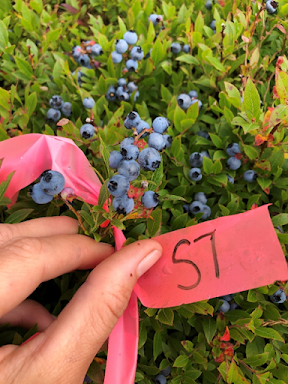
Wild blueberry stem marked for plant assessments (ATTTA©2022).

The aim of the research is to evaluate the effect of moving hives during pollination on blueberry fruit set and determining the optimal timing of placing honey bee for wild blueberry pollination.


Efficacy of Apivar® and Api Life Var® against Varroa destructor in eastern Canada

This summer, we are travelling through the Maritimes, collecting honey bee samples, in order to test the efficacy of Apivar® and Api Life Var® on Varroa mites. Starting at the end of July, we visited nine apiaries to collect samples of honey bees and their associated varroa mites for miticide testing. We brought the samples to our lab, treated the bees, and assessed the varroa populations effected by the treatments. This week, we began our second round of assessments, in which we return to the same apiaries for another collection of bees and mites to sample for treatment.

The aim of this project is to assess the efficacy of Apivar® (amitraz) against Varroa destructor in honey bee colonies in NB, NS, and PE; determine the efficacy of Api Life Var® against Varroa destructor in honey bee colonies in NB, NS, and PE.

Overwintering Queen Bank Trial

As a second year of pilot work, our overwintering queen bank trial has received additional funding and supported from Nova Scotia Beekeepers Association. We are working towards overwintering two hives with multiple queens banked within. In preparation for this, we completed two rounds of queen rearing at the end of June and early July. We are also growing strong colonies to eventually transform into our queen banks in the fall. In the spring, we will see how many queens survived the winter in the banks and measure the viability of those overwintered queens.


Worker bees on drawn out queen cups (ATTTA©2022).

The aim of this project is to determine the feasibility of mass queen overwintering outdoors in the Maritime region by evaluating the success of two different queen bank configurations.

Throughout the fall and winter, we will be able to assess the data that we collect in our summer field work. We look forward to sharing our findings at various honey bee and wild blueberry association meetings as well as here in our blog.

Connecting with ATTTA Specialists


If you’d like to connect with ATTTA specialists or learn more about our program, you can:


Welcoming our Summer Students!

Thursday, 19 May 2022


This week we are excited to introduce two new members to the team! ATTTA welcomes John MacDonald and Rebecca Campbell, who will be assisting us this year with new and continued research projects. Read on as we introduce our new members as well as some of our plans for the summer, including research on Varroa mite treatment and honeybee pollination of wild blueberry fields. 

Welcoming our Summer Students!

John MacDonald

John currently lives in Pleasant Valley, Nova Scotia, and has completed four years of Dalhousie University’s Plant Science Degree program, with honors, and is working towards certificates in Organic Agriculture and Integrated Pest Management. John is currently working on his thesis project in collaboration with the ATTTA, and Dr. Chris Cutler in the entomology lab at Dalhousie to measure the efficacy of Apivar and ApiLife Var against Varroa mites in commercial beekeeping operations in the Maritime provinces.

Varroa mites are a major issue throughout Canada (excluding Newfoundland), exacerbating the spread of viruses and overwintering losses of honey bees. There is only one reliable chemical treatment, ApiVar, used to control this parasite in Canada, but there has been a rising concern brought to the attention of ATTTA and the Canadian Honey Council (CHC) from beekeepers across Canada that Varroa mites are becoming resistant to ApiVar.

 Alternative control methods for Varroa mites are needed to slow the development of mite resistance to the synthetic treatments. ApiLife Var is a formulation of essential oils, including eucalyptus oil, levomenthol, camphor, and thymol, that was licensed in Canada in 2020. Essential oils have more variability in efficacy than synthetic chemicals, due to environmental conditions, so it is important to test these products in our Maritime climate. To date, no research has been done.

With the cooperation of commercial beekeepers who provide honey bees for blueberry pollination in Nova Scotia, Prince Edward Island, and New Brunswick, John and rest of the team at ATTTA will carry out miticide efficacy testing during the 2022 beekeeping season. This will provide valuable information on Varroa populations that may be resistant to ApiVar and for use of ApiLife Var as an alternative control method.

 Rebecca Campbell

Rebecca is a new member of the team and will be joining us for this year’s wild blueberry and honeybee research. She is 22 and a fifth-year Dalhousie student studying Bio-veterinary Science and hoping to pursue a career in apiculture research. Four years ago, Rebecca moved to Nova Scotia from Ontario. She has been fortunate to meet many new friends and family here and has built a great life. After traveling up and down this province and seeing many beautiful things, she plans to stay in Nova Scotia and make it home.


Our new summer student, Rebecca Campbell.

Rebecca will assist in a continued pollination study, this year measuring the effects of sequential loading and hive rotation on the pollination success of wild blueberry fields. Blueberry farmers all over Atlantic Canada have generously agreed to collaborate with the Atlantic Tech Transfer Team of Apiculture, allowing us to observe over a dozen fields throughout New Brunswick, Nova Scotia, and Prince Edward Island. These fields will be visited multiple times this season to collect data on the growth of the wild blueberry crop regarding sequential loading methods. The overall goal of this trial is to optimize wild blueberry pollination and determine the most beneficial way for sequential loading. During this project, the effect of hive strength on pollination will be observed to gather comprehensive data on how the strength of a hive can affect the pollination of wild blueberry fields. Another project this season will observe honeybees’ nutritional state during wild blueberry pollination. This continued project will look closely at the pollen collected from select hives to determine the species of plants the pollen is being collected from.

By the end of this 2022 season, we will have collected data on multiple projects regarding the honeybee pollination of wild blueberry fields across the Atlantic provinces. This data will help us understand more beneficial methods and techniques for the apiculture and agriculture industries.  


Connecting with ATTTA Specialists


If you’d like to connect with ATTTA specialists or learn more about our program, you can: