Showing posts with label events. Show all posts

Review of the NSBA Technical Session in Parrsboro

Thursday, 2 July 2026

This week the Nova Scotia Beekeepers Association, along with ATTTA, hosted an afternoon beekeeping event in Parrsboro. Fourteen attendees joined the session, creating an engaged group with lots of discussion and questions! Events like these are so important, helping beekeepers learn from one another and connecting with people in similar areas. Field events give everyone a chance to ask questions, share experiences and see how others manage their own operations.

Review of the NSBA Technical Session in Parrsboro

This event started with introductions by Dr. Andrew Byers apart of the Atlantic Tech Transfer Team for Apiculture, followed by Zoshia Fraser, who represented the Nova Scotia Department of Agriculture. Jennifer and David Harrison then welcomed everyone and introduced themselves, sharing the history of their beekeeping operation, how they got started and the work they do today. We were grateful for them opening their operation and welcoming beekeepers into their apiary for the afternoon.

Figure 1: Attendees in Jennifer Harrison’s Apiary (ATTTA ©, 2026)

After introductions, everyone suited up and headed into the hives. Jennifer began by showing the tools and equipment she likes to keep on hand in her operation. She explained her record keeping system, based on the year colour of the queens, to mark her hives and label tasks that need to be done.  This highlighted the importance of implementing an efficient way to keep track of the hives in her apiary. She also demonstrated her queen marking tools, her Cloake board setup, and her grafting frames. One highlight was her mating nucs, which were a standard deep box divided into three sections, each with its own entrance. 

Figure 2: Jennifer Harrison showing equipment she uses in her operation (ATTTA ©, 2026)

The group then split into two, one group with Jennifer, where she walked through assessing hive strength. Students learned when to split based on resources in the hive and the strength of the colony. She shared examples from her own operation, giving attendees knowledge on how she manages colony growth. The second group joined Andrew, who demonstrated how to inspect a captured swarm. He explained what to look for, how to monitor for varroa, and how to test mite levels using both an alcohol wash and an ether roll. He also discussed what steps to take after catching a swarm to ensure the colony is healthy. 

Figure 3: Jennifer Harrison performing an alcohol wash (Left) and Dr. Andrew Byers conducting an ether roll (Right) (ATTTA ©, 2026)

The afternoon was filled with enthusiasm, questions and great conversation. With 14 participants, the event offered hands-on learning and important discussions. Thank you so much to the Nova Scotia Beekeepers Association for supporting such a valuable session. A special thank you as well to Jennifer and David Harrison for being such welcoming and generous hosts. Their willingness to share their operation made this event a success and highlighted the value of learning from others! 

 Written by Kaitlyn Newton, ATTTA Seasonal Apiculturist

Connecting with ATTTA Specialists

If you’d like to connect with ATTTA specialists or learn more about our program, you can:

visit our website at https://www.perennia.ca/portfolio-items/honey-bees/

Email attta@perennia.ca


Review of the 2026 WBPANS Field Day

Thursday, 25 June 2026

In the Maritimes, wild blueberry production depends on insect pollination and beekeepers play an important role in making that possible. Because honey bees are the main pollinator used in wild blueberry fields, the relationship between blueberry growers and beekeepers is very important to the industry’s success. Events like the WBPANS field day help strengthen that partnership and highlight important work happening in the industry.

Review of the 2026 WBPANS Field Day

June has been an eventful month for the Atlantic Tech Transfer Team for Apiculture! This week on Wednesday June 24th, ATTTA attended the Wild Blueberry Producers Association of Nova Scotia (WBPANS) annual field day in Onslow. This field day provided an opportunity for producers to engage with new products, industry updates, and advanced techniques all related to the wild blueberry industry.

The morning began with registration, followed by an overview of the day’s events. Attendees then travelled to a local producer’s blueberry fields, where, along with blueberry specialist Hugh Lyu (Perennia), the impact of last year’s drought was discussed. This also included a mention of the impacts on wild blueberry production of this spring’s colder than average weather. This set the tone for the group to tour the Wild Blueberry Research Institute, learning about ongoing research projects from Dr. David Percival (Dalhousie University). The morning taught producers and beekeepers more about the current struggles happening in the industry, research on wild blueberry production, and provided the chance to ask questions directly to industry experts.

Figure 1: Peter Swinkels, blueberry producer, (Left) and Hugh Lyu (Right) on a Wild Blueberry Field (ATTTA ©, 2026)

After returning to the main venue, River Breeze Farm, participants spent the rest of the morning viewing trade show exhibits, which featured equipment suppliers, agri-businesses and research groups.  This experience gave attendees the chance to connect directly with service providers and build up an appetite. Lunch was catered by Sizzlers BBQ, which included a delicious wild blueberry crumble for dessert.

Following lunch, opening remarks from the WBPANS president Andrew Dobson, were followed by greetings from The Honourable Greg Morrow, Minister of Agriculture. The Minister recognized both the importance and the challenges of the wild blueberry industry. The WBPANS executive director, Janette McDonald, provided updates on the WBPANS organization. Hugh Lyu delivered an industry overview, discussing struggles producers have faced over the last year, and indicated that there is an optimistic expectation for wild blueberries this year.  It was predicted, looking at the current situation, that the Nova Scotia crop yield may be 30-40 million pounds.

Figure 2: Andrew Dobson, President of the Wild Blueberry Producers Association of Nova Scotia  (ATTTA ©, 2026)

Following the speakers, attendees moved outdoors for field demonstrations, and equipment displays. ATTTA hosted a display which focused on how to set up an electric fence to protect honey bees and bumble bees in areas with high bear pressure. This included how baiting techniques are used to train wildlife about fences, proper grounding for reliable fence performance, and considerations for placing honey bee and bumble bee colonies in wild blueberry fields, including recommended distances between them (100m). These demonstrations highlight to producers the importance of protecting hives, how to reduce wildlife conflicts and how to support pollination for wild blueberries.

Figure 3: ATTTA’s Demonstration of an Electric Fence designed for High-Bear Pressure Areas (in front of the River Breeze Farm)  (ATTTA ©, 2026)

The WBPANS Field Day was another successful event, with help of producers, researchers and industry partners to show support for the industry of which they are part. The turnout was amazing, with 214 people registered for the event! Thank you so much to the Wild Blueberry Producers Association of Nova Scotia for hosting such a great field day!

Written by Kaitlyn Newton, ATTTA Seasonal Apiculturist

Connecting with ATTTA Specialists

If you’d like to connect with ATTTA specialists or learn more about our program, you can:

visit our website at https://www.perennia.ca/portfolio-items/honey-bees/

Email attta@perennia.ca


Review of PEIBA Spring Workshop

Thursday, 30 April 2026

Last week the Atlantic Tech Transfer Team for Apiculture organized and facilitated a beekeeping workshop in partnership with the PEI Beekeepers’ Association. This workshop took place over 2 days, with several guest speakers, covered a wide range of beekeeping topics and providing the opportunity for new and experienced beekeepers to network and learn from each other. This week’s blog will highlight some of the discussions that took place during the event.

Review of PEIBA Spring Workshop

On April 24th and 25th ATTTA, partnered with the PEI Beekeeping Association, hosted a spring beekeeping workshop in Charlottetown. The event was attended by approximately 15 beekeepers from the Island and from New Brunswick, and there was an additional 4 guest speakers in attendance. The event started with a provincial update from Cameron Menzies (provincial apiarist) on the PEI beekeeping industry. In 2025 there was approximately 30 commercial beekeepers managing over 5000 colonies. There was an estimated 4675 PEI hives provided for pollination. Additionally, the province imported 3472 colonies for pollination from Ontario and British Columbia. The average rental price for a PEI colony for pollination in 2025 was $228. For honey production, there was an estimated 4000 honey producing hives with an average of 30lbs per hive last season. During provincial inspections there was no detected American foulbrood or Small Hive Beetle in the province, and detected Varroa mite levels were low (less than 1%). It is worth noting that for imported hives 16% of colonies were inspected, which is in excess of the required 10%. Last winter (2024-2025) the island had a sustainable winter loss of 23% of colonies, and beekeepers are still in the process of determining their winter loss for 2025-2026.

Cameron Menzies, PEI provincial apiarist, providing an industry update at the 2026 Spring Workshop.

Stephen Farmer (Vice President of PEI Beekeepers’ Association) provided an update on behalf of the beekeeping association. Currently, the PEIBA has 114 members which consists of beekeepers, supporters of the industry and students. The province is excited to be hosting the Atlantic Bee Tour this summer, which will take place on July 31st and August 1st.

Rémi Padé (Véto-pharma) discussed Apivar 2.0®, Amiflex® and Bactobee®. Only Apivar 2.0® and Amiflex® are registered in Canada both of which have the active ingredient amitraz. Apivar 2.0® has a few important differences from the original Apivar® product. Apivar 2.0® is a larger strip than Apivar®, with a lower concentration of amitraz, which results in an equal delivery of amitraz as the original formulation. The design of the plastic strips has improved tabs for hanging strips between frames, which helps increase contact of the product with bees and mites. Additionally, Apivar 2.0® does not have a withdrawal period prior to placing honey supers. Amiflex®, also containing the active ingredient amitraz (1.99%), is administered to colonies as a gel. Amiflex® works as a flash treatment, which can quickly knock down mite populations, but needs to be complimented with long-term release products as part of an integrated pest management approach.

To conclude the first day of presentations, JoAnn Pineau (Executive Director of the PEI Wild Blueberry Growers’ Association) gave an update on the association’s activities. JoAnn highlighted recent events of the association such as the Maritime Wild Blueberry Conference, upcoming events such as the PEIWBGA field day (details to be determined), and research priorities of the association.

To start the second day of the workshop, Dr. Andrew Byers (ATTTA Program Lead) discussed the ATTTA program, and highlighted some of ATTTA’s research and extension work. There are several upcoming training events that will be of interest to beekeepers including: New Brunswick Beekeepers’ Association Workshop (Memramcook – May 23), Queen Production Workshop (Bible Hill – June 17), and a summer technical session (Parrsboro – June 29).

Kayla Gaudet (ATTTA) gave a presentation on ATTTA’s Regional Varroa Mite, and amitraz efficacy testing for the region. This upcoming season will be the third and final year of data collection for this project. Additionally, Kayla discussed Varroa mite monitoring and the accuracy of both alcohol washes and sticky boards. The take home message is that monitoring (washes, sticky boards, or a combination of the two techniques) is essential for a successful Varroa mite management program.

Andrew Byers then discussed Tropilaelaps mites including the biology of the mite and the threat the mite presents to the Canadian beekeeping industry. Overall, there is still a lot of unknowns around the risk and management of Tropilaelaps mites to the beekeeping industry. ATTTA will be publishing a blog and factsheet on Tropilaelaps mites in the near future to share current knowledge of the biology of the mite and current research regarding monitoring and management of this pest which is happening globally.

Kayla Gaudet presented on wax moth management. Wax moth is primarily an issue with stored beekeeping equipment but can also be a problem with weaker colonies. The moths prefer infesting stored combs that are not actively populated by bees. Cultural practices are one of the most useful tools for beekeepers to prevent wax moth infestations. This includes proper storage of used hive equipment and hive products. All hive equipment should be stored in a closed building or storage container and should not be left outside.

Andrew Byers provided an update on growing degree days research, tools and applications for wild blueberry pollination. Across Nova Scotia and New Brunswick there is a network of weather stations which provide real-time data on weather conditions, and provide the required data for predicting the growing degree days of wild blueberries for a localized area. The PEI wild blueberry industry is aiming towards having networked weather stations installed on the island in the future, which provide a great benefit for determining wild blueberry plant development and planning for pollination.

To conclude the workshop, Kayla Gaudet discussed queen production and queen banking. Kayla discussed past research regarding indoor and outdoor queen banking in Canada, and within the Maritimes. The ATTTA team has been working towards doing an outdoor queen banking trial, with plans in place to set-up a trial this coming fall.

Thank you to all beekeepers and speakers who participated in last week’s workshop. The event was an excellent opportunity to learn and engage with beekeepers. The ATTTA team wishes all PEI beekeepers an enjoyable and successful 2026 beekeeping season.

Connecting with ATTTA Specialists

If you’d like to connect with ATTTA specialists or learn more about our program, you can:

visit our website at https://www.perennia.ca/portfolio-items/honey-bees/

Email attta@perennia.ca

Review of Prince Edward Island Beekeeper and Wild Blueberry Meetings

Thursday, 5 February 2026

Last week the Atlantic Tech Transfer Team for Apiculture had a series of meetings with beekeepers and wild blueberry growers in Charlottetown, PE and the surrounding area. These meetings provided a great opportunity to recap the 2025 beekeeping and pollination season, and to discuss future research plans and priorities of the ATTTA team. Read this week’s blog for an overview of the various meetings.

Review of Prince Edward Island Beekeeper and Wild Blueberry Meetings

Last week the Atlantic Tech Transfer Team for Apiculture had several meetings with various stakeholders of the PEI beekeeping and wild blueberry industries. ATTTA met with the PEI department of agriculture, the PEI Wild Blueberry Growers’ Association and the PEI Beekeepers’ Association to discuss research plans and priorities of ATTTA’s, and to learn more about PEI’s beekeeping and wild blueberry pollination season. In addition to meeting with industry representatives, ATTTA also met with any individual PEI beekeeper who expressed interest in sitting down with ATTTA one-on-one to discuss their own beekeeping interests, concerns and goals.

When discussing ATTTA’s research, one of the main projects of interest to all Maritime beekeepers, PEI included, is ATTTA’s Varroa mite work. ATTTA has one more season left of their regional Varroa mite survey and amitraz efficacy study, but the team is already discussing future honey bee health research, and, given the impact this pest has on the industry, research will continue to prioritize Varroa mite management.

ATTTA also discussed with industry past wild blueberry pollination work and the various research interests of island growers, such as the use of non-apis pollinators, importance and abundance of native pollinators on the island, and the use of weather stations and growing degree day models to improve pollination efficiency. ATTTA will continue to consult with all Maritime wild blueberry associations and government representatives when designing future pollination research projects.

Some of the topics discussed with individual beekeepers included wax moth management, overwintering preparation, splitting colonies, queen availability and queen production. Wax moth continues to be a concern for many island beekeepers. To help provide information on wax moth biology, prevention, and management of infestations, ATTTA published a fact sheet which can be found on the ATTta website: https://www.perennia.ca/portfolio-items/honey-bees/. The ATTTA team will also be presenting some information on wax moth management at upcoming PEI beekeeping events.

Overall, island beekeepers indicate having a good 2025 beekeeping season. Last winter, the province experienced a winter loss of 22.9% which is below their provincial average and a significant improvement from the previous winter (2023-2024) at 61.3%. An estimated 4,675 hives, supplied by approximately 25 to 30 beekeepers, went to pollinate wild blueberries, and an additional 3,472 hives were imported into the province during the pollination period. A full report regarding the 2025 beekeeping season, including estimated honey production for the province, will be provided by the provincial apiculturist at the upcoming annual general meeting for the PEI Beekeepers’ Association.

The PEI Beekeepers’ Association annual general meeting will be held on February 28th at the Charlottetown Library Learning Centre (97 Queen St Dominion Building), and all island beekeepers are encouraged to attend to learn about industry happenings and gain insight to new research happening within the beekeeping industry. Another event of interest to PEI beekeepers is an upcoming workshop organized by the PEI Beekeepers’ Association and ATTTA, which will be taking place on April 24th and 25th at the Farm Centre (420 University Ave, Charlottetown).

PEI Spring Workshop occurring on April 24th and 25th in Charlottetown, PE.

Thank you to all beekeepers, wild blueberry growers and industry representatives who took the time to met with our team last week. ATTTA is looking forward to the mentioned upcoming events, and for another great beekeeping season collaborating with island beekeepers and growers.

Connecting with ATTTA Specialists

If you’d like to connect with ATTTA specialists or learn more about our program, you can:

visit our website at https://www.perennia.ca/portfolio-items/honey-bees/

Email attta@perennia.ca

A Review of Bleuets NB Blueberries Annual Conference 2024

Thursday, 9 May 2024

This past weekend the Atlantic Tech Transfer Team for Apiculture had the pleasure of attending and presenting at the Bleuets New Brunswick Blueberries (BNBB) Annual Conference in Moncton, NB. The event was very well attended with approximately 200 combined attendees including delegates, industry representatives and trade show presenters. Read this week’s blog to learn the highlights of the event.

A Review of Bleuets NB Blueberries Annual Conference 2024

On May 3rd and 4th the Bleuets NB Blueberries held their annual conference for members of the wild blueberry industry. The event began on Friday afternoon with a welcome from outgoing BNBB president René Chiasson followed by a smudging ceremony provided by David Paul.  The Hon. Margaret Johnson gave a review of the importance of the blueberry sector for the province of New Brunswick and an overview of the strategic direction for the industry in the next number of years.  Overall, an exciting time of growth and expansion for the New Brunswick wild blueberry industry was presented by Minister Johnson.

Bleuets New Brunswick Blueberries Conference: Outgoing president René Chaisson receiving a gift in recognition of his leadership of the association for the past four years (also pictured, right, Donald Arseneault, directeur general, Bleuets NB Blueberries).

A federal guaranteed loan program, Advanced Payments Program, was outlined by Kara Chisholm, Executive Director of Agric-Commodity Management Association.  This program is designed to help farmers, including blueberry producers and beekeepers, with cashflow.  Advances are available to farmers each year between April 1 and August 31st annually.  The Program is being managed by the Agri-Commodity group for New Brunswick blueberry producers and details are available from Kara or her team members.

A marketing campaign aimed to promote wild blueberry consumption in the province of New Brunswick is supported by the NBBA and managed by the Ginger Agency.  A presentation by Sarah Martell, the agency’s president, outlined the promotional activities and social media work being done on behalf of blueberry producers.  Sarah’s talk was followed by board members of WBANA, including Partick O’Neil as the new Executive Director, who shared all the work this group is doing to support the wild blueberry industry national and international. 

The first day’s events concluded with a “fire-side” chat with John Bragg of Oxford Frozen Foods.  Mr. Bragg shared his remembrance of the early days of the wild blueberry industry and some advice for growers when facing the challenges of the future.  A Minister’s reception was a great finale and provided great opportunities to continue the discussions of the day.

The event continued May 4th with a presentation from Gilbert Lavoie (Forest Lavoie Conseil). Lavoie gave an informative presentation on the various factors impacting the wild blueberry market in Eastern Canada. Currently, Canada exports 75-85% of their total production to 35 countries, where the exporting price is dictated by supply and demand. The amount of inventory of wild blueberries drives market price, where there is an inverse relationship between the inventory and price. Last year, the Maritimes did not have a surplus production year, with 126 million pounds produced, which normally helps the market price, but this was not the case in 2023. Cultivated blueberries can help explain why the market price of wild blueberries was low, as cultivated blueberries were sold for less than wild blueberries which drove wild blueberry sales down. Lavoie also discussed how we can improve the wild blueberry industry moving forward. One of the most important aspects is for volume and price stability. The industry also needs to promote the added benefits of wild blueberries to the public, so that consumers are choosing wild over cultivated blueberries.

There was a presentation from Michel Melanson (Department of Agriculture, Aquaculture, and Fisheries) on behalf of the New Brunswick Wild Blueberry Pollination Strategy group. The working group consists of 2 representatives from BNBB, 2 from New Brunswick Beekeepers’ Association, 1 from ATTTA, and selected members from the NB Department of Agriculture. The group has developed a 5-year workplan to help address the need for more pollinators in New Brunswick.

Melanson discussed the main issues identified by this group, including honey bee health, market prices of honey and wild blueberries, labor shortages, and the international movement and availability of colonies. Given the anticipated increase in wild blueberry production in NB (39,000 acres of wild blueberry land will increase to 56,600 acres by 2029), the province will need to increase the current 9,500 NB honey bee colonies to 17,000, and the current 23,000 imported colonies to 40,000 colonies. Additionally, the number of leaf cuter bees will need to increase from 5,500 colonies to 7,000, and the number of bumble bee quads will need to increase from 9,000 to 11,000 to meet the demand for pollinating units.

The goals of the group include increasing the number of NB colonies, increasing the number of colonies being imported outside of the province, increasing the number of leaf cuter and bumble bees available to growers, and increasing support for native pollinators. Some of the initiatives of the group include advocating for financial support programs for NB beekeepers, education on honey bee health, increasing bee yard opportunities, promoting leaf cuter bees, and surveying the current need for bumble bees.

David Percival (Dalhousie University) gave a presentation on UAV systems and agrochemical delivery. He discussed the use of several systems for both the delivery of pesticides and nutrients. Percival discussed the use of these systems to develop fescue maps, which identifies where agrochemicals need to be sprayed for fescue and saves product and money by not providing a blanket pesticide application.

Dr. Lily Calderwood (University of Maine) gave a presentation on the current research being done regarding the use of mulch in wild blueberry fields. The use of mulch is useful in drought conditions, where it helps a field retain water for longer due to the increased water holding capacity compared to soil. Mulch also has the added benefit of smothering weeds, decreasing the amount of leaf spot disease, and decreasing tip midge presence. The study found wood chips to be the best choice for mulch in wild blueberry fields.

Dr. Craig MacEachern (Dalhousie University) discussed optimizing field efficiency during wild blueberry harvest with the use of various harvesters, and the benefit of having autosteer. The use of autosteer maximizes the amount of blueberries being harvested, and it also significantly helps the operator do their job.

The final presentation of the morning was from Colleen Craig on behalf of the Wild Blueberry Association of North America (WBANA). Colleen discussed the various projects WBANA funds all related to the health benefits of wild blueberries.

During the afternoon, ATTTA program lead, Dr. Andrew Byers, presented details of the overall work of the group and upcoming research in 2024. The team has a variety of projects lined-up, which will focus on honey bee health in the Maritimes; maximizing pollinator efficiency; and research on non-Apis pollinators.  John MacDonald outlined a body of work planned for the next few years which will also provide him with an opportunity to complete his MSc degree with Dalhousie University.  This collaborative effort will develop tools and models for improved placement and ultimately removal of honey bees placed on blueberry fields.

Other presentations of the event included Dr. Marion Tétégan Simon (VALORÉS) who gave a presentation on the fertilization requirements of wild blueberries and discussed current climate concerns for growers. The NB Agri-Alliance discussed options for addressing seasonal workforce needs. Finally, the event wrapped up with a presentation from Cedric MacLeod (Living Lab New Brunswick) who discussed the work of his team and explained various options for farmers to manage greenhouse gas emissions.

Thank you to all members of the BNBB who helped organize this event, and to those who work to support the wild blueberry industry in New Brunswick.

Connecting with ATTTA Specialists

If you’d like to connect with ATTTA specialists or learn more about our program, you can:

visit our website at https://www.perennia.ca/portfolio-items/honey-bees/

Email abyers@perennia.ca


A Review of PEI Wild Blueberry Growers' Association AGM 2024 and WBPANS Spring Information Meeting

Thursday, 11 April 2024

The ATTTA Team was busy last week attending meetings for Atlantic wild blueberry associations. Last Thursday, April 4th, ATTTA attended the PEI Wild Blueberry Growers’ Association annual general meeting in Charlottetown, PEI, where the team gave a program update and engaged with PEI blueberry growers and beekeepers. Following that, on April 5th, ATTTA was pleased to attend and present at the Wild Blueberry Producers’ Association of Nova Scotia spring information meeting in Truro, NS. Read this week’s blog to learn the highlights of both blueberry meetings.

A Review of PEI Wild Blueberry Growers’ Association AGM 2024

The PEI Wild Blueberry Growers’ Association held their annual general meeting last week on April 4th, where there were approximately 60 industry members in attendance. The meeting started with a market update from Gilbert Lavoie (Forest Lavoie Conseil). Lavoie discussed wild blueberry production, inventory, supply, sales, importing and exporting, and prices for both Quebec and the Maritime provinces. In the Maritimes, there was 126 million lbs. of wild blueberries produced in 2023. The price of frozen wild blueberries has dropped sharply ($1.45 per lbs.) due to the inventory of frozen blueberries remaining so high this past year. Lavoie discussed the strategy of the Wild Blueberry Association of North America (WBANA) to improve the market of wild blueberries, where there will be an emphasis on the value of wild blueberries compared to cultivated blueberries. There is also a need for both volume and price stability within the wild blueberry sector.

Amy Argentino (Fruit and Vegetable Growers of Canada - FVGC) discussed the work of FVGC, which is the national advocate for fruit and vegetable growers in Canada. Matt Ramsey (PEI Federation of Agriculture) discussed the challenges and opportunities for wild blueberry growers to lower their carbon footprint, and some of the incentive programs that are in place. Patrick O’Neil and Wade Dover (WBANA) presented on the history of WBANA and introduced Patrick as the new executive director of WBANA.

The ATTTA team was pleased to give a program update during the PEI meeting, where the team discussed their research projects for the upcoming field season. Cameron Menzies (PEI Department of Agriculture and Land) provided a wild blueberry extension report. The day concluded with the PEI Wild Blueberry Growers’ Association annual business meeting. Thank you to all members of the PEI Wild Blueberry Growers’ Association who helped organize this great event, and to those who work to support the wild blueberry industry of PEI.

Wild Blueberry Producers Association of Nova Scotia Spring Information Meeting

The ATTTA team was pleased to attend and present at the WBPANS spring information meeting on April 5th, where there were more than 100 industry members in attendance. The meeting started with a WBPANS update from David Harrison (president) and Peter Burgess (executive director), where they discussed the work of WBPANS for the past year, and the upcoming plans of the association.

Dr. Andrew Byers of the ATTTA Team gave a presentation on spraying best management practice around pollinators. This information is available in the recently published best management practices guide “Protecting Pollinators from Pesticides – Wild Blueberry”, which is available online. ATTTA intends to continue providing workshops and events around this best management practices guide, as this information is vital to beekeepers and blueberry growers in Atlantic Canada.

Hugh Lyu (Perennia Food and Agriculture Corp.) provided a wild blueberry management and production update for the Nova Scotia sector. Hugh discussed how winter conditions may have impacted wild blueberry crops, and most growers are optimistic about their crops entering the new growing season.

During the Nova Scotia Department of Agriculture program updates, it was reconfirmed that the Apiculture Sustainable Health and Growth program, will be available in 2024, among many other beneficial programs for farmers.

The spring meeting concluded with a panel discussion on innovative on-farm practices. This involved a talk about the benefits of two step mowing (rotary followed by flail mowing); the benefits of using weather stations as a blueberry grower; and the advantages of various sprayer equipment. Thank you to all members of WBPANS who helped organize this spring meeting.

Reminder – The “Protecting Pollinators from Pesticides – Wild Blueberry” Best Management Practices Guide is Available Online

The ATTTA Team would like to remind blueberry growers and beekeepers that the best management practices guide “Protecting Pollinators from Pesticides” is available on the Perennia website: https://www.perennia.ca/portfolio-items/honey-bees/ in both English and French. The focus of this guide is on minimizing the impacts of pesticides on pollinators and is meant for all those involved in wild blueberry production.


Connecting with ATTTA Specialists

If you’d like to connect with ATTTA specialists or learn more about our program, you can:

visit our website at https://www.perennia.ca/portfolio-items/honey-bees/

Email abyers@perennia.ca

Review of NB Beekeepers’ Association AGM 2024

Thursday, 7 March 2024

This past weekend, the Atlantic Tech Transfer Team for Apiculture had the pleasure of attending the New Brunswick Beekeepers’ Association Annual General Meeting in Dieppe, NB. The meeting was well-attended, with over 100 beekeepers, blueberry growers, and industry representatives from across Canada. The meeting spanned two days, March 1st and 2nd, and included a tradeshow, multiple speakers, industry updates, workshops, an annual business meeting, and a panel discussion. Read this week’s blog to learn the highlights of the event.

Review of NB Beekeepers’ Association AGM 2024

Another successful annual general meeting of the NB Beekeepers’ Association occurred on March 1st and 2nd in Dieppe, NB, where approximately 100 beekeepers and/or industry representatives were in attendance. Ian Steppler was the keynote speaker of the event, where he gave 3 presentations over the two-day event. Ian is well known for his YouTube channel “A Canadian’s Beekeeper Blog”, which has over 80 thousand subscribers, and highlights his 20 years of beekeeping experience.

Ian spoke about transitioning from a sideline to a commercial operation. During his presentation, Ian described how he effectively manages people, incorporates various pieces of equipment into his operation, and manages his time, so that his large-scale commercial beekeeping operation runs as efficiently as possible.

Ian gave a presentation on queen rearing. Ian’s beekeeping operation raises 700-1000 queens annually. Ian outlined the main advantages of raising local queens, including quality/longevity, availability, associated costs, and biosecurity. He discussed how he selects his breeder colonies and the wide variety of traits he selects for, as well as providing detailed information on the timeline he follows when rearing queens.

The final presentation by Ian Steppler was on nuc production. In his operation, they produce nucs to replace winter losses each year. Having a supply of nucs going into the winter ensures that winter losses can be replaced come Spring, and during a good year for winter loss, any surplus of nucs can be sold for additional profit.

New Brunswick Beekeepers’ Association Annual General Meeting 2024.

During the meeting attendees heard from the provincial apiculturist, Chris Maund. New Brunswick currently has 558 beekeepers (7% commercial) and over 12,000 honey bee colonies. The average honey production in New Brunswick this past year was 18.9kg/hive. The price of pollination rentals for 2023 ranged between $157 to $200 per hive for wild blueberry pollination and between $125 to $275 for cranberry pollination. The province imported approximately 19,000 colonies, the majority of which came from Ontario. Currently, the New Brunswick border is closed to the importation of bumble bees from Mexico and honey bee queens from Ukraine. Overall, the province had a good year for overwinter loss, with an average of 24.2%, which is below the national and Atlantic Canada average.

Attendees also heard from the chief apiary inspector, Karen Thurlow. No cases of American Foulbrood or Small Hive Beetle were found in New Brunswick colonies in 2023. For Varroa mite treatment, Apivar continues to be the leading treatment in New Brunswick, with oxalic acid being a close second.

Mike Melanson gave a blueberry industry update during the meeting. There were 60 million pounds of blueberries produced in New Brunswick in 2023. Pollination was supplied by 30,000 honey bee hives (both from New Brunswick and imported from elsewhere in Canada), over 5,000 leafcutter bee colonies, and 9,000 bumble bee quads. Overall, excessive rainfall in New Brunswick added additional pest pressure to blueberries and delayed the harvest for 2023.

The Atlantic Tech Transfer Team was pleased to give a workshop on miticide resistance. The workshop covered an overview of past projects done by ATTTA, highlighting the efficacy of various Varroa mite treatments in Atlantic Canada. The presentation also provided insight into the science of how reduced efficacy occurs and what beekeepers can do to prevent it.

The event wrapped up with a panel discussion moderated by the NBBA President, Chris Lockhart. The panel consisted of Dr. Andrew Byers (ATTTA), Roland Michaud (NBBA board member), Boyd Hicks (commercial beekeeper), and Karen Thurlow (Chief Apiary Inspector). The panel discussed some of the implications of climate change on beekeeping, pests and diseases, advantages/disadvantages of technology in beekeeping, and the advantages/disadvantages of running singles versus doubles in an operation.

Thank you to all members of the NB Beekeepers’ Association who helped organize this great event, especially NBBA executives Chris Lockhart and Brian Pond, and to those who work to support the beekeeping industry of New Brunswick.

Connecting with ATTTA Specialists

If you’d like to connect with ATTTA specialists or learn more about our program, you can:

visit our website at https://www.perennia.ca/portfolio-items/honey-bees/

Email abyers@perennia.ca

Review of NS Beekeepers’ Association AGM 2024

Thursday, 29 February 2024

This past weekend the Nova Scotia Beekeepers’ Association held their annual general meeting in Truro, Nova Scotia. The Atlantic Tech Transfer Team for Apiculture was pleased to attend and present at this year’s meeting. Read this week’s blog to learn about the highlights of the event, and to find out what is happening in the Nova Scotia beekeeping industry.

Review of NS Beekeepers’ Association AGM 2024

Another successful annual general meeting of the NS Beekeepers’ Association occurred on February 24th in Truro, NS, where approximately 90 beekeepers and/or industry representatives were in attendance. The event included a commercial beekeeper meeting, several tradeshow exhibits, and multiple guest speakers including the Atlantic Tech Transfer Team for Apiculture. During the AGM, the NSBA also held their annual business meeting.

Past and present team members of the Atlantic Tech Transfer Team for Apiculture at the Nova Scotia Beekeepers’ Association annual general meeting 2024 (Left to right: Jillian Shaw, Rebecca Campbell, Kayla Gaudet, Andrew Byers, Jonathan Wort, John MacDonald, and Greg Dugas).

Jason Sproule, the provincial apiculturist of Nova Scotia, gave an update on the Nova Scotia beekeeping industry for 2023. As of 2023, Nova Scotia has 912 beekeepers (of which approximately 200 are newly registered beekeepers), and over 27 thousand active honey bee colonies spread across over 1000 apiaries. There are 41 beekeepers contributing to queen production, and an impressive 416 beekeepers contributing to honey production. The average honey crop for Nova Scotia this past year was 21 kg per hive. The Nova Scotia honey bee winter loss average continues to be below the national average, with a provincial loss of 15.6% in the winter of 2022-2023.

The average pollination rental price was $161.56, but when removing outliers the average is closer to $185. There is a continued need for pollination units in Nova Scotia, but blueberry growers who made pollination arrangements early in the season say their pollination needs were met.

This past year there were 153 apiary inspections across Nova Scotia. Of these inspections American Foulbrood was detected in one operation, and the department was quick to respond by managing any disease transmission risks.

The province is currently working to improve vet-client relationships for the administration of antimicrobials to honey bee colonies, such as oxytetracycline. Information has been provided to NS veterinarians through their professional association on how they can access information and training to better support the province’s beekeepers.

During the provincial report, there was a reminder of the importance of properly managing swarms. When beekeeping, it is important to try to prevent swarms by splitting colonies, if possible try to recapture swarms, consider setting up swarm traps and lures to make recapturing easier, and, if experienced, volunteer to collect swarms in your area. All of the mentioned tasks will help prevent colony loss of production, prevent property damage, and help maintain a positive public opinion of honey bees.

Mathew Boland, of the Saint Mary’s School of Commerce, gave an overview of the NSBA Cost of Production Tool. The tool is designed to help Nova Scotia beekeepers determine the economic feasibility and profitability of entering the industry or business expansion. The tool can be downloaded from the NSBA website.

Rodney Reid, the Atlantic representative for the Canadian Honey Council, gave a brief overview of the work being done by the CHC. Currently, CHC is focused on stock issues, such as the associated risks of the importation of queens and packages into Canada. They are also focused on preventing honey fraud in Canada.

During the morning session attendees also heard from the Minister of Agriculture, Greg Morrow, who spoke about the work the Department of Agriculture is doing to support the beekeeping industry, such as the implementation of the Apiculture Sustainability Growth and Health Program, which will continue next fiscal year.

The keynote address of the meeting was from Doug McRory who spoke about building a sustainable apiary. Doug explained the various tasks involved in his beekeeping operation, with a specific focus on his strategy to make nucleus colonies and queens, and how he manages various pests and diseases of honey bees.

Neil Erb gave an update on behalf of the Wild Blueberry Producers Association of Nova Scotia. Overall, the wild blueberry industry is struggling with continued decreased margins of profit. The selling price of wild blueberries is not increasing at the same rate as input costs of production. He suggested that wild blueberries should get a premium price over highbush blueberries and European blueberries. This would help stabilize the farmgate price of wild blueberries in Nova Scotia.

The final presentation of the day was from John Murray who spoke about the business of beekeeping. John gave a great presentation where he explained some of the economics of growing a beekeeping operation, and he highlighted how useful the NSBA Cost of Production Model Tool can be when beekeepers are trying to make decisions about economic feasibility.

The event wrapped up with the NSBA Honorary Lifetime Membership Award, which was presented to Tom Cosmon and Mary Anne Whidden. This award is presented to those who have made significant contributions to the association and the beekeeping industry. Congratulations to Tom and Mary Anne for receiving this well-deserved award.

Thank you to all members of the NS Beekeepers’ Association who helped organize this great event, especially the NSBA president Duncan Wetzel, and to those who work to support the beekeeping industry of Nova Scotia. 

Connecting with ATTTA Specialists

If you’d like to connect with ATTTA specialists or learn more about our program, you can:

visit our website at https://www.perennia.ca/portfolio-items/honey-bees/

Email abyers@perennia.ca

Review of Bee Tech 2024

Thursday, 15 February 2024

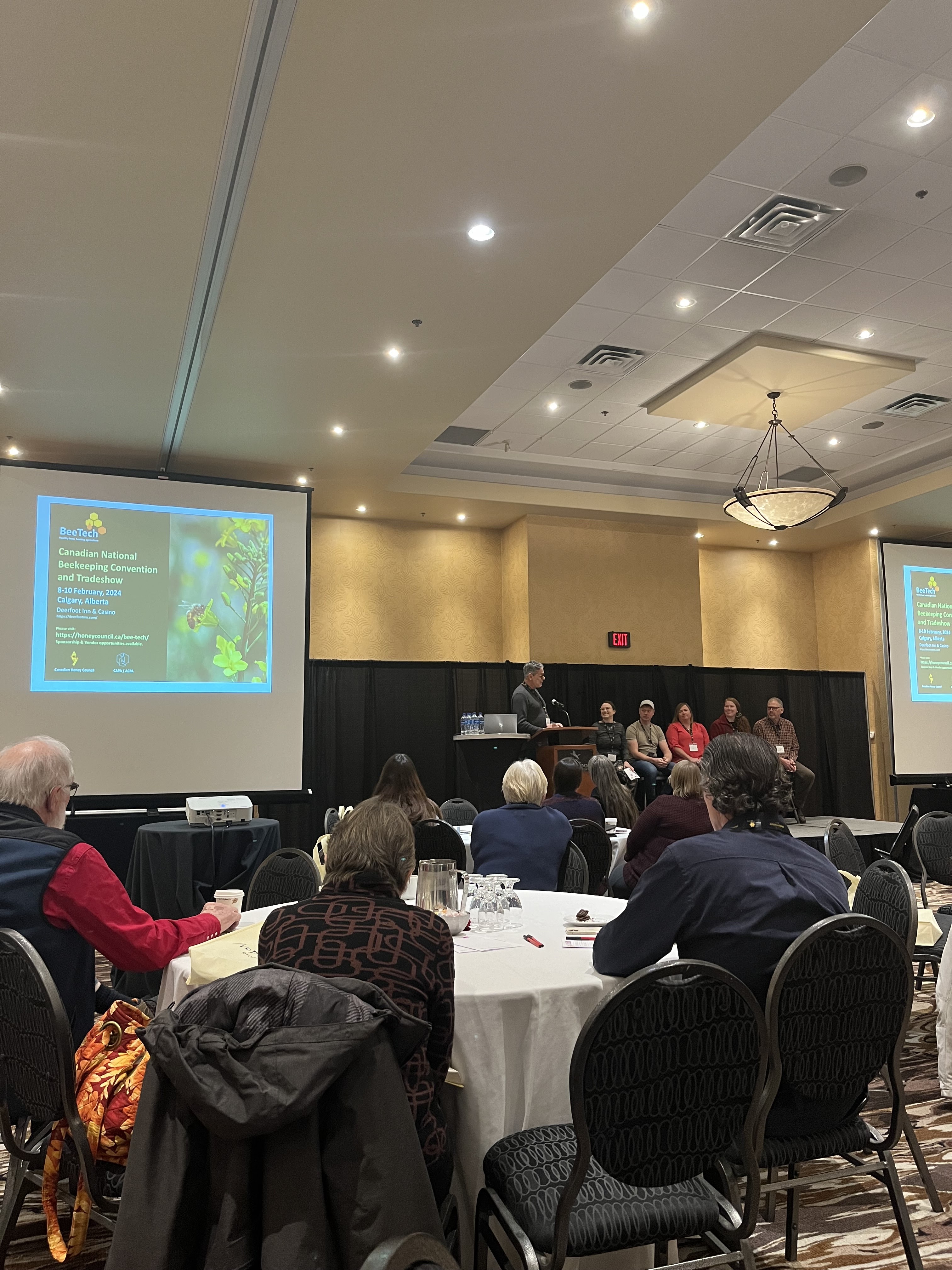
Last week beekeepers and industry representatives across the country had the pleasure of attending Bee Tech – a national beekeeping convention and tradeshow presented by the Canadian Honey Council (CHC) and the Canadian Association of Professional Apiculturists (CAPA). This joint meeting between CHC and CAPA was the first of its kind, and during the two-day event there were over 50 speakers and panelists discussing a wide range of topics relevant to the Canadian beekeeping industry.

Review of Bee Tech 2024

Preceding the Bee Tech convention, both CHC and CAPA held their annual general meetings. These were closed meetings only to be attended by CHC and CAPA members. As members of CAPA, ATTTA attended their annual general meeting to learn about the current work being done by the association. During the meeting the final results of the CAPA honey bee winter loss survey 2022-2023 were discussed in detail. All members of the beekeeping industry are encouraged to read the results of the survey on the CAPA website.

Bee Tech 2024

The official Bee Tech convention kicked off the morning of Friday February 9th. Attendees heard from Dr. Jeff Pettis (Research Scientist and Consultant, Pettis and Associates LLC) on how climate change is impacting the beekeeping industry. For example, a study from Chile shows that weather changes, such as excessive rain, are directly impacting honey production. Climate impacts on honey production are being seen in Canada as well. Additionally, higher carbon dioxide levels are impacting pollen quality. Several studies have been done demonstrating higher carbon dioxide levels are resulting in a reduction of protein concentration in pollen.

Maggie Gill (DEFRA -UK) gave a very informative session on Tropilaelaps mites. These mites are from Asia and are more damaging than Varroa mites by vectoring more viruses, quicker movement, faster reproduction, smaller and harder to detect, and more aggressive than Varroa. Although not detected in North America yet, the industry must be vigilant in educating and monitoring for Tropilaelaps mites. A team of inspectors from United States and Canada are investigating detection methods for these damaging mites. One of the biggest challenges the team is facing is that these mites are much smaller than Varroa mites, which makes them difficult to detect with current monitoring techniques.

The first panel discussion of the conference was on regional beekeeping issues. Atlantic Canada was represented by Chris Lockhart (New Brunswick Beekeepers Association president). Chris highlighted that one of the biggest issues facing Atlantic Canada (especially NB and PEI) is the growing demand for pollination units. New Brunswick and Prince Edward Island cannot meet their own pollination needs and must rely on importing bees from other provinces. Overall, in Atlantic Canada we have a growing need for commercial beekeepers. Additionally, the Maritimes needs to maintain the efficacy of Varroa treatments, and the country as a whole needs to help Newfoundland remain Varroa free.

The next panel discussion was on domestic bee production. Some of the major issues impacting domestic bee production include seasonality (late spring and short beekeeping season), long winters, and labour shortages. Although many Canadian beekeepers want to only use local stock, one of the biggest issues our industry faces is having queens early in the season. One possible solution to this problem is overwintering both nucleus colonies and queen banks.

Dr. Erika Plettner (Simmon Fraser University) gave a presentation on a new acaracide, which is the compound 1-allyloxy-4-propoxybenzene. She described some of the current research being done to understand the compound’s mode of action on phoretic mites. Robert Lu (University of Alberta) also gave a presentation on a different novel compound to control Varroa mites, which is 3c(3, 6). This novel compound shows high efficacy compared to some other products. However, there is still a large amount of work to be done before this product is ready for the market.

Phyllis MacCallum (Senior Program Manager AgriLMI) gave an update on the labour market for the Canadian apiary sector. The take home message is that the Canadian apiary sector is experiencing a severe shortage of labour. In 2022, 31% of apiary employers were unable to find the workers they needed. This labour shortage is expected to grow exponentially over the next few years, with an expected rise of more than 15% by 2030.

On day two of Bee Tech, there was a panel discussion on the relationship between the Canadian and United States beekeeping industries. The panel discussed their opinions on if the border should be open for importation of packages to Canada from United States. Some industry representatives are concerned about new pests and diseases that could come with the importation of packages, and how this may impact the Canadian beekeeping industry. Some industry representatives think it will be beneficial to have options when acquiring bees, and that opening the boarder to packages will help the industry increase honey bee stock. The discussion that occurred was respectful of all opinions and made those in attendance think critically about the topic. 

Thank you to everyone who participated and organized Bee Tech 2024. Rod Scarlett, president of the Canadian Honey Council, did a fantastic job at leading the organization and facilitation of the conference. The Atlantic Tech Transfer Team for Apiculture was please to attend Bee Tech and looks forward to similar events in the near future.

Connecting with ATTTA Specialists

If you’d like to connect with ATTTA specialists or learn more about our program, you can:

visit our website at https://www.perennia.ca/portfolio-items/honey-bees/

Email abyers@perennia.ca


Review of PEI Beekeepers Association AGM 2024

Thursday, 25 January 2024

This past weekend the Prince Edward Island Beekeeping Association held there annual general meeting in Charlottetown. The Atlantic Tech Transfer Team for Apiculture was pleased to attend and present at this year’s meeting. Read this week’s blog to learn about the highlights of the event, and to find out what is happening in the PEI beekeeping industry.

Review of PEI Beekeepers Association AGM 2024

President of PEI Beekeepers Association, Troy Fraser (2024)

Another successful annual general meeting of the PEI Beekeepers Association occurred on January 20th in Charlottetown, PEI, where approximately 40 beekeepers and/or industry representatives were in attendance. Throughout the event there were four guest speakers, including the provincial apiarist Cameron Menzies. Cameron provided an annual report on the PEI beekeeping industry.

As of 2023, there are 25 commercial beekeepers in PEI, and approximately 5 500 commercial hives. Additionally, PEI had an increase in the number of hobbyist beekeepers over the past few years. Overall, the pollination demand in PEI continues to exceed the supply of pollination units, and this past year the average cost per pollination unit in PEI was $225.

Last winter, PEI had a provincial winter loss of 46.7%. Since 2007, PEI continues to remain on par with the national winter loss, with the exception of a couple of hard winters for beekeeping in PEI.

Just like the rest of Atlantic Canada, the flying conditions for honey bees in PEI this past summer were not optimal. Because of excessive rainfall, there were very few flying days for honey bees, which impacted pollination and honey production. In 2023, there was 19.6 million lbs. of blueberries produced on the island, which is down from the 5-year average of 20.3 million lbs. The wet growing season added a lot of fungal pressure to wild blueberries. As for honey production, in 2023, there was an average of 25lbs of honey per hive, which was down from the 10-year average of 42lbs per hive. There were a total of 3,400 honey producing colonies in PEI in 2023, and the average price of honey was $3/lb. (bulk) or $5/lb. (retail).

PEI continues to be vigilant with their hive inspections for importations providing pollination services. In 2023, a total of 668 hives had a full brood inspection, and 324 hives had a top bar inspection. One load of honey bees was prevented from entering the province due to the presence of small hive beetle. Within the province, there was no American foulbrood or small hive beetle found.

Following Cameron’s provincial report, Ian Steppler gave a presentation on transitioning a small-scale beekeeping operation to a large-scale commercial operation. Ian is well known for his YouTube channel “A Canadian’s Beekeeper Blog”, which has over 80 thousand subscribers, and highlights his 20 years of beekeeping experience. Ian runs a third-generation family farm in Miami, Manitoba, and manages an apiary of 1 500 hives. During his presentation, Ian described how he effectively manages people, incorporates various pieces of equipment into his operation, and manages his time, so that his large-scale commercial beekeeping operation runs as efficiently as possible. To learn about Ian’s success in beekeeping check out his YouTube videos at https://www.youtube.com/c/aCanadianBeekeeper%E2%80%99sBlog

ATTTA was the third guest speaker of the event. The team gave a research update on our 2023 projects, which you can read all about in our past blog “Summary of ATTTA 2023 Summer Projects”. The team also discussed our training and extension work, such as our beekeeping course “The Fundamentals of Beekeeping”, and various workshops. We also discussed our new best management guide “Protecting pollinators from pesticides”, which can be found at https://www.perennia.ca/wp-content/uploads/2024/01/Protecting-Pollinators-from-Pesticides.pdf

The final guest speaker of the day was Fletcher Colpitts, who has been a beekeeper for 40 years and is a past honey bee inspector for New Brunswick and PEI. Fletcher gave an informative presentation on queen rearing without grafting. For years now, Fletcher has been making use of how queens are naturally reared to develop a system in his own operation to rear large numbers of queens. Fletcher shared many helpful tips for how he’s been successful rearing queens. One of the biggest take-aways from the presentation is that timing is everything when rearing queens, and in order to produce good queens the timeline must be followed precisely.  

Thank you to all members of the PEI Beekeepers Association who helped organize this great event, and to those who work to support the beekeeping industry of PEI.


Connecting with ATTTA Specialists

If you’d like to connect with ATTTA specialists or learn more about our program, you can:

visit our website at https://www.perennia.ca/portfolio-items/honey-bees/

Email abyers@perennia.ca