Showing posts with label PEIBA. Show all posts

Review of the Atlantic Bee Tour 2026

Thursday, 6 August 2026

This past weekend, the Atlantic Tech Transfer Team for Apiculture attended the 2026 Atlantic Bee Tour, hosted by the Prince Edward Island Beekeepers Association in Charlottetown, Prince Edward Island. With 50 attendees, the event brought together beekeepers, industry members and researchers from across the region. As in previous years, the Atlantic Bee Tour served as an important opportunity for beekeepers to network, learn, and share knowledge. This event included industry updates, hands-on demonstrations and visits to local businesses, all showing the essential role of honey bees in the Atlantic region.

Review of the Atlantic Bee Tour 2026

The first day of the tour consisted of presentations and educational learning about current challenges, industry updates and important information to help other beekeepers. Stephen Farmer, a local beekeeper from PEI and executive member of the PEIBA board, started off the event with an introduction and to say thank you to everyone involved. Cameron Menzies, PEI Provincial Apiarist, opened the morning with an update on the state of beekeeping in the province. He noted that PEI is home to roughly 5,000 commercial hives, used for honey production, pollination, or both, and that the province continues to face significant overwintering challenges. The 2025-2026 winter losses were driven primarily by weak colonies going into fall, harsh weather conditions, poor queens, and starvation. Despite these setbacks, Cameron shared encouraging results from the 2025 summer inspections, which showed low Varroa mite levels, no small hive beetle, and only low levels of European foulbrood. He also emphasized the importance of wild blueberry pollination in PEI, which relies on a 1:1 ratio of local hives to imported hives, showing how important local pollinators are for growers across the province.

Figure 1: Cameron Menzies Presenting (ATTTA ©, 2026)

Following Cameron’s update, attendees heard from Lauren Park of the Canadian Honey Council, who provided a national perspective on current industry priorities. She outlined topics the council focuses on, like miticide registration, pollination issues, and national policy discussions. Lauren also addressed concerns surrounding honey adulteration and importation issues. Lauren also highlighted upcoming industry events, including the 2027 Pollination Symposium in Quebec.

Figure 2: Lauren Park Receiving a gift on behalf of the PEIBA (ATTTA ©, 2026)

The Atlantic Tech Transfer Team for Apiculture shared updates on disease monitoring and research, including Varroa mite surveys, amitraz efficacy testing, and ongoing work related to emerging pathogens such as Vairimorpha (formerly Nosema) and Lotmaria passim. These updates offered attendees a clear picture of the scientific work underway to support evidence‑based management practices throughout the region.

Jeff Lee from Honey Bee Zen Apiaries discussed his own operation in British Columbia, sharing his knowledge of different forages and cover crops to improve forage density and pollinator pathways; this approach is used to strengthen both honey bee and wild pollinator health. Amanda Goodman Lee shared an engaging session on honey marketing, explaining why local honey remains a strong competitor in the market and how producers can communicate value to customers. Also, Jeff and Amanda both talked about tricks they have learned from their beekeeping experience.

The afternoon sessions shifted toward practical demonstrations and applied learning. Karen Thurlow led a microscopy display, showing participants how to prepare slides, identifying Vairimorph, and showed different types of pollen found in colonies. She also shared practical tips from her own operation, offering guidance on efficient equipment use and management strategies. The first day was filled with a balance of scientific and practical learning, providing attendees with lots of informational knowledge.

Figure 3: Fireweed Pollen Under a Microscope (ATTTA ©, 2026)

The second day of the Atlantic Bee Tour brought participants on a bus, showing diverse beekeeping and honey-related companies in PEI. The morning began at Ella’s Forest, where attendees toured the facility and learned about the dried wild blueberry products made. Then followed an in-hive demonstration for determining hygienic behaviour. From there, the group travelled to Red Island Cider for a behind-the-scenes tour of their production facility. The cidery even created a special honey-infused cider for the Bee Tour!

Figure 4: Products from Ella’s Forest (ATTTA ©, 2026)

Figure 5: In-Hive Demonstration of UBeeO® by Stephen Farmer (ATTTA ©, 2026)

After lunch at Founder’s Hall, the tour continued to Island Honey Wine Co. where participants sampled a variety of meads, learned about the business and had a chance to tour the area. This trip showed the diversity of how honey and in-hive products can be transformed into innovative products! The final destination of the tour was at a local beekeeper’s operation, Jason and Monica Campbell. Then the tour ended at New Glasgow for a delicious lobster supper!

Figure 6: Photos from the Island Honey Wine Co. (ATTTA ©, 2026)

The Atlantic Bee Tour was a great event for beekeepers across the region, offering valuable opportunities for learning and meeting members of the industry. The ATTTA team extends sincere thanks to the PEI Beekeeper’s Association for hosting this amazing event. We will look forward to the next Atlantic Bee Tour in 2028.

 Written by Kaitlyn Newton, ATTTA Seasonal Apiculturist

Connecting with ATTTA Specialists

If you’d like to connect with ATTTA specialists or learn more about our program, you can:

visit our website at https://www.perennia.ca/portfolio-items/honey-bees/

Email attta@perennia.ca

Review of PEIBA Spring Workshop

Thursday, 30 April 2026

Last week the Atlantic Tech Transfer Team for Apiculture organized and facilitated a beekeeping workshop in partnership with the PEI Beekeepers’ Association. This workshop took place over 2 days, with several guest speakers, covered a wide range of beekeeping topics and providing the opportunity for new and experienced beekeepers to network and learn from each other. This week’s blog will highlight some of the discussions that took place during the event.

Review of PEIBA Spring Workshop

On April 24th and 25th ATTTA, partnered with the PEI Beekeeping Association, hosted a spring beekeeping workshop in Charlottetown. The event was attended by approximately 15 beekeepers from the Island and from New Brunswick, and there was an additional 4 guest speakers in attendance. The event started with a provincial update from Cameron Menzies (provincial apiarist) on the PEI beekeeping industry. In 2025 there was approximately 30 commercial beekeepers managing over 5000 colonies. There was an estimated 4675 PEI hives provided for pollination. Additionally, the province imported 3472 colonies for pollination from Ontario and British Columbia. The average rental price for a PEI colony for pollination in 2025 was $228. For honey production, there was an estimated 4000 honey producing hives with an average of 30lbs per hive last season. During provincial inspections there was no detected American foulbrood or Small Hive Beetle in the province, and detected Varroa mite levels were low (less than 1%). It is worth noting that for imported hives 16% of colonies were inspected, which is in excess of the required 10%. Last winter (2024-2025) the island had a sustainable winter loss of 23% of colonies, and beekeepers are still in the process of determining their winter loss for 2025-2026.

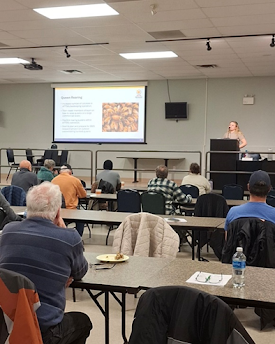
Cameron Menzies, PEI provincial apiarist, providing an industry update at the 2026 Spring Workshop.

Stephen Farmer (Vice President of PEI Beekeepers’ Association) provided an update on behalf of the beekeeping association. Currently, the PEIBA has 114 members which consists of beekeepers, supporters of the industry and students. The province is excited to be hosting the Atlantic Bee Tour this summer, which will take place on July 31st and August 1st.

Rémi Padé (Véto-pharma) discussed Apivar 2.0®, Amiflex® and Bactobee®. Only Apivar 2.0® and Amiflex® are registered in Canada both of which have the active ingredient amitraz. Apivar 2.0® has a few important differences from the original Apivar® product. Apivar 2.0® is a larger strip than Apivar®, with a lower concentration of amitraz, which results in an equal delivery of amitraz as the original formulation. The design of the plastic strips has improved tabs for hanging strips between frames, which helps increase contact of the product with bees and mites. Additionally, Apivar 2.0® does not have a withdrawal period prior to placing honey supers. Amiflex®, also containing the active ingredient amitraz (1.99%), is administered to colonies as a gel. Amiflex® works as a flash treatment, which can quickly knock down mite populations, but needs to be complimented with long-term release products as part of an integrated pest management approach.

To conclude the first day of presentations, JoAnn Pineau (Executive Director of the PEI Wild Blueberry Growers’ Association) gave an update on the association’s activities. JoAnn highlighted recent events of the association such as the Maritime Wild Blueberry Conference, upcoming events such as the PEIWBGA field day (details to be determined), and research priorities of the association.

To start the second day of the workshop, Dr. Andrew Byers (ATTTA Program Lead) discussed the ATTTA program, and highlighted some of ATTTA’s research and extension work. There are several upcoming training events that will be of interest to beekeepers including: New Brunswick Beekeepers’ Association Workshop (Memramcook – May 23), Queen Production Workshop (Bible Hill – June 17), and a summer technical session (Parrsboro – June 29).

Kayla Gaudet (ATTTA) gave a presentation on ATTTA’s Regional Varroa Mite, and amitraz efficacy testing for the region. This upcoming season will be the third and final year of data collection for this project. Additionally, Kayla discussed Varroa mite monitoring and the accuracy of both alcohol washes and sticky boards. The take home message is that monitoring (washes, sticky boards, or a combination of the two techniques) is essential for a successful Varroa mite management program.

Andrew Byers then discussed Tropilaelaps mites including the biology of the mite and the threat the mite presents to the Canadian beekeeping industry. Overall, there is still a lot of unknowns around the risk and management of Tropilaelaps mites to the beekeeping industry. ATTTA will be publishing a blog and factsheet on Tropilaelaps mites in the near future to share current knowledge of the biology of the mite and current research regarding monitoring and management of this pest which is happening globally.

Kayla Gaudet presented on wax moth management. Wax moth is primarily an issue with stored beekeeping equipment but can also be a problem with weaker colonies. The moths prefer infesting stored combs that are not actively populated by bees. Cultural practices are one of the most useful tools for beekeepers to prevent wax moth infestations. This includes proper storage of used hive equipment and hive products. All hive equipment should be stored in a closed building or storage container and should not be left outside.

Andrew Byers provided an update on growing degree days research, tools and applications for wild blueberry pollination. Across Nova Scotia and New Brunswick there is a network of weather stations which provide real-time data on weather conditions, and provide the required data for predicting the growing degree days of wild blueberries for a localized area. The PEI wild blueberry industry is aiming towards having networked weather stations installed on the island in the future, which provide a great benefit for determining wild blueberry plant development and planning for pollination.

To conclude the workshop, Kayla Gaudet discussed queen production and queen banking. Kayla discussed past research regarding indoor and outdoor queen banking in Canada, and within the Maritimes. The ATTTA team has been working towards doing an outdoor queen banking trial, with plans in place to set-up a trial this coming fall.

Thank you to all beekeepers and speakers who participated in last week’s workshop. The event was an excellent opportunity to learn and engage with beekeepers. The ATTTA team wishes all PEI beekeepers an enjoyable and successful 2026 beekeeping season.

Connecting with ATTTA Specialists

If you’d like to connect with ATTTA specialists or learn more about our program, you can:

visit our website at https://www.perennia.ca/portfolio-items/honey-bees/

Email attta@perennia.ca
Review: PEI Beekeepers’ Association Annual General Meeting

Thursday, 6 March 2025

This past weekend the Atlantic Tech Transfer Team for Apiculture (ATTTA) had the pleasure of attending the Prince Edward Island Beekeepers’ Association (PEIBA) annual general meeting in Charlottetown, PE. The event was well attended with representation from the beekeeping industry, wild blueberry industry, government, equipment suppliers, and other industry representatives. Read this week’s blog to learn about the highlights of the event.

Review: PEI Beekeepers’ Association Annual General Meeting

The Prince Edward Island Beekeepers’ Association (PEIBA) annual general meeting 2025 occurred on March 1st in Charlottetown, PE. Troy Fraser, PEIBA president, welcomed everyone to the meeting and started the PEIBA business meeting with the president’s report. The association reviewed their 2024 financials and addressed any potential board elections prior to beginning presentations for the day.

Cameron Menzies, PEI provincial apiarist, gave a provincial update on the island beekeeping industry. Currently, there are an approximate 25 commercial beekeepers on the island who manage 4,500 colonies for pollination services and honey production. This past year the province experienced their highest colony winter loss on record at 61%. The industry reports that weak colonies in the fall is the number one reason for winter loss, followed by poor queens, weather, and Varroa mites. For Varroa mite management, the PEI department of agriculture inspected eight commercial beekeeping operations and sampled mite levels ranging between 0 and 1%, which is below the economic threshold for treatment and suggests that management practices are good. The department also found no American foulbrood during inspections, low incidents of European foulbrood and no small hive beetle. This past season, 9,818 hives provided pollination to wild blueberries on the island, which included local hives and hives imported from Ontario, Manitoba and British Columbia. The average pollination stocking density across the island was 1.6 hives / acre. The average rental price was $226 / hive. There was 2,500 honey producing colonies in 2024, which produced an average of 25lbs. / hive.

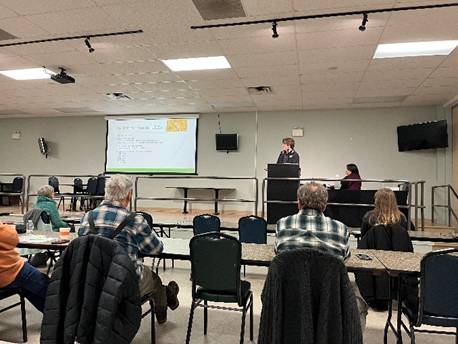
Cameron Menzies, PEI provincial apiarist, providing an industry update at the PEI Beekeepers’ Association annual general meeting 2025.

Next, Dr. Kaira Wagoner, Optera CEO and co-inventor of the UBeeOTM Assay, gave a presentation on the use of UBeeO for selecting hygienic behaviour in honey bee colonies. Dr. Wagoner discussed the benefits of hygienic behaviour for Varroa mite management, including reducing the industry’s reliance on chemical treatment. The Unhealthy Brood Odor (UBeeO) AssayTM works to select hygienic behaviour by introducing pheromones of unhealthy brood over a section of healthy brood, and assessing the percentage of brood cells that worker bees manipulate. A colony is considered to have hygienic behaviour when 60% of cells are manipulated. The UBeeO AssayTM has less variability of efficacy compared to other hygienic tests such as the “freeze kill” method. Overall, the results of UBeeO testing are indicating that colonies that have a higher UBeeO score have less disease and pest pressure, including lower Varroa mite levels.

To start the afternoon session, Troy Fraser (PEIBA president) discussed the association’s goals for hygienic testing and stock going forward. Their first goal is to promote the use of hygienic testing on PEI. Second, they want to introduce Varroa sensitive hygiene queens to the province. Third, they want to incorporate Varroa sensitive hygiene testing and monitoring practices into island beekeeping operations. Fourth, they want to establish a source of local Varroa sensitive hygiene queens on the island. Finally, the fifth goal is to maintain the local hygienic stock using instrumental insemination.

Karen Thurlow, New Brunswick chief apiary inspector, gave a presentation on her knowledge of queen breeding, and shared a variety of helpful information for new and experienced beekeepers. Karen explained how she has made beekeeping less physically exerting with her unique configuration of both cell starter and cell finisher colonies when rearing queens, which utilizes multiple nuc boxes rather than 10-frame deep boxes (which can present a challenge to move without a second set of hands). Karen also discussed her beekeeping practices throughout the season including feeding colonies, Varroa mite management, and equalizing colonies. 

Karen Thurlow, New Brunswick chief apiary inspector, discussing with her unique configuration of both cell starters and cell finishers at the PEI Beekeepers’ Association annual general meeting 2025.

The final presentation of the day was from Kayla Gaudet (Atlantic Tech Transfer Team for Apiculture) who gave a program update on ATTTA’s extension and research work. If interested in learning about ATTTA’s research visit: https://www.perennia.ca/portfolio-items/honey-bees/. The ATTTA team will be back on PEI on April 25th and 26th for an upcoming workshop in partnership with the PEIBA. More information about the workshop will be shared in the coming weeks.

Kayla Gaudet, the Atlantic Tech Transfer Team for Apiculture, providing a research and extension update at the PEI Beekeepers’ Association annual general meeting 2025.

Thank you to all the organizers of this great event, and to all of the presenters for their knowledge and expertise they bring to the industry.

Kayla Gaudet, the Atlantic Tech Transfer Team for Apiculture, with PEI beekeepers Monica Campbell, Connor Costain and Jason Campbell at the PEI Beekeepers’ Association annual general meeting 2025.

Connecting with ATTTA Specialists

If you’d like to connect with ATTTA specialists or learn more about our program, you can:

visit our website at https://www.perennia.ca/portfolio-items/honey-bees/

Email attta@perennia.ca


Report on The Prince Edward Island Beekeepers Association AGM 2022

Thursday, 15 December 2022

The time of year has begun for beekeeper gatherings and meetings. Winter is a great opportunity to connect with the community, reflect on the season past, and start planning for the year to come! This past Saturday, the Prince Edward Island Beekeepers Association held their Annual General Meeting in Charlottetown. ATTTA was pleased to be a part of this lovely event and will reflect on the highlights of the meeting in this week’s blog.

Report on the Prince Edward Island Beekeepers Association AGM 2022

Members of the PEIBA came together this weekend and were joined by guest speakers from across the country. The day began with an informative update from Provincial Apiarist, Cameron Menzies, who provided a snapshot of the PEI beekeeping industry. The growing industry continues to pursue the goal of being self-sufficient for honey bee pollination of wild blueberry fields. Towards this end, the 2022 Pollination Expansion Program approved over $300 thousand year to support beekeepers. Since the program began, the industry has seen 25% hive increase on the island. To fill the existing pollination gap, additional hives are imported primarily from Ontario. Brood inspections by Cameron and his team indicated no signs of biosecurity threats in these colonies. Conditions for pollination were good this year, and the island saw high yields of wild blueberries, the second largest yield to date! This is optimistic for the province, as productive wild blueberry land continues to expand.

Beekeeper Ian Steppler joined the meeting remotely from Alberta, where he produces his popular YouTube Channel, A Canadian Beekeeper’s Blog.  Ian offered insight into techniques to improve apiary sustainability by maintaining a reliable stock of nucleus colonies to replace seasonal losses. The cycle begins by overwintering a collection of healthy nucs to replace winter losses. Next, spring assessments reveal additional unproductive colonies to be replaced and identify prolific colonies which are used to resupply the nuc bank. Ian also discussed his queen production system. Internal queen rearing facilitates rapid nuc production during the beekeeping season, which can then be used to replace weak hives in the fall and provide an abundance of strong nucleus colonies to overwinter. In cyclical fashion, the sustainability of the apiary is supported by an abundance of available nucs to replace dead or failing colonies.

Paul Kelly, from the University of Guelph Honey Bee Research Centre, participated in the meeting as well. Paul emphasized ways that a beekeeping community can move towards self-sufficiency by support from within. Speaking from his experience, Paul discussed how the Ontario industry improved their regional self-sufficiency by reducing overwintering losses, improving queen production techniques, replacing losses internally with hive splits, and overwintering nucs to restore winter hive losses. 

ATTTA provided our team and research updates, as well, as we continue to make our way across the Atlantic Region to join the beekeeping and wild blueberry associations in their annual gatherings. Starting with an encouraging address to association members, President Troy Fraser concluded the event with a constructive business meeting. Overall, it was a successful event and ATTTA looks forward to the coming year for PEI beekeepers!


Connecting with ATTTA Specialists


If you’d like to connect with ATTTA specialists or learn more about our program, you can: