Showing posts with label Atlantic Bee Tour. Show all posts

Review of the Atlantic Bee Tour 2026

Thursday, 6 August 2026

This past weekend, the Atlantic Tech Transfer Team for Apiculture attended the 2026 Atlantic Bee Tour, hosted by the Prince Edward Island Beekeepers Association in Charlottetown, Prince Edward Island. With 50 attendees, the event brought together beekeepers, industry members and researchers from across the region. As in previous years, the Atlantic Bee Tour served as an important opportunity for beekeepers to network, learn, and share knowledge. This event included industry updates, hands-on demonstrations and visits to local businesses, all showing the essential role of honey bees in the Atlantic region.

Review of the Atlantic Bee Tour 2026

The first day of the tour consisted of presentations and educational learning about current challenges, industry updates and important information to help other beekeepers. Stephen Farmer, a local beekeeper from PEI and executive member of the PEIBA board, started off the event with an introduction and to say thank you to everyone involved. Cameron Menzies, PEI Provincial Apiarist, opened the morning with an update on the state of beekeeping in the province. He noted that PEI is home to roughly 5,000 commercial hives, used for honey production, pollination, or both, and that the province continues to face significant overwintering challenges. The 2025-2026 winter losses were driven primarily by weak colonies going into fall, harsh weather conditions, poor queens, and starvation. Despite these setbacks, Cameron shared encouraging results from the 2025 summer inspections, which showed low Varroa mite levels, no small hive beetle, and only low levels of European foulbrood. He also emphasized the importance of wild blueberry pollination in PEI, which relies on a 1:1 ratio of local hives to imported hives, showing how important local pollinators are for growers across the province.

Figure 1: Cameron Menzies Presenting (ATTTA ©, 2026)

Following Cameron’s update, attendees heard from Lauren Park of the Canadian Honey Council, who provided a national perspective on current industry priorities. She outlined topics the council focuses on, like miticide registration, pollination issues, and national policy discussions. Lauren also addressed concerns surrounding honey adulteration and importation issues. Lauren also highlighted upcoming industry events, including the 2027 Pollination Symposium in Quebec.

Figure 2: Lauren Park Receiving a gift on behalf of the PEIBA (ATTTA ©, 2026)

The Atlantic Tech Transfer Team for Apiculture shared updates on disease monitoring and research, including Varroa mite surveys, amitraz efficacy testing, and ongoing work related to emerging pathogens such as Vairimorpha (formerly Nosema) and Lotmaria passim. These updates offered attendees a clear picture of the scientific work underway to support evidence‑based management practices throughout the region.

Jeff Lee from Honey Bee Zen Apiaries discussed his own operation in British Columbia, sharing his knowledge of different forages and cover crops to improve forage density and pollinator pathways; this approach is used to strengthen both honey bee and wild pollinator health. Amanda Goodman Lee shared an engaging session on honey marketing, explaining why local honey remains a strong competitor in the market and how producers can communicate value to customers. Also, Jeff and Amanda both talked about tricks they have learned from their beekeeping experience.

The afternoon sessions shifted toward practical demonstrations and applied learning. Karen Thurlow led a microscopy display, showing participants how to prepare slides, identifying Vairimorph, and showed different types of pollen found in colonies. She also shared practical tips from her own operation, offering guidance on efficient equipment use and management strategies. The first day was filled with a balance of scientific and practical learning, providing attendees with lots of informational knowledge.

Figure 3: Fireweed Pollen Under a Microscope (ATTTA ©, 2026)

The second day of the Atlantic Bee Tour brought participants on a bus, showing diverse beekeeping and honey-related companies in PEI. The morning began at Ella’s Forest, where attendees toured the facility and learned about the dried wild blueberry products made. Then followed an in-hive demonstration for determining hygienic behaviour. From there, the group travelled to Red Island Cider for a behind-the-scenes tour of their production facility. The cidery even created a special honey-infused cider for the Bee Tour!

Figure 4: Products from Ella’s Forest (ATTTA ©, 2026)

Figure 5: In-Hive Demonstration of UBeeO® by Stephen Farmer (ATTTA ©, 2026)

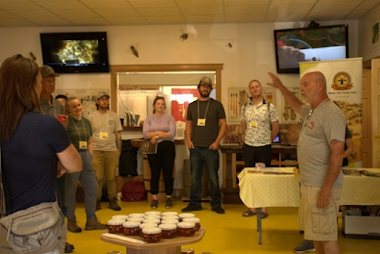
After lunch at Founder’s Hall, the tour continued to Island Honey Wine Co. where participants sampled a variety of meads, learned about the business and had a chance to tour the area. This trip showed the diversity of how honey and in-hive products can be transformed into innovative products! The final destination of the tour was at a local beekeeper’s operation, Jason and Monica Campbell. Then the tour ended at New Glasgow for a delicious lobster supper!

Figure 6: Photos from the Island Honey Wine Co. (ATTTA ©, 2026)

The Atlantic Bee Tour was a great event for beekeepers across the region, offering valuable opportunities for learning and meeting members of the industry. The ATTTA team extends sincere thanks to the PEI Beekeeper’s Association for hosting this amazing event. We will look forward to the next Atlantic Bee Tour in 2028.

 Written by Kaitlyn Newton, ATTTA Seasonal Apiculturist

Connecting with ATTTA Specialists

If you’d like to connect with ATTTA specialists or learn more about our program, you can:

visit our website at https://www.perennia.ca/portfolio-items/honey-bees/

Email attta@perennia.ca
Review of 2024 Atlantic Bee Tour

Thursday, 1 August 2024

This past weekend the Atlantic Tech Transfer Team for Apiculture had the pleasure of participating in the 2024 Atlantic Bee Tour hosted by the New Brunswick Beekeepers Association in Bathurst and Charlo, NB. There were upwards of 50 attendees, with representation across the Atlantic region. The event consisted of blueberry field tours, a commercial beekeeper's meeting, presentations from industry representatives, a tour of the Charlo Honey House, and a variety of workshops for beekeepers to partake in. The Atlantic Bee Tour is an important event to our industry providing an opportunity for beekeepers to network and learn. Read this week’s blog to learn the details of this successful event.

Review of 2024 Atlantic Bee Tour

Beekeepers across the Atlantic region gathered in Bathurst, NB on Friday July 26th for the 2024 Atlantic Bee Tour. The event started with a visit to a local wild blueberry field in Lavillette, NB owned by John Schenkels. Lots of discussion occurred around the fields, including topics such as pollination requirements of wild blueberries in New Brunswick, outlook of the 2024 wild blueberry season, and both the history/current operations of John Schenkels’ blueberry fields.

Later in the day a commercial beekeeper meeting took place in Bathurst, NB. Dr. Andrew Byers (The Tech Transfer Lead) gave an overview of the 2024 beekeeping season so far. Dr. Byers discussed the preliminary report from the Canadian Association for Professional Apiculturists (CAPA) on honey bee winter losses in Canada. Dr. Byers also discussed the Varroa mite research currently being done by the ATTTA Team. Next week’s blog will provide a mid-season summary on ATTTA’s Varroa mite research for 2024.

Michel Melanson (New Brunswick Department of Agriculture, Aquaculture and Fisheries) discussed details of the New Brunswick Wild Blueberry Pollination Strategy on behalf of the Joint Pollination Committee. The strategy is a 5-year plan that will work towards increasing pollination resources for New Brunswick blueberry producers by 60% from 47,000 to 75,000 pollinating units by spring of 2029. The strategy consists of five goals, including: increase the number of New Brunswick honey bee colonies available for pollination by 79%; increase the number of honey bee colonies available for importation by 74%; increase the number of alfalfa leafcutting bee gallons in New Brunswick by 27%; increase the number of bumble bee quads in New Brunswick by 22%; and support native bees as pollinators. Each goal has distinct initiatives to help achieve the goal by 2029. More details of the strategy can be found in the published executive summary on the Government of New Brunswick website.

The evening of Friday the 26th consisted of 2 excellent presentations. Pascale Michaud (University of Moncton) discussed 3 projects that are occurring at the University. Dr. Michaud discussed how low concentrations of pesticides (particularly the insecticide imidacloprid) have impacts on the longevity of the western honey bee lifespan. The second project the University has been researching is the effect of overwintering on the honey bee immune system. The project looked at the difference in phagocytosis occurring in summer versus winter. Finally, the University of Moncton has been researching the relationship between colony infections and honey bee health. There were 50 colonies followed for approximately 1 year, and for each hive a swab was taken from the entrance and bottom board. The team assesses for a variety of honey bee diseases, and classifies the infection as “not detected”, “low level”, or “high level”. This service is also offered to beekeepers who are interested in knowing their honey bee disease profile through AgroGene Solutions.

Fletcher Colpitts (New Brunswick Chief Apiary Inspector, retired) gave a talk on the early days of beekeeping and pollination in New Brunswick. Mr. Colpitts discussed how beekeeping practices have changed from decade to decade, including the challenges that occurred once Varroa mites were introduced into New Brunswick beekeeping. He also discussed how pollination services continued to become more efficient with the introduction of new equipment/practices, and how his family’s operation changed over the years.

On Saturday July 27th the Atlantic Bee Tour continued in Charlo, NB at the Charlo Honey House, which is owned and operated by Eric and Chantal Neil. Eric gave a tour of the honey house showing everyone the various extraction equipment and the variety of products sold at the shop. The Charlo Honey House is a local tourist attraction and is well worth a visit.

Brian Pond (NBBA) welcomes everyone to the Charlo Honey House for the day.

ATTTA Team (Greg Dugas and John MacDonald) checking out extraction equipment at the Charlo Honey House.

Karen Thurlow (Chief Apiary Inspector) gave a talk during the morning sharing all her tips and tricks to make beekeeping as efficient as possible.

Simultaneously, during the morning session, Nathan Mutch (President of New Brunswick Beekeepers Association) successfully performed a beard of bees, which had the audience highly entertained. If you have never seen a bee beard, be sure to look this up online. We sincerely thank Nathan for enduring multiple stings for the team, and we recommend serious caution to any beekeeper considering attempting this in their future.

Nathan Mutch (NBBA) with a beard of bees.

During the afternoon session various workshops occurred throughout the apiary. Kayla Gaudet and John MacDonald (Atlantic Tech Transfer Team for Apiculture) gave a workshop on monitoring for Varroa mites throughout the beekeeping season. Nathan Mutch discussed how to make splits. Karen Thurlow gave a workshop on doing a hive inspection from top to bottom. Finally, Chris Lockhart (New Brunswick Beekeepers Association board member) discussed various systems of palletization.

Karen Thurlow (Chief Apiary Inspector) showing a group how to complete a full hive inspection.

Chris Lockhart (NBBA) with a 4-hive pallet.

On behalf of the ATTTA team we would like to thank everyone involved with making this year’s Bee Tour a success. Thank you to Brain Pond (New Brunswick Beekeepers Association) for all his work coordinating and running this event. Thank you to other NBBA members including Nathan Mutch and Chris Lockhart for all their work educating and mentoring beekeepers throughout the event. We would like to thank John Schenkels for allowing the group to tour his fields, and our other hosts Eric and Chantel Neil for the use of the Charlo Honey House for Saturday’s events. Finally, we would like to thank all of the presenters throughout the event, including Michel Melanson, Pascal Michaud, Fletcher Colpitts and Karen Thurlow - we appreciation the knowledge each of you bring to these events. We hope to see everyone at the Atlantic Bee Tour 2026.

Connecting with ATTTA Specialists

If you’d like to connect with ATTTA specialists or learn more about our program, you can:

visit our website at https://www.perennia.ca/portfolio-items/honey-bees/

Email abyers@perennia.ca


Summer Events

Thursday, 18 July 2024


The wild blueberry and beekeeping industries depend on each other for continued growth. Despite being busy, the summer is a useful time for beekeepers and wild blueberry producers to have events to learn about what’s happening in these industries. The Atlantic Tech Transfer Team for Apiculture had the pleasure of attending the New Brunswick Beekeeper’s Association (NBBA) evening session last Saturday and the Wild Blueberry Producer’s Association of Nova Scotia’s (WBPANS) field day this past Wednesday. Continue reading for details on these great events! 

NBBA Evening Meeting Summary

A group of New Brunswick beekeepers gathered for an evening meeting, entitled “Bees and Honey….From frame to barrel” on the evening of Saturday July 13th. This event was put on by the New Brunswick Beekeeping Association and hosted by Chris Lockhart of Lockhart Apiaries and Atlantic Gold Honey.  The event, held in the Moncton area, was well attended by over 20 local beekeepers, providing an excellent mid season opportunity for discussion.  There were three short presentations across the evening.  Chris Lockhart gave an overview of his operation and showed his extraction operation.  The Atlantic Tech Transfer Team for Apiculture did a demonstration on honey quality, diversity and classification.  Additionally, ATTTA talked about mid season disease management.  Overall, a pleasant and well received industry event organized by the NBBA to support the New Brunswick beekeeping sector.


Chris Lockhart (center) discussing his beekeeping operation, flanked by prominent NB beekeepers, Eric Neil (left) and Boyd Hicks (right) at the recent NBBA evening meeting.

WBPANS 2024 Field Day

On July 17th, the WBPANS held their annual summer meeting, hosted by Paul and Lori Kittilsen at their beekeeping farm in the Debert area.  The event began in the morning with tours and demonstrations around the Kittilsen’s farm. These included wild blueberry and beekeeping machinery demonstrations, an example of a pollinator strip, and tours through the Kittilsen’s honey extraction room, bottling room, and construction workshop. 

Paul Kittilsen speaking at the WBPANS Annual Meeting

There were many exhibitors set up throughout the day to give demonstrations. There were equipment and machinery displays, where attendees could test drive forklifts and harvesters and shop for new equipment. There were displays and delegates from across the agri-business sector, including NS Crop and Livestock Insurance and Farm Credit Canada, as well as the chance to talk to government staff and industry representatives. Also, attendees could talk to wild blueberry researchers and representatives, including many researchers from Dalhousie University, Living Labs, and Perennia. 

The Kilted Chef and his team provided a delicious wild blueberry themed lunch, during which there were presentations given. The WBPANS president, David Harrison, and executive director, Peter Burgess, of WBPANS welcomed the group and provided a WBPANS update. Hugh Lyu, the wild blueberry extension specialist at Perennia, provided an industry update looking at the season so far this year. Also, Paul and Lori Kittilsen introduced everyone to their team and gave an overview of their business and history as beekeepers and honey producers. The Kittilsen’s have nearly 2000 honey bee hives that go to wild blueberry fields for pollination, hugely contributing to the wild blueberry industry. 

John and Kaitlyn from ATTTA with the Kilted Chef at the WBPANS Annual meeting

Thank you to all the members of WBPANS who helped organize this field day, and to all those who work to support the wild blueberry industry in Nova Scotia. 

The next beekeeper event for our region the Atlantic Bee Tour held in Bathurst and Charlo on the 26 & 27 July.  Details can be found on the NBBA web site: https://nbba.ca/

 Connecting with ATTTA Specialists

If you’d like to connect with ATTTA specialists or learn more about our program, you can:

visit our website at https://www.perennia.ca/portfolio-items/honey-bees/

Email abyers@perennia.ca


Beekeeper Life-Long Learning

Thursday, 20 April 2023

Beekeeping is not an activity conducted in isolation.  Honey bees range over great distances and there is often overlap in foraging activity with neighbouring beekeepers.  This forced, resource sharing is perhaps why our community is so welcoming of new beekeepers and willing to engage in collective educational activities.  An understanding that we are all in this together.  This is also shown through frequent beekeeping congregations held to mingle and learn.  Through this blog, we report on these specifically when they occur and there seems to always be something happening!

Beekeeper Life-Long Learning 

Last week in the Atlantic region, there were two meetings to discuss beekeeping and pollination.  Held in Prince Edward Island, both were well attended, informative events.  On Friday, the Wild Blueberry Growers Association organized a meeting titled “Wild Blueberry Information Day and AGM”.  Alongside the meeting was also a tradeshow with important supporters of the wild blueberry industry in attendance.  The goal of the meeting was to provide an update on the current wild blueberry industry in PEI.  This was provided through an introduction and welcome from the current PE WBGA president, Benny Nabuurs and a market report, given By Gilbert Lavoie.  An update on the overall North American wild blueberry industry was also provided by Neri Vautour (Wild Blueberry Association of North America).  Information specific to beekeeping was supplied by Cameron Menzies (PEI Department of Agriculture and Land) and the Atlantic Tech Transfer Team for Apiculture.

The following day, a well attended workshop was conducted in partnership with ATTTA and the PEI Beekeepers Association.  Saturday morning was spent in an engaging conversation with a large group of new beekeepers (and some old ones😊).  This was a great demonstration of the enthusiasm for beekeeping and related learning opportunities in PEI. The discussion ranged across many aspects of beekeeping, including queen outdoor overwintering and mite control.

Figure 1 Beekeepers attending the Atlantic Bee Tour 2022, engaged in learning!

The enthusiasm shown in PEI for beekeeping is shared across the whole region.  As ATTTA travels to attend meetings and provide training there are always new beekeepers in attendance.  Most of these events are organized by industry associations and these groups have a number of upcoming events in the works this season.  As a new beekeeper, the best way to engage with the industry is through your provincial associations.  So, make sure that you are a member to open the doors to great social, educational and professional happenings.

Another important aspect of the life-long learning that is beekeeping, is to ensure that you have a mentor.  Every beekeeper, no matter the length of their experience, should have someone with whom they can discuss the challenges of this unique enterprise.  All of the beekeeping associations have a process to support new beekeepers in gaining a mentor.  So, if you haven’t already, take advantage of this opportunity.  In a recent conversation with a seasoned beekeeper with decades of experience, the question was posed, “how long does it take to become a good beekeeper?”  After a moment’s reflection, the answer was, “I don’t know yet!”  The best beekeepers are the ones who understand there is always more to learn.

Reminder – the registration for the Fundamentals of Beekeeping is open!  Details can be found here or by contacting Dalhousie University directly.  


Connecting with ATTTA Specialists


If you’d like to connect with ATTTA specialists or learn more about our program, you can:


Atlantic Bee Tour 2022

Thursday, 25 August 2022

This past weekend ATTTA was pleased to attend the Atlantic Bee Tour held in Antigonish! The Atlantic Bee Tour, previously known as the Maritime Bee Tour, is a biennial beekeeper event that had a couple of postponements due to COVID-19. It is an informative and community building experience in which beekeepers from the Atlantic Provinces are invited to gather at a local beekeeping operation for tours, workshops, and an opportunity to connect with one another. In this week’s blog, we will reflect on the events of this most recent Bee Tour.

Atlantic Bee Tour 2022

Well known local beekeepers, Mario Swinkels and Ben Cornect were the hosts of the 2022 Atlantic Bee Tour which was organized by the Nova Scotia Beekeepers Association. The event began at Pins Bowling Center in Antigonish, which provided a very pleasant environment to gather and listen to presentations. The first speaker was Chris Lockhart, a prominent NB Beekeeper, who spoke about the benefits of running single deep brood chambers as compared to doubles. He addressed concerns about overwintering starvation and excessive swarming and was convincing that with proper management, single brood chamber colonies are a valid and intriguing option in Atlantic Canada. Some of the benefits he suggested included: increase honey collection, easier maintenance of burr comb build up, finding the queen, and the overall reduced quantity of hive bodies!

Next, NS beekeeper Lauren Park presented about queen raising in Atlantic Canada, providing a broad overview of the steps involved in queen rearing, from choosing the colonies to use in raising queens to harvesting the mature cells for mating. Raising queens locally, better supports our industry and has the potential to lead to more a climatically-hardy, locally adapted stock of Atlantic honey bees.

The next portion of the evening split the group into commercial and small-scale beekeepers. While the commercial beekeepers engaged in a round table discussion about the state of the industry, ATTTA presented on managing varroa mites throughout the beekeeping season. Having a solid grasp on varroa mite management will be integral to the success of all beekeeping operations in the Maritime region.  We suggest an integrated pest management approach, which includes regular monitoring and diversity of treatments. 

The event resumed the following morning, which was a beautiful sunny day. The day began with a thorough tour of Cornect Family Farm. We toured the extraction facility, honey house, and an overwintering nuc yard. One unique aspect of this operation is a hydraulic crane used for hive transportation. With this machine, Ben is able to more rapidly and smoothly transport beehives to wild blueberry fields for pollination. The crane is fast, efficient, and causes almost no disturbance to the bees within, making a much more pleasant experience for late night hive loading.

Crane lifting a pallet of four beehives (ATTTA©2022).

Next, was a tour of Swinkels Bee Products and afternoon workshops. The Swinkels’ operation was interesting to see, as it is in a transitional period while they are expanding their extraction facility to increase their capacity. Seeing the current operation and the progress of the expansion allowed both new and established beekeepers to imagine the potential of their own operation and learn from the experience of an established and successful beekeeper. After the tour, the day wrapped up with four small-group workshops. ATTTA and others led workshops on a range of beekeeping topics.

Mario Swinkels discussing his creamed honey machine (ATTTA©2022).

Overall, the Atlantic Bee Tour was a lovely and informative event. Thank you to everyone involved and we look forward to the next event in 2024, held in another yet to be determined Atlantic Canadian province!


Connecting with ATTTA Specialists


If you’d like to connect with ATTTA specialists or learn more about our program, you can: