Showing posts with label bee hive. Show all posts

Review of the Atlantic Bee Tour 2026

Thursday, 6 August 2026

This past weekend, the Atlantic Tech Transfer Team for Apiculture attended the 2026 Atlantic Bee Tour, hosted by the Prince Edward Island Beekeepers Association in Charlottetown, Prince Edward Island. With 50 attendees, the event brought together beekeepers, industry members and researchers from across the region. As in previous years, the Atlantic Bee Tour served as an important opportunity for beekeepers to network, learn, and share knowledge. This event included industry updates, hands-on demonstrations and visits to local businesses, all showing the essential role of honey bees in the Atlantic region.

Review of the Atlantic Bee Tour 2026

The first day of the tour consisted of presentations and educational learning about current challenges, industry updates and important information to help other beekeepers. Stephen Farmer, a local beekeeper from PEI and executive member of the PEIBA board, started off the event with an introduction and to say thank you to everyone involved. Cameron Menzies, PEI Provincial Apiarist, opened the morning with an update on the state of beekeeping in the province. He noted that PEI is home to roughly 5,000 commercial hives, used for honey production, pollination, or both, and that the province continues to face significant overwintering challenges. The 2025-2026 winter losses were driven primarily by weak colonies going into fall, harsh weather conditions, poor queens, and starvation. Despite these setbacks, Cameron shared encouraging results from the 2025 summer inspections, which showed low Varroa mite levels, no small hive beetle, and only low levels of European foulbrood. He also emphasized the importance of wild blueberry pollination in PEI, which relies on a 1:1 ratio of local hives to imported hives, showing how important local pollinators are for growers across the province.

Figure 1: Cameron Menzies Presenting (ATTTA ©, 2026)

Following Cameron’s update, attendees heard from Lauren Park of the Canadian Honey Council, who provided a national perspective on current industry priorities. She outlined topics the council focuses on, like miticide registration, pollination issues, and national policy discussions. Lauren also addressed concerns surrounding honey adulteration and importation issues. Lauren also highlighted upcoming industry events, including the 2027 Pollination Symposium in Quebec.

Figure 2: Lauren Park Receiving a gift on behalf of the PEIBA (ATTTA ©, 2026)

The Atlantic Tech Transfer Team for Apiculture shared updates on disease monitoring and research, including Varroa mite surveys, amitraz efficacy testing, and ongoing work related to emerging pathogens such as Vairimorpha (formerly Nosema) and Lotmaria passim. These updates offered attendees a clear picture of the scientific work underway to support evidence‑based management practices throughout the region.

Jeff Lee from Honey Bee Zen Apiaries discussed his own operation in British Columbia, sharing his knowledge of different forages and cover crops to improve forage density and pollinator pathways; this approach is used to strengthen both honey bee and wild pollinator health. Amanda Goodman Lee shared an engaging session on honey marketing, explaining why local honey remains a strong competitor in the market and how producers can communicate value to customers. Also, Jeff and Amanda both talked about tricks they have learned from their beekeeping experience.

The afternoon sessions shifted toward practical demonstrations and applied learning. Karen Thurlow led a microscopy display, showing participants how to prepare slides, identifying Vairimorph, and showed different types of pollen found in colonies. She also shared practical tips from her own operation, offering guidance on efficient equipment use and management strategies. The first day was filled with a balance of scientific and practical learning, providing attendees with lots of informational knowledge.

Figure 3: Fireweed Pollen Under a Microscope (ATTTA ©, 2026)

The second day of the Atlantic Bee Tour brought participants on a bus, showing diverse beekeeping and honey-related companies in PEI. The morning began at Ella’s Forest, where attendees toured the facility and learned about the dried wild blueberry products made. Then followed an in-hive demonstration for determining hygienic behaviour. From there, the group travelled to Red Island Cider for a behind-the-scenes tour of their production facility. The cidery even created a special honey-infused cider for the Bee Tour!

Figure 4: Products from Ella’s Forest (ATTTA ©, 2026)

Figure 5: In-Hive Demonstration of UBeeO® by Stephen Farmer (ATTTA ©, 2026)

After lunch at Founder’s Hall, the tour continued to Island Honey Wine Co. where participants sampled a variety of meads, learned about the business and had a chance to tour the area. This trip showed the diversity of how honey and in-hive products can be transformed into innovative products! The final destination of the tour was at a local beekeeper’s operation, Jason and Monica Campbell. Then the tour ended at New Glasgow for a delicious lobster supper!

Figure 6: Photos from the Island Honey Wine Co. (ATTTA ©, 2026)

The Atlantic Bee Tour was a great event for beekeepers across the region, offering valuable opportunities for learning and meeting members of the industry. The ATTTA team extends sincere thanks to the PEI Beekeeper’s Association for hosting this amazing event. We will look forward to the next Atlantic Bee Tour in 2028.

 Written by Kaitlyn Newton, ATTTA Seasonal Apiculturist

Connecting with ATTTA Specialists

If you’d like to connect with ATTTA specialists or learn more about our program, you can:

visit our website at https://www.perennia.ca/portfolio-items/honey-bees/

Email attta@perennia.ca

What the Cell: The Bee-ginning

Thursday, 4 July 2024

In honey bee hives, there remains much to discover about the intricate world of the cells found in the comb. Previously on the last blog about cells, food storage and different types of food for the honey bees was discussed. The behavior of bees is purposeful, and they strategically position food and brood in their hive.  The placement and size of cells play an important role in the bees’ development. By exploring the inside of cells, we can understand brood, and the development of the bees.

What the Cell: The Bee-ginning

Within a bee colony, three castes of bees play crucial roles, each with its unique characteristics. Worker bees, the most abundant in a hive, are small, sterile, female bees that acquire various jobs over their life cycle from nursing to foraging. The cells where worker bees develop are the same size as the cells used to store food 1. These cells are around 5.20-5.40 mm 2. Drones, on the other hand, are male bees that make up about 15% of the hive's population 1. Unfertilized eggs are placed into larger drone cells, these cells are approximately 6.20-6.40 mm 2. Drone cells are located on the outer part of the hive, and their primary role is to mate with a virgin queen 3. Lastly, the queen bee, the largest in the hive, has an essential responsibly of laying eggs so the colony can grow 1. Since there is only one queen, the presence of queen cups may indicate swarming, a substandard queen, the loss of a queen, or worker bees may just make them for “practice”1. Based on if an egg is fertilized or not, the size of the cell it is placed in, and the diet the larvae is fed all determines the caste of bee 4.

Honey bees and brood (©ATTTA 2021)

Honey bees are insects that go through metamorphosis 5. All three castes within a colony which are workers, drones, and a queen, undergo distinct developmental stages before they are full grown. These stages are just slightly different depending on their role. The journey begins when the queen lays the egg. This egg development will last about three days 1. Next, the egg hatches into a larva, resembling white grubs 1.  The larva feeds for several days to grow. For worker bees and drones, the larva stage lasts approximately six days, and 4.6 for queen bees 1. Initially all bee larva are nourished with royal jelly for the first two days. However, female eggs that are continuing to receive royal jelly have the potential to develop into queens 5. After approximately five days the larva get capped with a mixture of pollen and wax 5. The capped brood then forms a silk cocoon around itself for three days before becoming a pupa 5. During the pupa stage the bee goes through many morphological changes. The legs, wings, and abdomen all form during this stage before becoming an adult bee 1. The duration of these stages varies among the bees. Drone bees have the longest development period, taking approximately 24-25 days to mature from egg to emergence 1. Worker bees typically develop within 19-22 days, and queens have the shortest developing time, emerging in roughly 15-17 days 1.

When observing the brood within a hive, the health of the colony becomes clear. A frame that is densely filled with brood, could be a sign that the hive is healthy. It suggests that the environment is stable and temperature for the developing brood is being regulated 6. This also indicates that the queen is laying eggs effectively 6. During the beekeeping season, the stored food in the cells will be consumed, and eggs will hatch. However, as long as the egg-laying pattern remains consistent, the hive’s efficiency is likely to persist. Ideally, the brood should be located at the center of the hive, with food stores on the outer frames. When examining a single frame, the brood should be positioned at the bottom, with food stored above. Honey should form an arching pattern at the top, with pollen situated between honey and brood.

Good arching brood pattern (©ATTTA 2021)

Checking inside the hive is essential for understanding the honey bee colony’s dynamic and overall health. By examining the cells and the frames they inhabit, it should now be clearer about what would be seen inside the hive. The cells reveal the diverse foods honey bees consume, and the shapes of the cells can help identify the bee class residing there. Additionally, observing brood in a cell provides a glimpse into the bee’s life cycle. Reading the cells is important to understand many important aspects of a colony.  

 Written by Kaitlyn Newton, ATTTA Seasonal Apiculturist

References

  1. Sammataro, D. and Avitabile, A., 2021. The beekeeper’s handbook fifth addition. Cornell University Press.
  2. Zhang, L., Shao, L., Raza, M.F., Han, R. and Li, W., 2024. The Effect of Comb Cell Size on the Development of Apis mellifera Drones. Life, 14(2), p.222.
  3. Boes, K.E., 2010. Honeybee colony drone production and maintenance in accordance with environmental factors: an interplay of queen and worker decisions. Insectes sociaux, 57, pp.1-9.
  4. Wei, H., He, X.J., Liao, C.H., Wu, X.B., Jiang, W.J., Zhang, B., Zhou, L.B., Zhang, L.Z., Barron, A.B. and Zeng, Z.J., 2019. A maternal effect on queen production in honeybees. Current Biology, 29(13), pp.2208-2213.
  5. Yadav, S., Kumar, Y. and Jat, B.L., 2017. Honeybee: Diversity, castes and life cycle. Industrial entomology, pp.5-34.
  6. Camazine, S., 1991. Self-organizing pattern formation on the combs of honey bee colonies. Behavioral ecology and sociobiology, 28, pp.61-76. 

 Connecting with ATTTA Specialists

If you’d like to connect with ATTTA specialists or learn more about our program, you can:

visit our website at https://www.perennia.ca/portfolio-items/honey-bees/

Email abyers@perennia.ca


What the Cell?

Thursday, 6 June 2024

Whether you are a seasoned beekeeper with years of experience, or just starting out on your apiary journey, it is always important to revisit the basics. By refreshing your memory, or reinforcing seemingly straightforward topics, diving back into fundamentals can greatly enhance your understanding of beekeeping. In honey bee hives there are numerous cells that are built from wax by the bees. These cells serve various functions, including storing food and taking care of brood.  This week we will explore some facts about honey comb cells.

What the Cell?

Honey bees construct hexagonal cells which make up the comb found on frames in the hive. Worker cells, which contain developing female or worker bees, can have an approximate size of 5.20-5.40 mm, and drone cell, where male bees develop,  sizes can range from 6.20-6.40 mm6. The cell are constructed using beeswax that the bees produce from a secretory gland in their abdomen1. These cells are used for different purposes. Nurturing brood and storing food are both functions of the different cells.  By understanding what the different types of cells should look like, beekeepers can help to keep the hive well balanced and healthy. By recognizing these different cell types, beekeepers can also understand hive changes such as when a colony is going to swarm. 

Queen, eggs, drone, capped brood, honey, pollen (©ATTTA 2022)

Nectar, which is an aqueous solution of sugars, amino acids and minerals, is gathered from flowers by honeybees to bring back to the hive using their honey stomach2. Once the forager bee gets back to the hive, it passes on the nectar to a receiver bee, and sucrase gets added to the nectar before being placed in the cell2.  Sucrase is an enzyme that breaks down sucrose into simpler sugar molecules2. It is the job of the receiver bee to break down sucrose, but both forager and receiver bees have the enzyme sucrase7.  The water must be evaporated from the nectar to increase sugar concentration and form honey. Nectar starts at a water content as high as 80% and the bees reduce it to approximately 17-20%2. By evaporating most of the water, it also helps to store the honey long term, because fermenting organisms cannot live there2. Bees actively evaporate nectar by regurgitation and re-ingesting droplets, and passive evaporation is also done by bees using a fanning behavior3 . Once the moisture content is low, and the honey is ripe, it will be capped off with a thin layer of wax so it can be stored indefinitely4 . Honey is hygroscopic, so if the bees cap it the moisture from the environment should not re-enter the cell, which prevents fermentation8. The honey is then used for food when bees cannot forage for nectar.

Cells with capped and uncapped honey (©ATTTA 2024)

Pollen is attracted to the bees and is transferred from the anthers of flowers2. Pollen is an important source of nutrients for bees because it contains a proteins, lipids, vitamins, and minerals5. Bees collect pollen using a small amount of nectar to make the pollen stick and give it beneficial bacteria, then they put it into pollen baskets on their back legs, known as corbiculae2. When back from foraging the honeybees back push the pollen pellets off their legs into an empty cell, or one half filled with pollen. Housekeeping bees then pack the pollen and add nectar from their honey sac to start a fermentation process2. The microflora of pollen contains bacteria, yeasts and molds which all play a role in fermentation9. But primarily the process is driven by the lactic acid bacteria, which produces lactic acid playing a crucial role in preserving the bee bread10. This is how beebread is formed, and bees sometimes cap the cells with honey to preserve it since it does not last as long as honey does2.

In a well-organized hive bees exhibit remarkable precision in arranging their food and offspring.  The outer frames mostly contain food stores. Within a single frame, bees construct an arching figure where honey is stored in the upper cells, followed by a layer of pollen beneath, and finally, the lower cells are designed for brood. Typically, the brood is concentrated in the center of the hive in an area called the brood nest. This interesting aspect of bee behavior will be explored further in an upcoming blog post.

Written by Kaitlyn Newton, ATTTA Seasonal Apiculturist


References:

  1. Xu, R., Ma, B., Yang, Y., Dong, X., Li, J., Xu, X. and Fang, Y., 2024. Proteome-metabolome profiling of wax gland complex reveals functional changes in honeybee (Apis mellifera L.). iScience.

  2. Sammataro, D. and Avitabile, A., 2021. The beekeeper’s handbook fifth addition. Cornell University Press.
  3. Nicolson, S.W., Human, H. and Pirk, C.W., 2022. Honey bees save energy in honey processing by dehydrating nectar before returning to the nest. Scientific Reports, 12(1), p.16224.
  4. Fernandes, K.E., Frost, E.A., Remnant, E.J., Schell, K.R., Cokcetin, N.N. and Carter, D.A., 2022. The role of honey in the ecology of the hive: Nutrition, detoxification, longevity, and protection against hive pathogens. Frontiers in Nutrition, 9, p.954170.
  5.  Huang, Z., 2010. Honey bee nutrition. American Bee Journal, 150(8), pp.773-776.
  6.  Zhang, L., Shao, L., Raza, M.F., Han, R. and Li, W., 2024. The Effect of Comb Cell Size on the Development of Apis mellifera Drones. Life, 14(2), p.222.
  7.  Zhu, Y.C., Caren, J., Reddy, G.V., Li, W. and Yao, J., 2020. Effect of age on insecticide susceptibility and enzymatic activities of three detoxification enzymes and one invertase in honey bee workers (Apis mellifera). Comparative Biochemistry and Physiology Part C: Toxicology & Pharmacology, 238, p.108844
  8. Kubásek, J., Svobodová, K., Půta, F. and Krejčí, A.B., 2022. Honeybees control the gas permeability of brood and honey cappings. iScience, 25(11), p.105445.
  9.  Miłek, M., Mołoń, M., Kula-Maximenko, M., Sidor, E., Zaguła, G. and Dżugan, M., 2023. Chemical Composition and Bioactivity of Laboratory-Fermented Bee Pollen in Comparison with Natural Bee Bread. Biomolecules, 13(7), p.1025
  10.  Kieliszek, M., Piwowarek, K., Kot, A.M., Błażejak, S., Chlebowska-Śmigiel, A. and Wolska, I., 2018. Pollen and bee bread as new health-oriented products: A review. Trends in Food Science & Technology, 71, pp.170-180.


                                                 Connecting with ATTTA Specialists

If you’d like to connect with ATTTA specialists or learn more about our program, you can:

visit our website at https://www.perennia.ca/portfolio-items/honey-bees/

Email abyers@perennia.ca


Alternative Hive Options in Atlantic Canada

Thursday, 9 June 2022

There is a lot to think about when you first start beekeeping. An important decision that needs to be made is what type of hive to use. This decision usually depends on what kind of beekeeper you want to be and for what purpose you will use your bees. Some hives are best suited for honey production, others are good for pollination, and some are perfect if you want to have easier access inside your hives.  The Langstroth, Top Bar, Warré hive, and Flow® Hive will all be discussed to help determine which is right for you.

Alternative Hive Options in Atlantic Canada

Langstroth Hive

Langstroth hive: https://www.almanac.com/beekeeping-101-types-of-beehives

The classic Langstroth hive, designed and crafted by Lorenzo Lorraine Langstroth in 1852, is the most common beehive style in Atlantic Canada. This hive can be built with minor differences but usually consists of a bottom board that provides an entrance and stability, an inner and outer cover, and middleboxes commonly called supers. These supers come in three different sizes; deep, medium, and shallow. By stacking new supers on top of existing ones, you can expand your hive, giving the colony room to grow. Inside these supers, there are ten removable frames with foundation on which the bees build comb. The Langstroth hives allow the keeper to inspect the colony and observe brood, honey production, and overall hive strength.

Top Bar Hive

The Top Bar hive has a much different appearance than the Langstroth. Its box is approximately three feet long and raised from the ground to be at a more comfortable height for beekeeping. This type of hive gets its name from the bars at the top, which replace the need for frames. These top bars allow the bees to build their combs without foundation. This type of hive allows expansion horizontally with the following board moved as additional space is required by the colony.  

Warré hive


The Warré hive is a combination of the Langstroth and Top Bar hives. It was designed by a French monk named Abbé Émile Warré. Warré created his hive to more closely mimic hives that are found in nature. It uses the top bar design to allow the bees to develop their own comb. This system also expands vertically using supers. However, unlike the Langstroth hive, the supers are added to the bottom of the existing hive. By doing this, it encourages the bees to build new combs downward. While adding the new supers to the bottom, the top supers can be removed to filter out the old combs and keep the hive clean. This hive can be low maintenance and collecting honey from the removed top supers is relatively easy. 

Flow® Hive

Flow ® Hive: https://www.honeyflow.com/products/flow-hive-2-plus

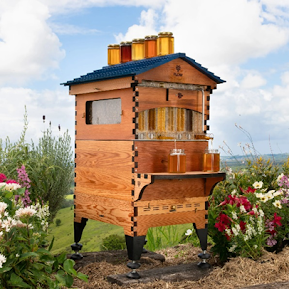
A newer hive on the market is the Flow® Hive. It was introduced to Canada in 2015 by Stuart and Cedar Anderson from Australia. It is designed to allow easy collection of honey. Much like the Langstroth hive, the Flow® Hive uses supers containing ten frames. However, these frames have mostly completed cells, made of plastic, already in place for the bees to fill. When it comes time to harvest your honey, you can drain the honey without entering the hive, using specific hive tools. As this hive was initially designed for an Australian climate, its minimal use here in Atlantic Canada has not provided the opportunity to fully prove its adaptability to our winters!

These four hive styles all create a perfect home for honeybees. The best one for you will depend on what you plan to do with your hives and your preferences. However, for beginners, the Langstroth hive may be a good bet. In Atlantic Canada, Langstroth equipment is widely available, relatively inexpensive, and well established. This familiarity will provide available support and advice from mentors and other beekeepers.  So, Langstroth equipment will be easier for new beekeepers while they are learning all the ins and outs of apiculture.  Typically, your first bees will arrive as a nucleus colony, or nuc, ready to be established in a Langstroth hive.  The Langstroth hive is also what is used for pollination services.  So, if this is a current or future consideration, this style of beekeeping is recommended.

Written by Rebecca Campbell, ATTTA Summer Research Assistant rcampbell@perennia.ca


Connecting with ATTTA Specialists


If you’d like to connect with ATTTA specialists or learn more about our program, you can:


Swarm Biosecurity

Thursday, 2 June 2022

Sometimes free things can be costly, as may be the case with a honey bee swarm. With swarm season upon us, it is a good time to consider what to do if you spot a swarm that isn’t from your apiary. Swarms, brought into your apiary, may present a risk for the rest of your bees. This week’s blog is on catching ‘free’ swarms and the biosecurity measures that should be considered when doing so.

Swarm Biosecurity

For honey bees, swarming is a natural reproductive process but there are also other reasons for a colony to leave a hive. In absconding, there could be an attempt to ensure the colonies health through reducing disease or pest pressure by leaving behind mites, bacteria, or fungus and relocating to a new fresh home. If a colony swarms due to hive congestion, the mother colony may still be infected. So when we find a swarm there is no immediate indication of the disease status or reason for the bees relocating. Vertical transmission of pathogens may occur between the colonies and spread to another apiary.  When a diseased or pest-ridden swarm is relocated within or near an apiary, it has the potential to impact on the health of all the colonies in that yard.

Honey bee swarm on a tree branch (Photo: Tim Howell, South Carolina Blackwater Beekeepers Association)

Where possible, understanding the background on a swarm will help identify the level of danger but usually very little information is available. A best management practice would be to assume that a caught swarm presents a high biosecurity risk and the colony should be quarantined. A quarantined area should be far enough away from other apiaries to prevent robbing and drifting. Equipment from quarantined hives should not be immediately used in other hives. All hive tools should also be disinfected by torching after working in quarantined hives.

The honeybees in the quarantined swarm can be inspected and tested for certain pests and diseases. Varroa mite testing can be done on site by using an ether roll, alcohol wash, or sticky board. Methods for testing and economic thresholds can be found in the Summer Disease and Pest Monitoring factsheet by ATTTA. Samples of adult bees can also be tested for Nosema. Atlantic beekeepers are welcome to send samples to ATTTA for nosema diagnosis! Once brood production begins inspection for diseases, such as American and European foulbrood should be undertaken.

Swarms from unknown sources can be more damaging, and costly, to your apiary than beneficial. With best management practices, such as monitoring, testing, and quarantining, the risks that come with collecting swarms can be reduced. Also, using best management practices can help reduce swarming, and the potential spread of pests and diseases to neighboring apiaries. 

Written by John MacDonald, ATTTA Seasonal Apiculturist johnmacdonald@perennia.ca


Connecting with ATTTA Specialists


If you’d like to connect with ATTTA specialists or learn more about our program, you can:


Wax On Wax Off

Thursday, 17 February 2022

Today we will wrap up our discussion of frames. It is clear that considerably more effort goes into preparing wax foundation frames compared to plastic. The reason that we have chosen to use wax is that, observationally, bees demonstrate a preference for such foundation and will draw out comb more readily. Quick production of wax by honey bees is useful as it is beneficial to refresh your comb periodically. We will explain this idea as we continue, now let’s begin! 

Wax On Wax Off

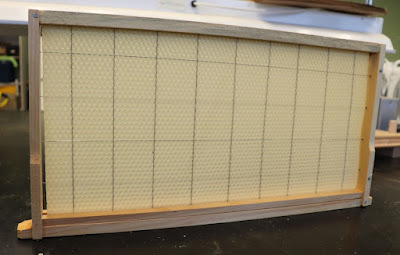
The final steps in assembling our frame are to insert the wax and embed the wire. It is suggested that if the frame will be used for honey extraction, to use foundation with vertical wires for extra strength. Insert the foundation such that it weaves through every other line of wire and the top and bottom of the sheet lay in the grooves of the top and bottom bars. Replace the wooden cleat back in its original position, flush against the wax foundation, and use a hammer or a staple gun to drive four brads perpendicularly through the cleat, securing it once again to the top bar.

Figure 1. Showing an inverted deep frame with a well-placed sheet of wax foundation.  You can observe the secured wax foundation, centered in the middle of the frame.  Both vertical and horizontal wires which support the foundation are also visible along with the wooden cleat.

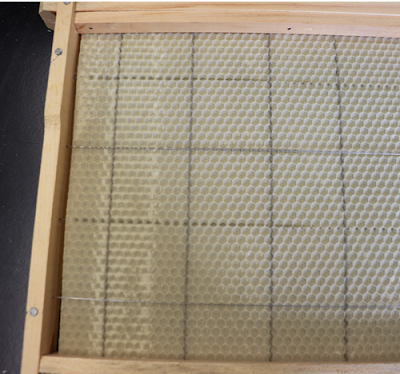
Now we will embed the wire into the wax. Bees prefer to feel wax rather than the metal wire and this will support them in producing uniform comb. There are safe and reliable tools available for embedding wire from local beekeeping supply stores. The principle is to heat the wires just enough to melt the surrounding wax and become encased.  Commonly, beekeepers use a tool which passes a DC current through the wire, heating it and melting the wax around the wire.  This is a quick, straightforward method but it is easy to overheat the wires, so be very cautious.  Wires can also be pressed into the wax with an embedding tool.  Basically, these are a spurred wheel which rolls along the wire to push it into the wax.  Some of these tools also are heated to help with the process. With the wires embedded our frame is ready to enter a hive!

Figure 2. A frame containing embedded wires.  This is a better surface for the bees to work than that shown in the previous figure!

Once in the hive, the bees will begin building comb on the new foundation. Wax production is integral to all beekeeping operations whether beeswax is an economic output or not. It is necessary for growing hive numbers and comb rotation is a valuable component of integrated pest management (Pernal and Clay 2013). The Canadian Association of Professional Apiculturists suggests that brood comb only remain in an apiary for three to five years for optimal hive health. Chemical residues leftover from miticide treatments or brought into the hive from foraging activity can persist and accumulate in wax (Murcia-Morales et al 2022). Rotating new brood comb also improves colony productivity by allowing brood to develop into larger, more productive individuals (Taha et al. 2021). Each bee that develops within a cell leaves behind developmental material which, overtime, results in smaller cells and smaller bees. Check out our Comb Rotation ATTTA Factsheet for more information!


Murcia-Morales, María, Horacio Heinzen, Piedad Parrilla-Vázquez, María del Mar Gómez-Ramos, and Amadeo R. Fernández-Alba. 2022. “Presence and Distribution of Pesticides in Apicultural Products: A Critical Appraisal.” TrAC Trends in Analytical Chemistry 146 (January): 116506. https://doi.org/10.1016/j.trac.2021.116506.

Pernal, S.F. and Clay, H. (eds). 2013. Honey bee disease and pests, 3rd Edition. Canadian Association Professional Apiculturists, Beaverlodge, AB, Canada 68 pp. 

Taha, El-Kazafy A., Osama M. Rakha, El-Said M. Elnabawy, Mohamed M. Hassan, and Dalia M.B. Shawer. 2021. “Comb Age Significantly Influences the Productivity of the Honeybee (Apis Mellifera) Colony.” Journal of King Saud University - Science 33 (4): 101436. https://doi.org/10.1016/j.jksus.2021.101436.


Connecting with ATTTA Specialists


If you’d like to connect with ATTTA specialists or learn more about our program, you can:


Essential Oils to Suppress Varroa Mites

Thursday, 9 December 2021

During the upcoming holiday season, we will be partaking in those indulgences saved only for this celebratory time of year.  The odor of cinnamon, cloves and nutmeg will fill the air.  As we gather together not only will we be surrounded by these favorite smells and flavors, we will be exchanging gifts.  We all recognize the offerings by the Magi of gold, frankincense and myrrh as the original gifts of Christmas.  What might you ask has this to do with beekeeping?  You will be surprised, so read on to learn more.

Another launch of a “Beekeeping Minute” video.  These short videos are bite size pieces of beekeeping presented to help new entrants understand basics of both the art and science of keeping honey bees.  This week's video is on cleaning hive tools and can be found here: Atlantic Bees: https://youtu.be/4xWgErUbw6w

Essential Oils to Suppress Varroa Mites

Beekeepers are continually battling varroa mite with all the weapons available to us!  Experienced beekeepers know that high varroa mite levels will result in lost colonies.  The arsenal to fight these parasites is down to only one reliable chemical treatment and there is concern that this may be coming to the end of its life cycle.  Resistance seems to be inevitable and we have had a good run with Apivar.  Beekeepers who are keeping their fingers crossed and hoping it remains effective are likely also expecting Santa Clause to come this Christmas!  So alternatives need to be considered.  We have options that due to their mechanism of action and being naturally derived will not create resistant mites as far as we know.  One of these options is essential oils.

What are essential oils is a fair question to ask.  The definition from the Commission of the European Pharmacopoeia, essential oils are odorous products, usually with a complex composition, obtained from a botanically defined plant raw material by steam distillation, dry distillation, or a suitable mechanical process without heating1..  Closer to home, the government of Canada definition states, “Essential oils are complex mixtures of volatile compounds produced as secondary metabolites in aromatic plants. They can be extracted from these plants by distillation, solvent extraction, cold pressing, and other means.”2.  Therefore, these are plant-based products extracted so as to be little altered from the original botanical compounds found naturally.  Along with the definitions above, these oils must maintain the “essence” of the original plant which for our understanding would mean odor.  The odor being the volatile products, or vapors, of these substances and important for their mode of action as a pesticide.  The original purpose of these substances in the plant are complex but often act as insect repellants.

How do they work?  The mechanism of action is poorly understood.  They operate at a molecular level to perturb cellular, ionic and enzymatic activities.  It would seem that evolutionarily, there are target insects for these plant compounds as either repellants or attractants.  It could also be suggested that entomophilous plants, requiring insect pollination, would not target bees negatively with these natural defenses.  This suggests why certain essential oils are not as toxic to bees as they are to mites!

So a few examples of essential oils include frankincense and myrrh, to bring us back to our Christmas theme.  An additional list of other examples reads like part of a Christmas pudding recipe: cinnamon, cloves, nutmeg, ginger and mace.  For a more extensive list of essential oils tested experimentally as controls for varroa mites, read Evaluating the Efficacy of 30 Different Essential Oils against Varroa destructor and Honey Bee Workers (link provided below)..  With all these examples, we must remember that we can only treat our bees with products which have been registered for use in Canada.  There are two essential oil products available for beekeepers in Canada to control varroa mites.

Thymovar is derived from the herb thyme with the active ingredient thymol and has been licensed in Canada in 20162.. ApiLife Var is a combination of essential oils including Eucalyptus oil, levomenthol, camphor, and thymol; licensed in Canada 20204..  Recent research in Canada has demonstrated that thymol based acaricides can be up to 96.6% effective in controlling varroa mites5..

Hundreds of essential oils have been tested as acaricides 6..  We have two essential oil products available for use here in Canada.  These are proven effective and also have the advantage of being a natural plant derived product.  If used correctly they also have no effects on human health and a reduced chance of harmful residue compared to synthetic acaricides.  There seems to be no concerns of resistance developing in mites with these products.  Current research indicates low toxicity for honey bees and even less than formic acid or oxalic acid.

As concern over the long-term efficacy of chemical treatments grows, we are looking optimistically at alternatives.  As part of an integrated pest management approach to controlling Varroa destructor we must use varied strategies to ensure the health of our bees.  As we are now planning our IPM strategies to control varroa mites this coming season, consider all treatment options including essential oils.  As wise men knew in the past, essential oils are to be valued whether as Christmas gifts or in maintaining healthy honey bee colonies! 

 1. Hýbl, M.; Bohatá, A.; Rádsetoulalová, I.; Kopecký, M.; Hoštiˇcková, I.; Vaníˇcková, A.; Mráz, P. (2021) Evaluating the Efficacy of 30 Different Essential Oils against Varroa destructor and Honey Bee Workers (Apis mellifera). Insects, 12, 1045. https://pubmed.ncbi.nlm.nih.gov/34821845/

 2. Pest Management Regulatory Agency (2017) Regulatory Directive DIR2017-02, Essential Oil-based Personal Insect Repellents (EOPIR) https://www.canada.ca/en/health-canada/services/consumer-product-safety/reports-publications/pesticides-pest-management/policies-guidelines/regulatory-directive/2017/02-regulatory-directive-essential-oil-based-personal-insect-repellents-dir-2017-02.html

3. Pest Management Regulatory Agency (2016) Registration Decision RD2016-16, Thymol, https://www.canada.ca/en/health-canada/services/consumer-product-safety/reports-publications/pesticides-pest-management/decisions-updates/registration-decision/2016/thymol-rd2016-16.html#a3

4. Pest Management Regulatory Agency (2020) Racemic camphor,eucalyptus oil, lmenthol and thymol and Api Life VAR, https://publications.gc.ca/collections/collection_2020/sc-hc/h113-9/H113-9-2020-12-eng.pdf

5. Qodratollah Sabahi, Nuria Morfin, Berna Emsen, Hanan A Gashout, Paul G Kelly, Stephanie Otto, A Rod Merrill, Ernesto Guzman-Novoa, Evaluation of Dry and Wet Formulations of Oxalic Acid, Thymol, and Oregano Oil for Varroa Mite (Acari: Varroidae) Control in Honey Bee (Hymenoptera: Apidae) Colonies, Journal of Economic Entomology, Volume 113, Issue 6, December 2020, Pages 2588–2594, https://doi.org/10.1093/jee/toaa218

6. Abdessamad Aglagane, El-Mustapha Laghzaoui, Sana Ben Elfakir, Omar Er-Rguibi, Abdelaziz Abbad, El Hassan El Mouden & Mohamed Aourir (2021) Essential oils as sustainable control agents against Varroa destructor (Acari, Varroidae), an ectoparasitic mite of the western honeybees Apis mellifera (Hymenoptera: Apidae): Review of recent literature (2010-onwards), International Journal of Acarology, 47:5, 436-445


                                                Connecting with ATTTA Specialists


If you’d like to connect with ATTTA specialists or learn more about our program, you can:


How Much do We Need to Feed?

Thursday, 16 September 2021

Last week we discussed different styles of equipment which can be used to feed supplementary sugar syrup to honey bees. This week, we will continue the discussion of fall feeding, considering the nutritional requirements for the bees and how much syrup will be necessary to achieve these requirements.

Also, see information below on our latest ATTTA podcast.

How Much do We Need to Feed?

Beekeepers typically need to feed bees in the fall to replace the honey harvested from the hive. In Atlantic Canada, it is recommended to overwinter hives with at least 35kg of honey stored. With these reserves, strong hives should be able to withstand the winter. A common way to measure the honey content in a hive is by lifting the hive to assess its weight. If you are able to lift the hive with one hand, it is likely that the hive is too light and requires feeding. With experience beekeepers become very good at assessing hive weight with this “heft” test.

Supplementary feeding may be required at various times throughout the beekeeping season and is done for different reasons. For example, a new colony which does not yet have drawn comb will need to be fed to stimulate wax production. In the fall, feeding is typically for the purpose of stocking food for the winter. For this, a ratio of 2:1 sugar to water is the ideal syrup. Thick syrup is useful for fall feeding because it creates less work for the bees. When forager bees collect nectar and bring back it to the hive, it is then cured within the hive for proper storage. Nectar typically starts with about 70% water content and is stored as honey with about 18% water. Water is removed first through the act of passing the nectar from mouth to mouth within the colony and then further by fanning bees and warm air circulating through the hive. Removing excess water creates a substance with a higher sugar concentration, allowing bees to store more energy efficient reserves in less space and creating a substance that is not capable of spoiling! Supplementary sugar syrup needs the same treatment. By providing bees thicker syrup to begin with, they are more easily able to cure the syrup into a storable form.


How much syrup must you feed your bees? This question depends on how much honey is already in the hive and how much stored food you would like your bees to have. One gallon of 2:1 sugar syrup will be converted into about 3.2 kgs of stored food. Therefore, if you want your bees to store an additional 35 kgs on top of what is already in the hive, you must feed them 11 gallons (41 liters) of 2:1 feed.  It is very unlikely that a normal, healthy hive would contain no honey. Be mindful of excessive feeding, as well. It is possible to overfeed your bees and be left with a honey bound hive. In this case, the queen may run out of space to lay and the population of bees in the spring will be unfavorably low. The bees will also need time to cure the syrup into its storable form. If they are not allowed sufficient time to cure the syrup, it may enter the winter with excessive water content and end up freezing or fermenting, both of which are detrimental to overwintering bees. Here in Atlantic Canada, September is a good time to start with supplemental feeding and normally by mid October feeding should be complete.

For even more information on feeding your bees and getting them ready for the winter, check out the ATTTA Fall Honey Bee Management Guide (https://www.perennia.ca/wp-content/uploads/2019/10/09-fall-honey-bee-management-guide-eng.pdf) and Feeding Honey Bees (https://www.perennia.ca/wp-content/uploads/2018/04/06-feeding-honeybees-eng.pdf) fact sheets.


What’s the Buzz with ATTTA Beekeeping Podcast 

Episode 8

The Canadian Honey Council (CHC) represents all beekeepers from the hobbyist with one hive through to the largest commercial operation with thousands of colonies.  Nationally, there are more than 10 000 beekeepers, managing nearly one million colonies, supported directly by the work of the CHC.  As the national association of the beekeeping industry, the CHC undertakes many of the big issues related to honey fraud, product labelling, employment and much more.  This month’s episode of What’s the Buzz with ATTTA Beekeeping podcast explores the work of the CHC through a discussion with the association’s executive director, Rod Scarlett. You can find the podcast HERE.

Connecting with ATTTA Specialists


If you’d like to connect with ATTTA specialists or learn more about our program, you can: