
In honey bee hives, there remains much to discover about the intricate world of the cells found in the comb. Previously on the last blog about cells, food storage and different types of food for the honey bees was discussed. The behavior of bees is purposeful, and they strategically position food and brood in their hive. The placement and size of cells play an important role in the bees’ development. By exploring the inside of cells, we can understand brood, and the development of the bees.
What
the Cell: The Bee-ginning
Within a bee colony, three castes of bees play crucial roles, each with its unique characteristics. Worker bees, the most abundant in a hive, are small, sterile, female bees that acquire various jobs over their life cycle from nursing to foraging. The cells where worker bees develop are the same size as the cells used to store food 1. These cells are around 5.20-5.40 mm 2. Drones, on the other hand, are male bees that make up about 15% of the hive's population 1. Unfertilized eggs are placed into larger drone cells, these cells are approximately 6.20-6.40 mm 2. Drone cells are located on the outer part of the hive, and their primary role is to mate with a virgin queen 3. Lastly, the queen bee, the largest in the hive, has an essential responsibly of laying eggs so the colony can grow 1. Since there is only one queen, the presence of queen cups may indicate swarming, a substandard queen, the loss of a queen, or worker bees may just make them for “practice”1. Based on if an egg is fertilized or not, the size of the cell it is placed in, and the diet the larvae is fed all determines the caste of bee 4.

Honey bees are insects that go through metamorphosis 5. All three castes within a colony which are workers, drones, and a queen, undergo distinct developmental stages before they are full grown. These stages are just slightly different depending on their role. The journey begins when the queen lays the egg. This egg development will last about three days 1. Next, the egg hatches into a larva, resembling white grubs 1. The larva feeds for several days to grow. For worker bees and drones, the larva stage lasts approximately six days, and 4.6 for queen bees 1. Initially all bee larva are nourished with royal jelly for the first two days. However, female eggs that are continuing to receive royal jelly have the potential to develop into queens 5. After approximately five days the larva get capped with a mixture of pollen and wax 5. The capped brood then forms a silk cocoon around itself for three days before becoming a pupa 5. During the pupa stage the bee goes through many morphological changes. The legs, wings, and abdomen all form during this stage before becoming an adult bee 1. The duration of these stages varies among the bees. Drone bees have the longest development period, taking approximately 24-25 days to mature from egg to emergence 1. Worker bees typically develop within 19-22 days, and queens have the shortest developing time, emerging in roughly 15-17 days 1.
When
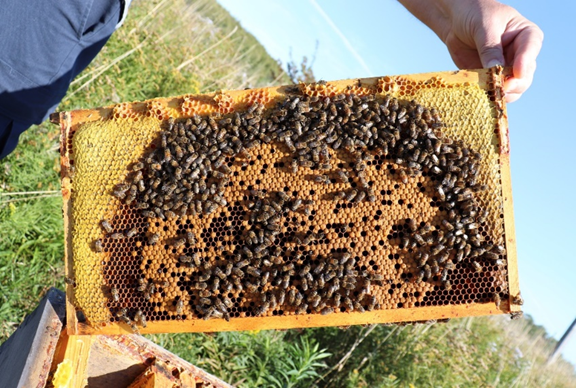
observing the brood within a hive, the health of the colony becomes clear. A frame
that is densely filled with brood, could be a sign that the hive is healthy. It
suggests that the environment is stable and temperature for the developing brood
is being regulated 6. This also indicates that the queen is laying
eggs effectively 6. During the beekeeping season, the stored food in
the cells will be consumed, and eggs will hatch. However, as long as the egg-laying
pattern remains consistent, the hive’s efficiency is likely to persist. Ideally,
the brood should be located at the center of the hive, with food stores on the
outer frames. When examining a single frame, the brood should be positioned at
the bottom, with food stored above. Honey should form an arching pattern at the
top, with pollen situated between honey and brood.
Checking
inside the hive is essential for understanding the honey bee colony’s dynamic
and overall health. By examining the cells and the frames they inhabit, it
should now be clearer about what would be seen inside the hive. The cells reveal
the diverse foods honey bees consume, and the shapes of the cells can help
identify the bee class residing there. Additionally, observing brood in a cell provides
a glimpse into the bee’s life cycle. Reading the cells is important to
understand many important aspects of a colony.
References
- Sammataro, D. and Avitabile, A., 2021. The beekeeper’s handbook fifth addition. Cornell University Press.
- Zhang, L., Shao, L., Raza, M.F., Han, R. and Li, W., 2024. The Effect of Comb Cell Size on the Development of Apis mellifera Drones. Life, 14(2), p.222.
- Boes, K.E., 2010. Honeybee colony drone production and maintenance in accordance with environmental factors: an interplay of queen and worker decisions. Insectes sociaux, 57, pp.1-9.
- Wei, H., He, X.J., Liao, C.H., Wu, X.B., Jiang, W.J., Zhang, B., Zhou, L.B., Zhang, L.Z., Barron, A.B. and Zeng, Z.J., 2019. A maternal effect on queen production in honeybees. Current Biology, 29(13), pp.2208-2213.
- Yadav, S., Kumar, Y. and Jat, B.L., 2017. Honeybee: Diversity, castes and life cycle. Industrial entomology, pp.5-34.
- Camazine, S., 1991. Self-organizing pattern formation on the combs of honey bee colonies. Behavioral ecology and sociobiology, 28, pp.61-76.
If you’d like to connect with ATTTA specialists or learn more about our program, you can:
visit our website at https://www.perennia.ca/portfolio-items/honey-bees/
Email abyers@perennia.ca
