Showing posts with label queen. Show all posts

How to Identify and Manage the Issue of Laying Workers

Thursday, 20 November 2025

An issue you may have encountered as a beekeeper is the presence of laying worker bees. A worker bee can only lay drones, and therefore she cannot maintain a healthy and productive colony dynamic. Read this week’s blog to learn more about how the issue of laying workers results, how to identify the presence of laying workers and what management steps a beekeeper can take to correct the issue.

How to Identify and Manage the Issue of Laying Workers

After a colony loses its queen, and if it is unable to raise a new queen due to limited resources available (i.e. no eggs or larvae less than three days old), there is a possibility that worker bees will start to lay unfertilized eggs. Given that a laying worker bee can only lay unfertilized (male/drone) eggs the population dynamic of the colony will start to shift from worker bees to an abnormally high drone population, which is not sustainable long-term given that worker bees carry out essential colony tasks.

When a queen is present within a colony her pheromones suppress the development of ovaries in worker bees, which makes her the only reproductive female of the colony1. Once a colony is queenless, the concentration of existing queen pheromones will gradually decrease and eventually the ovaries of worker bees have the potential to mature1. In order for the eggs in the ovaries of workers to mature worker bees must be fed royal jelly1. Although capable of laying eggs, workers lack the capability and anatomy to mate, which means they can only lay unfertilized eggs1,2.

Over the past few decades there has been some research conducted on the physiology of laying workers, and how this group of bees differs from queens and non-laying workers. Researchers have found that there is greater variation in the size of eggs laid by worker bees compared to queens, with a coefficient of variance for egg length being 3.5 times higher in laying workers3. On average, it was found that eggs from queens were longer (1.620 mm), but narrower (0.368 mm) than eggs from laying workers (1.579 mm and 0.378 mm)3. In one study the development of the hypopharyngeal gland (HPG) and hemolymph vitellogenin titers was examined in laying workers to assess if their physiology was more similar to nurse bees or forger bees4. The researchers discovered that laying workers have physiology more similar to nurse bees compared to forger bees indicating that workers are more likely to have ovaries mature in a queenless colony earlier on in their lifespan4.

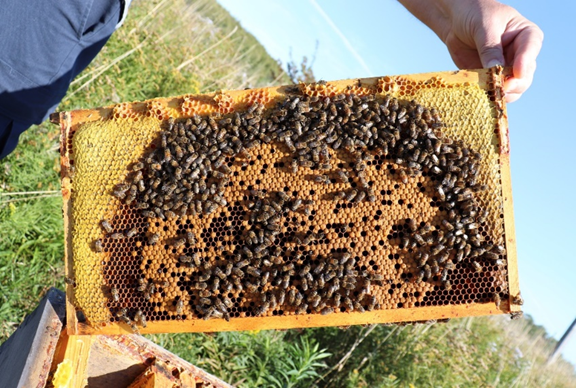
Generally, a colony will be queenless for approximately 21 days before a laying worker exists within the colony1. There are a few key indicators of laying workers. To start, laying workers often lay multiple eggs per cell, and they are usually on the sides of the cell rather than the bottom of the cell2. This is the result of workers having a shorter abdomen compared to a queen who can properly lay eggs at the base of the cell2. Other key indicators of laying workers include a spotty brood pattern and an abnormally high percentage of drones and drone brood compared to workers2.

Multiple eggs laid on sides of brood cells is a key sign of laying worker bees (© S. Camazine2).

It is difficult to locate and remove a laying worker as she is similar in appearance to other workers, and there can be many laying worker per colony, therefore, the management of this issue is not straightforward2. The requeening of a colony that has laying workers is not usually successful2. Frequently the colony will reject the introduced queen or queen cell if a laying worker is present1,2.

Unfortunately, disassembling a colony is the best way to address the issue of a laying worker. If the colony shows no signs of disease, all the bees from the colony should be shaken onto the ground in the apiary, remove their hive, and the bees will drift to other colonies2. There are some other suggested approaches to managing the issue, but they are not guaranteed to be successful.

The best way to prevent a laying worker is to recognize when a colony has become queenless as soon as possible, and either ensure the colony has the proper resources to raise their own queen or provide the colony with a new queen. Beekeepers should inspect colonies regularly which will help them to identify multiple queen problems early on.

References

  1. Sammataro, D., and Avitabile, A. 2021. A beekeeper’s handbook: fifth edition. Cornell University Press.
  2. Pernal, S. F., and Clay, H., 2013. Honey bee diseases and pests, 3rd Edition. Canadian Association Professional Apiarists, Beaverlodge, AB, Canada 68 pp.
  3. Woyke, J., 1994. Comparison of the size of eggs from Apis mellifera L queens and laying workers. Apidologie, 25(2), pp.179-187.
  4. Nakaoka, T., Takeuchi, H. and Kubo, T., 2008. Laying workers in queenless honeybee (Apis mellifera L.) colonies have physiological states similar to that of nurse bees but opposite that of foragers. Journal of Insect Physiology, 54(5), pp.806-812.

Connecting with ATTTA Specialists

If you’d like to connect with ATTTA specialists or learn more about our program, you can:

visit our website at https://www.perennia.ca/portfolio-items/honey-bees/

Email attta@perennia.ca


Queen Grafting Techniques and Tools

Thursday, 5 September 2024

Last week’s blog explored one option for rearing queens known as the Cloake Board Method. An important step in the queen rearing process is grafting the larvae. There are multiple techniques and tools which can be utilized to graft queens, and this week’s blog will explore those options and hopefully provide guidance to beekeepers who are new to queen rearing.

Queen Grafting Techniques and Tools

Beekeepers who intend to produce queens on a larger scale typically do so by grafting. Grafting is the process of transferring a larva from a brood cell into a plastic or wax queen cell cup1. This process is also known as the Doolittle method. Grafting takes an abundance of practice, and the small details of the process cannot be overlooked. To be successful at grafting a beekeeper must have patience, a steady hand and excellent vision.

The first step in the grafting process is to select a grafting frame from the breeder colony1. The chosen breeder colony should have the desired traits the beekeeper wants within their operation, such as: a good laying queen, strong colony build-up, and non-aggressive behavior. The desired traits of a breeder colony are entirely dependent on the beekeeper’s needs and preference. In many larger scale queen producing operations their priority is to keep a high amount of genetic diversity by grafting from numerous breeder colonies all with different genetics.

Furthermore, when selecting the grafting frame from the breeder colony there are specific things to look for. The most important thing to find on a grafting frame is an abundance of larvae that are between 12 and 24 hours old1. These larvae will be very small with a slight comma-shaped curvature, while older larvae are larger with a more defined C-shape1. The age of the larvae affects the acceptance rate of queen cells1. A study by Rehman et al. found that the younger the larvae are grafted the higher the acceptance rate of queen cells in colonies. Larvae that were grafted between 12-24 hours had an acceptance rate of 76.7%, whereas those grafted between 24-48 hours had an acceptance rate of 55.7% and if grafted between 48-72 hours the acceptance rate dropped to 20.0%.

There are additional risks to grafting older larvae as well. First, queens produced from older larvae do not perform as well. Second, if larvae vary in age, there is a risk of the older larvae developing first and emerging prior to harvesting cells. The earliest queens to emerge are likely to kill other developing cells, which may be a serious loss of time, money and resources.

Once the grafting frame has been taken out of the breeder colony it is essential to start grafting right away. This is because larvae are vulnerable to chilling, desiccation and starvation outside of the hive1. The use of a damp towel over the grafting frame can help keep the humidity high enough for the larvae short term. Most often grafting is done in a sheltered warm area. It is typically easiest to place the grafting frame on an incline and use a headlamp to find the ideal larvae on the frame. Therefore, it is important to select a frame with lots of young larvae to minimize the amount of time spent searching for the correct larvae.

There are a variety of grafting tools to choose from. When new to grafting, it is recommended to try a variety of tools to determine a personal preference. Two of the more popular options for grafting tools are the Chinese tool and the German tool. The Chinese grafting tool has a pliable plastic tip which slides under the larva and royal jelly, and it is a good option because it provides a sufficient amount of royal jelly into the cell cup1. The German tool is made of stainless steel with a fine tip end, which provides good precision when picking up and setting down the larva.

Grafting using German tool (ATTTA©2024).

To graft, place the grafting tool underneath the larva and gently lift it outside of the cell. It is best practice to graft from behind the curvature of the larva and aim to scope a small amount of royal jelly too. Always place the larva down in the exact same position it was retrieved in. Changing the position of the larva could result in the larva drowning in royal jelly. Larvae are placed into queen cell cups and the cups are placed into grafting bars with fit into the grafting frame. When transporting the newly grafted frame cells should face upwards and can be covered with a damp cloth to avoid desiccation. 

There is a benefit to priming the queen cell cups with royal jelly prior to placing any larvae inside of them1. Priming with royal jelly prevents desiccation and provides a small amount of nutrition to the larvae1. However, as mentioned, larvae can drown in royal jelly so be careful of their placement and use the royal jelly sparingly. The study by Rehman et al. found that priming cells with royal jelly resulted in a queen cell acceptance rate of 78.8%, whereas those not primed with royal jelly (dry grafting) had an acceptance rate of 37.8%. 

Overall, grafting allows beekeepers to make large numbers of queens. The process of rearing queens through grafting requires an abundance of practice to be successful and is a rewarding skill to learn.

Connecting with ATTTA Specialists

If you’d like to connect with ATTTA specialists or learn more about our program, you can:

visit our website at https://www.perennia.ca/portfolio-items/honey-bees/

Email abyers@perennia.ca

References

  1. Rehman, N.U., Anjum, S.I., Qureshi, N.A., Khan, M.H., Albasher, G., Kaleem, M. and Kamal, A., 2024. The effect of larval age, and wet and dry grafting, on the rearing of queen bees using the Doolittle grafting method. Entomological Research, 54(1), p.e12700.

What the Cell: The Bee-ginning

Thursday, 4 July 2024

In honey bee hives, there remains much to discover about the intricate world of the cells found in the comb. Previously on the last blog about cells, food storage and different types of food for the honey bees was discussed. The behavior of bees is purposeful, and they strategically position food and brood in their hive.  The placement and size of cells play an important role in the bees’ development. By exploring the inside of cells, we can understand brood, and the development of the bees.

What the Cell: The Bee-ginning

Within a bee colony, three castes of bees play crucial roles, each with its unique characteristics. Worker bees, the most abundant in a hive, are small, sterile, female bees that acquire various jobs over their life cycle from nursing to foraging. The cells where worker bees develop are the same size as the cells used to store food 1. These cells are around 5.20-5.40 mm 2. Drones, on the other hand, are male bees that make up about 15% of the hive's population 1. Unfertilized eggs are placed into larger drone cells, these cells are approximately 6.20-6.40 mm 2. Drone cells are located on the outer part of the hive, and their primary role is to mate with a virgin queen 3. Lastly, the queen bee, the largest in the hive, has an essential responsibly of laying eggs so the colony can grow 1. Since there is only one queen, the presence of queen cups may indicate swarming, a substandard queen, the loss of a queen, or worker bees may just make them for “practice”1. Based on if an egg is fertilized or not, the size of the cell it is placed in, and the diet the larvae is fed all determines the caste of bee 4.

Honey bees and brood (©ATTTA 2021)

Honey bees are insects that go through metamorphosis 5. All three castes within a colony which are workers, drones, and a queen, undergo distinct developmental stages before they are full grown. These stages are just slightly different depending on their role. The journey begins when the queen lays the egg. This egg development will last about three days 1. Next, the egg hatches into a larva, resembling white grubs 1.  The larva feeds for several days to grow. For worker bees and drones, the larva stage lasts approximately six days, and 4.6 for queen bees 1. Initially all bee larva are nourished with royal jelly for the first two days. However, female eggs that are continuing to receive royal jelly have the potential to develop into queens 5. After approximately five days the larva get capped with a mixture of pollen and wax 5. The capped brood then forms a silk cocoon around itself for three days before becoming a pupa 5. During the pupa stage the bee goes through many morphological changes. The legs, wings, and abdomen all form during this stage before becoming an adult bee 1. The duration of these stages varies among the bees. Drone bees have the longest development period, taking approximately 24-25 days to mature from egg to emergence 1. Worker bees typically develop within 19-22 days, and queens have the shortest developing time, emerging in roughly 15-17 days 1.

When observing the brood within a hive, the health of the colony becomes clear. A frame that is densely filled with brood, could be a sign that the hive is healthy. It suggests that the environment is stable and temperature for the developing brood is being regulated 6. This also indicates that the queen is laying eggs effectively 6. During the beekeeping season, the stored food in the cells will be consumed, and eggs will hatch. However, as long as the egg-laying pattern remains consistent, the hive’s efficiency is likely to persist. Ideally, the brood should be located at the center of the hive, with food stores on the outer frames. When examining a single frame, the brood should be positioned at the bottom, with food stored above. Honey should form an arching pattern at the top, with pollen situated between honey and brood.

Good arching brood pattern (©ATTTA 2021)

Checking inside the hive is essential for understanding the honey bee colony’s dynamic and overall health. By examining the cells and the frames they inhabit, it should now be clearer about what would be seen inside the hive. The cells reveal the diverse foods honey bees consume, and the shapes of the cells can help identify the bee class residing there. Additionally, observing brood in a cell provides a glimpse into the bee’s life cycle. Reading the cells is important to understand many important aspects of a colony.  

 Written by Kaitlyn Newton, ATTTA Seasonal Apiculturist

References

  1. Sammataro, D. and Avitabile, A., 2021. The beekeeper’s handbook fifth addition. Cornell University Press.
  2. Zhang, L., Shao, L., Raza, M.F., Han, R. and Li, W., 2024. The Effect of Comb Cell Size on the Development of Apis mellifera Drones. Life, 14(2), p.222.
  3. Boes, K.E., 2010. Honeybee colony drone production and maintenance in accordance with environmental factors: an interplay of queen and worker decisions. Insectes sociaux, 57, pp.1-9.
  4. Wei, H., He, X.J., Liao, C.H., Wu, X.B., Jiang, W.J., Zhang, B., Zhou, L.B., Zhang, L.Z., Barron, A.B. and Zeng, Z.J., 2019. A maternal effect on queen production in honeybees. Current Biology, 29(13), pp.2208-2213.
  5. Yadav, S., Kumar, Y. and Jat, B.L., 2017. Honeybee: Diversity, castes and life cycle. Industrial entomology, pp.5-34.
  6. Camazine, S., 1991. Self-organizing pattern formation on the combs of honey bee colonies. Behavioral ecology and sociobiology, 28, pp.61-76. 

 Connecting with ATTTA Specialists

If you’d like to connect with ATTTA specialists or learn more about our program, you can:

visit our website at https://www.perennia.ca/portfolio-items/honey-bees/

Email abyers@perennia.ca


Honey Bee Biology Series: Comparison of Natural Requeening Scenarios

Thursday, 27 April 2023

During the spring and early summer months swarming season is occurring for honey bees. through spring build up, a hive may have overcrowding and minimal cell space for a queen to lay eggs. Therefore, healthy colonies of honey bees develop a strong swarm impulse, and a population change occurs in the hive. Like honey bees, our ATTTA team also has changes occurring this spring, including the addition of a new apiculturist.  This week’s blog will provide an introduction to both the new ATTTA apiculturist and honey bee requeening scenarios.

Exciting ATTTA Announcement

Kayla Gaudet joins the ATTTA team as our newest apiculturist. She will assist with research projects for honey bees and pollination by working collaboratively with beekeepers and blueberry growers throughout the Atlantic region.

Kayla has a background in Biology and Environmental Management. She completed her Bachelor of Science degree in 2020, with an honours and a major in Biology at the University of New Brunswick. She then continued her education at Acadia University, where she graduated in 2022 with a Master of Science in Biology. Her MSc thesis focused on developing a natural-based pesticide for agricultural and residential purposes. She developed and tested this product with an industry partner to be effective against the two-spotted spider mite and a common necrotrophic fungus (Botrytis cinerea). She also assessed the secondary impacts of the pesticide on the common eastern bumble bee (Bombus impatiens).

Kayla will be sharing her interest in entomology by writing a series of blog posts all about basic honey bee biology. To start she will be exploring requeening scenarios in honey bees.

New Apiculturist, Kayla Gaudet (K.Gaudet 2023)

Honey Bee Biology Series: Comparison of Natural Requeening Scenarios


Natural requeening is when a colony of bees rears a new queen without the intervention of a beekeeper. There are three different scenarios that can trigger honey bees to rear a new queen: swarming, supersedure, and emergency response.

Swarming is one scenario where honey bees rear a new queen. Worker bees will build swarm cells at the base of comb. With the presence of swarm cells, one of two things will occur in the hive. Either the existing queen lays eggs in the swarm cells or the workers will move fertilized eggs to the cells. Once the virgin queen has developed in the cell, queen piping occurs between the virgin queen and the original mated queen. Queen piping is the communication (tooting and quacking) between queen bees to indicate each other’s presence. The original queen will then leave the colony with half the population to find a new hive, and the new queen will remain.

If there is an old or problematic queen the colony may decide to rear a new queen, which is known as a supersedure. The workers will form queen cups from existing worker cells on the frame face, and the queen lays eggs in the prepared cups. A new virgin queen will emerge, and she will replace the old queen.

A healthy queen on comb (ATTTA©2021).

A queen may die suddenly due to disease, predation or a beekeeper error. If this happens there is a quick emergency response. Within two days of queen loss, workers will create emergency queen cells scattered around existing young worker larvae. The young larvae will then fed on royal jelly and be raised as queens.

In any scenario, there are several requirements of the hive to raise a new queen, including: a sufficient amount of honey and pollen in the hive; sufficient population size; and the hive must have eggs or very young larvae. The descriptions above are a very brief overview of requeening scenarios.  Each of these has additional complexity which will be explored in the coming weeks. If you want to learn more about each of the requeening scenarios be sure to check out our next few blog posts. 


Connecting with ATTTA Specialists


If you’d like to connect with ATTTA specialists or learn more about our program, you can: