Showing posts with label queen cells. Show all posts

Honey Bee Biology Series: Emergency Requeening

Thursday, 18 May 2023

In nature, events can occur unexpectedly, and when this happens animals often have an innate response to deal with a situation. Honey bees are excellent at responding to their environment, and to situations within their hive. For example, if their queen suddenly dies, the colony is quick to recognize this fact, and emergency requeening will occur. This week’s blog will explain how honey bees rear a new queen if their queen suddenly dies.

Honey Bee Biology Series: Emergency Requeening

A queen may die suddenly due to many factors, including beekeeper error. If this happens there is a emergency response to make the colony queenright. Usually, within two days of queen loss, workers will create emergency queen cells constructed on the face of the comb amid capped worker brood (Sammataro and Avitabile 2011; Winston 1987). The sudden loss of a queen forces the bees to modify worker cells into queen cells, and as the larval queens develop, the cells’ edges are slowly enlarged by the added wax. This will eventually form the peanut-shaped vertical, capped cell that is the characteristic of all queen cells. In emergency replacement, few (between one and three) cells will be produced.

The developed young larvae will then feed on royal jelly and be raised as queens. When emerged, the new virgin queen will kill other developing queens and take over the hive (Winston 1987).

Attempts to make queens from older worker larvae may result in intermediate forms of queens on maturation. Overall, emergency or supersedure queens rarely look as robust as queens developed during the swarm season (Sammataro and Avitabile 2011). 
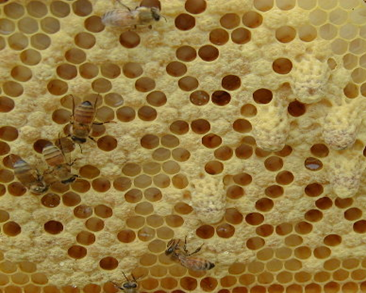
Emergency requeening cells (Nelson, 2022)

There are also situations when a colony loses its queen and is unable to rear a replacement queen. This is the result of a lack of eggs or young larvae (less than 3 days old). In this situation, some workers may start to lay eggs. The ovaries of these females will mature, and after these bees are fed royal jelly, eggs will mature. Since workers are incapable of mating, the eggs they lay will be unfertilized or drone eggs. If a population has laying workers it will slowly decline because the rearing of new workers stops with the loss of the queen (Sammataro and Avitabile 2011). A laying worker colony can be recognized by more than one egg being present in each cell, and if the eggs are on the sides of the cell walls, instead of the bottom. If eggs have not been laid as expected a laying worker colony should be suspected (Sammataro and Avitabile 2011).

It is important for beekeepers to have a good understanding of natural requeening scenarios, because, as a beekeeper, you can rear queens by simply letting the bees make their own. There are several risks associated with letting the bees make their own queen, but experienced beekeepers can successfully manage the process to allow a colony to rear a satisfactory queen. In fact many of the manipulations beekeepers undertake, such as splits, requeening, managing swarms, can be more successful with an understanding of the natural processes as done by the bees.


Connecting with ATTTA Specialists


If you’d like to connect with ATTTA specialists or learn more about our program, you can:


References
Sammataro, D., and Avitabile, A. 2011. The beekeeper's handbook. 4th ed. Ithaca, N.Y., Comstock Pub. Associates.
Winston, M.L., 1987. The biology of the honey bee. Harvard university press.


Honey Bee Biology Series: Natural Supersedure of Honey Bee Queens

Thursday, 11 May 2023

You have probably heard before that the queen is by far the most important member of a honey bee colony. Without a queen, for more than a short period, a colony is certain to die. The queen is so important because she is the only female with fully developed ovaries. Therefore, it is the role of the queen to lay a lot of eggs and to unite the colony by producing chemical scents. So, what happens if the queen is not good at doing her job? This week’s blog will explore what happens if there is an old or problematic queen in a colony, and how that colony will survive.


Honey Bee Biology Series: Natural Supersedure of Honey Bee Queens 


A supersedure is the bee’s way of replacing an existing queen without the intervention of a beekeeper when there is an old, unhealthy, or overall problematic queen. The supersedure process differs from that of swarming which is associated with reproduction, and in which one or more queens are raised and the original queen leaves the colony with a swarm. No new colony is formed when colonies supersede their queen. Instead supersede queens are raised out of need, including: an old and unproductive queen; injured or diseased queen; a reduced amount of queen mandibular pheromone (QMP) in the hive; queen has depleted spermatheca and is producing too many drones, or the queen is poorly bred. Any of the mentioned reasons can trigger a colony to supersede their queen (Hamdan 2010; Winston 1987).


Once a hive has been triggered to perform a supersedure, the workers will form queen cups from existing worker cells on the frame face, and the queen will lay eggs in the prepared cups. Like when a swarm occurs, virgin queens will develop in the queen cups (Winston 1987). The first queen to emerge from her cell will immediately sting the unhatched queens to death, or if there is more than one queen emerged the queens will fight to the death. After about 4‐7 days, the virgin queen is ready to mate, and she will commence laying eggs after 2-3 days. The original queen will be killed once the new queen starts laying eggs. During a supersedure, there may be a short in-between period where there are 2 queens in the hive laying eggs (Hamdan 2010).


Supersedure queen cells (Hamdan 2010) 

Occasionally, in spite of queen laying poorly, and therefore not producing a good brood pattern, she will not be superseded. This is likely due to her still producing an adequate amount of QMP. A high concentration of QMP will prevent supersedure by the colony (Hamdan 2010). The presence of this pheromone inhibits queen cell building, as well as the development of workers’ ovaries. Bees will evaluate the quality of their queen, in part, based on the abundance of QMP (Hamdan 2010). A young and healthy queen inhibits her replacement by producing lots of QMP, but her pheromone production will decrease with age. This is why age is considered one of the triggers, mentioned above, for supersedure. Also, it is important to note that population size also has an impact on the occurrence of a supersedure. If a colony is too large for the amount of QMP being produced by a queen supersedure may be triggered (Hamdan 2010).

A supersedure is one natural scenario where honey bees requeen their colony. Be sure to check out next week’s blog where the final requeening scenario (emergency requeening) will be explained.

Connecting with ATTTA Specialists


If you’d like to connect with ATTTA specialists or learn more about our program, you can:


References
Hamdan, K. 2010. Natural Supersedure of Queens in Honey Bee Colonies. Bee World. 87(3): 52 – 54. 

Winston, M.L., 1987. The biology of the honey bee. Harvard university press.

Honey Bee Biology Series: The Natural Conditions of Swarming

Thursday, 4 May 2023

It is well known that during the spring months honey bees are starting to swarm. During the early part of the season, honey bees swarm due to overcrowding in the hive. However, did you know that there are other causes for honey bees to swarm? Also, we can recognize the signs of a hive ready to swarm and predict when swarming will occur. This week’s blog will explain how and why swarming occurs, and also how we can predict when this event will occur. 

Honey Bee Biology Series: The Natural Conditions of Swarming

Swarming is the natural mechanism of colony reproduction. The colony divides, and leaves daughter queens to hatch and perpetuate the hive. Most often swarming is triggered by hive congestion, low potency of the queen mandibular pheromone, and minimal cell space for a queen to lay eggs. But swarming can also be triggered by a failing queen or a lack of ventilation in the hive (Winston 1987).

Once the hive has been triggered to swarm, worker bees will build swarm cells at the base of comb. Additionally, the queen lays drone eggs to carry on her genes. Next, the existing queen will lay eggs in the swarm cells or worker bees will move fertilized eggs into the cells (Winston 1987). When beekeeping, one way to recognize a hive that is ready to swarm is the presence of swarm cells. Swarm cells are found hanging at the bottom of the frame, whereas cells produced during an emergency requeening or supersedure are typically found in the middle of the frame. There are several other signs that a hive is ready to swarm, including: rapid growth of the worker bee population, drone rearing, bound broodnest, restlessness of existing queen, reduced laying, and field bees are less active (Winston 1987). 

Emerged swarm cells (Von Dietlien, 2021)

Once the hive is ready to swarm (typically when new queens have been reared in swarm cells) queen piping (tooting and quacking) occurs between the new queens and the original queen. Upon piping, workers can decide to protect the responding new queens by feeding them or they can ignore piping and let emerging queens find and kill other queens (Simpson and Cherry 1969). Recent research suggests that piping serves as information to the workers about the number of capped and released queens in order to decrease the rate of competition (Ramsey et al. 2020). Regardless of the signal function, it still indicates the presence of a virgin queen in preparation for a swarm.

When a new queen emerges two different scenarios can occur. The first scenario is that a new queen will take over the original colony, and the original queen will leave with a group of forager bees to find a new hive. The second scenario, known as an ‘afterswarm’, is where the population is still too large and the new queen also leaves the hive with a portion of the colony. This process may repeat until the population is a suitable size for the hive. 

Swarming requires a lot of preparation and the signals used can be olfactory as well as acoustic or vibrational (Rangel and Seeley 2008; Schlegel et al. 2012). Vibration signals are indicative of honey bee behaviour and overall health of the colony. They can be caused by honey bees contracting their thoracic wing muscle and pressing their vibrating bodies against the wax of the hive or another bee (Kirchner, 1993).

Automatic monitoring systems are an emerging tool for beekeepers to determine swarming preparation in a colony. The visual analysis of sound emitted by honey bees is a useful method for swarming detection. A study done by Ramsey et al. (2020) was able to successfully find a signal indicative of swarming, and was able to trigger accurate pre-swarming alarms. This work was originally done by Bencsik et al. (2011) where the honey bee swarming process was identified by analyzing the time course of hive vibrations.

Accelerometer installed in a bee hive frame to monitor swarming activity (Ramsey et al. 2020).


Overall, swarming is an important way for honey bees to spread to new locations and increase in numbers. Additionally, for a swarm to be successful requeening must occur. Next week’s blog will be exploring a different requeening scenario known as a supersedure.


Connecting with ATTTA Specialists


If you’d like to connect with ATTTA specialists or learn more about our program, you can:


References
Bencsik, M., Bencsik, J., Baxter, M., Lucian, A., Romieu, J. and Millet, M. 2011. Identification of the honey bee swarming process by analysing the time course of hive vibrations. Computers and Electronics in Agriculture. 76 (1).
Kirchner, W. 1993. Acoustical communication in honeybees. Apidologie. 24(3): 297 – 307.

Ramsey, M.T., Bencsik, M., Newton, M.I. et al. 2020. The prediction of swarming in honeybee colonies using vibrational spectra. Sci Rep.

Rangel, J., Seeley, T. 2012. Colony fissioning in honey bees: size and significance of the swarm fraction. Insectes Sociaux. 59 (4): 453 – 462.

Schlegel et al. 2012. Beeping and piping: characterization of two mechano-acoustic signals used by honey bees in swarming. Naturwissenschaften.

99(12): (2012) 1067 – 1071.

Simpson, J., Cherry, S.M. 1969. Queen confinement, queen piping and swarming in Apis mellifera colonies. Anim. Behav. 17: 271 – 278.

Winston, M.L., 1987. The biology of the honey bee. harvard university press.

Honey Bee Biology Series: Comparison of Natural Requeening Scenarios

Thursday, 27 April 2023

During the spring and early summer months swarming season is occurring for honey bees. through spring build up, a hive may have overcrowding and minimal cell space for a queen to lay eggs. Therefore, healthy colonies of honey bees develop a strong swarm impulse, and a population change occurs in the hive. Like honey bees, our ATTTA team also has changes occurring this spring, including the addition of a new apiculturist.  This week’s blog will provide an introduction to both the new ATTTA apiculturist and honey bee requeening scenarios.

Exciting ATTTA Announcement

Kayla Gaudet joins the ATTTA team as our newest apiculturist. She will assist with research projects for honey bees and pollination by working collaboratively with beekeepers and blueberry growers throughout the Atlantic region.

Kayla has a background in Biology and Environmental Management. She completed her Bachelor of Science degree in 2020, with an honours and a major in Biology at the University of New Brunswick. She then continued her education at Acadia University, where she graduated in 2022 with a Master of Science in Biology. Her MSc thesis focused on developing a natural-based pesticide for agricultural and residential purposes. She developed and tested this product with an industry partner to be effective against the two-spotted spider mite and a common necrotrophic fungus (Botrytis cinerea). She also assessed the secondary impacts of the pesticide on the common eastern bumble bee (Bombus impatiens).

Kayla will be sharing her interest in entomology by writing a series of blog posts all about basic honey bee biology. To start she will be exploring requeening scenarios in honey bees.

New Apiculturist, Kayla Gaudet (K.Gaudet 2023)

Honey Bee Biology Series: Comparison of Natural Requeening Scenarios


Natural requeening is when a colony of bees rears a new queen without the intervention of a beekeeper. There are three different scenarios that can trigger honey bees to rear a new queen: swarming, supersedure, and emergency response.

Swarming is one scenario where honey bees rear a new queen. Worker bees will build swarm cells at the base of comb. With the presence of swarm cells, one of two things will occur in the hive. Either the existing queen lays eggs in the swarm cells or the workers will move fertilized eggs to the cells. Once the virgin queen has developed in the cell, queen piping occurs between the virgin queen and the original mated queen. Queen piping is the communication (tooting and quacking) between queen bees to indicate each other’s presence. The original queen will then leave the colony with half the population to find a new hive, and the new queen will remain.

If there is an old or problematic queen the colony may decide to rear a new queen, which is known as a supersedure. The workers will form queen cups from existing worker cells on the frame face, and the queen lays eggs in the prepared cups. A new virgin queen will emerge, and she will replace the old queen.

A healthy queen on comb (ATTTA©2021).

A queen may die suddenly due to disease, predation or a beekeeper error. If this happens there is a quick emergency response. Within two days of queen loss, workers will create emergency queen cells scattered around existing young worker larvae. The young larvae will then fed on royal jelly and be raised as queens.

In any scenario, there are several requirements of the hive to raise a new queen, including: a sufficient amount of honey and pollen in the hive; sufficient population size; and the hive must have eggs or very young larvae. The descriptions above are a very brief overview of requeening scenarios.  Each of these has additional complexity which will be explored in the coming weeks. If you want to learn more about each of the requeening scenarios be sure to check out our next few blog posts. 


Connecting with ATTTA Specialists


If you’d like to connect with ATTTA specialists or learn more about our program, you can:


Black Queen Cell Virus: One of the Most Prevalent Viral Pathogens of Honey Bees

Thursday, 26 August 2021

During the current pandemic, social isolation has helped control the spread of Covid-19.  Unfortunately, honey bees are unable to socially isolate to curb the spread of viral diseases in their populations.  They live in large numbers, in very close proximity, engage in trophallaxis and allogrooming.  Spread of viral disease in a honey be colony is almost inevitable.  Interestingly, although honey bees may struggle to prevent viral diseases moving through their colonies, they may be helping us stay healthy.  There is recent work investigating how hive products can fight Covid-19 (Yahya Al Naggar, 2021) and even how honey bees are able to diagnose the Coronavirus.  Honey bee scientists in the bio-veterinary research laboratory at Wageningen University have successfully trained bee to detect Coronavirus positive samples to gain a food reward (Wageningen, 2021).  Even when it comes to viruses, we find further examples of how honey bees help us!  This week we will look at Black Queen Cell virus as we near the end of our series on honey bee viruses.

Black Queen Cell Virus: One of the Most Prevalent Viral Pathogens of Honey Bees

As the name implies, the Black Queen Cell Virus (BQCV) is a disease associated with developing queens at the larval and pupal stages.  The virus is transmitted horizontally by the worker bees as they move from infected cells to healthy queen cells.  There is also a suggestion that vertical transmission may occur from the queen through to her eggs.  Infection of BQCV in a developing queen larva will result in the death and ultimate necrosis of the pupa.  This results in the blackened, decomposing, undeveloped queen and the classic symptoms used to diagnose this disease.  This virus is most commonly seen in the spring of year but not limited to that season.  It has been suggested that this is the most common, although least understood, of the approximately 24 viruses infecting honey bees.  Believed to be present asymptomatically in adult queens and workers, the elevated titres seen in the developing queens cause morbidity.  Therefor this is a serious disease for the honey bee queen production industry.


Figure1. Virion Structure of the Black Queen Cell Virus (Spurny et al. 2017).


It has become obvious from our previous discussions that varroa infestation is linked to viral infections of honey bees.  This is not the only pest or disease which is been associated with viral disease transmission.  Nosema and  BQCV have been demonstrated in coinfections.  It has even been suggested that Nosema ceranae and BQCV act synergistically to significantly decrease host survival.  Additionally, Nosema and varroa have a negative, interactive effect on honey bee health.  So it is not surprising that varroa mite infestation are associated with this virus as well.  It would be easy to imagine this infectious triad could collapse a colony.  Optimistically, all three of these are less likely to occur in strong, healthy colonies.


Figure 2. Queen cell showing BQCV infection (Photo: Robert Snyder, BeeInformed)

There is no treatment for BQCV but there are ways to manage the risk of this disease.  As suggested above, ensure that your colonies are kept strong and healthy.  Manage your varroa mite populations.  Apply standard biosecurity practices, such as flaming hive tools, moving bees and equipment carefully between apiaries and operations.  Monitor for Nosema and treat if necessary.  Specific to queen operations, ensure specialist equipment such as grafting tools are sterile.  Ensure that cell builder and finisher colonies are healthy.  Mating nucs should be kept well fed, healthy and disease free!  If you find an incidence of BQCV in your operation, put appropriate measures in place to trace back the source and stop onward spread.

Next week will conclude this short series on honey bee viral disease as we look at Kashmir Bee virus.  This virus is also linked to varroa mite infestation and a close relative of the previously discussed Acute Bee Paralysis Virus.  Make sure not to miss any of our blogs by subscribing through the link in the left hand column.

Spurny R, Pridal A, Palkova L, Kiem HKT, de Miranda JR, Plevka P. Virion Structure of Black Queen Cell Virus, a Common Honeybee Pathogen. J Virol. 2017; 91(6): e02100–16. pmid:28077635

Wageningen University 2021 https://www.wur.nl/en/news-wur/Show/Training-bees-to-smell-the-coronavirus.htm

Yahya Al Naggar, John P. Giesy, Mohamed M. Abdel-Daim, Mohammad Javed Ansari, Saad N. Al-Kahtani, Galal Yahya, 2021 Fighting against the second wave of COVID-19: Can honeybee products help protect against the pandemic?, Saudi Journal of Biological Sciences, Volume 28, Issue 3, Pages 1519-1527


Connecting with ATTTA Specialists


If you’d like to connect with ATTTA specialists or learn more about our program, you can:


What to do with Your Queen Cells

Friday, 9 July 2021

This week the queen series is back for another post! Our previous posts provided an overview of how you can rear queen honey bees, from obtaining larvae to managing cell builders. Today, we will explore some different options for what you can do with your queen cells now that they are ready to be removed from their cell builder colonies.

What to do with Your Queen Cells

After two days in a starter colony and eight days in a finisher colony, your queen cells are ripe and ready for harvest! A queen takes 16 days to fully develop from the time she is laid as an egg. Recall that grafting was already four days into the queen’s development, so after ten additional days in the cell builder colonies you can expect your queens to emerge within two days. For comfort, and in case your larvae were a bit older 24 hours, it is recommended to be prepared for the queens’ emergence by this time.

So what can you do with your cells? The norm in Canada has been for queen producers to use queen cells to restock their own apiaries. One practice is to put the cell directly into the colony in which she will reign. For example, a newly split colony can be provided with a queen by simply placing the cell between the top bars, hanging down into the brood nest. There she will emerge, and in about two weeks she should begin to lay eggs of her own.

Another option is to sell your queens! Selling queens can provide beekeepers with additional revenue, supply the demand for local queens, and reduce the risk of foreign pest and disease introduction to our region. The simplest way to sell queens is as queen cells. They must be transported with care and in a timely fashion to their new hive where they will take their mating flight. However, while, this is simpler for the producer, the consumer demand is greater for mated queens.

Mated queens can be produced using mating yards and mating nucs. Mating yards are much like any other apiary but should be additionally stocked with an abundance of healthy drones. Drones are supplied to the yard by inserting drone comb into strong hives about five weeks before your queens are ready to emerge. The other distinction is that the yard will contain mating nucs. There is a lot of variation between mating nucs, in essence they are smaller colonies for virgin queens to emerge into and from which they take their mating flight. A queen cell can be placed into a mating nuc directly from the finishing cell builder. Allow two weeks to pass before returning to check in. During this time, she needs to emerge, reach sexual maturity, become mated, and begin laying, and she will be the most successful if the hive does not become stressed with disturbance. Mating yards require a lot of resources, so remember to feed the colonies in the absence of a good honey flow. When your queen is successfully mated and ready for sale, she can be placed in a queen cage with attendants and candy!

That concludes the queen series for this summer, and we hope that our readers will be encouraged to try their hand at raising healthy queen bees! Thank you for reading!


Connecting with ATTTA Specialists


If you’d like to connect with ATTTA specialists or learn more about our program, you can: