Showing posts with label swarm. Show all posts

Honey Bee Biology Series: Emergency Requeening

Thursday, 18 May 2023

In nature, events can occur unexpectedly, and when this happens animals often have an innate response to deal with a situation. Honey bees are excellent at responding to their environment, and to situations within their hive. For example, if their queen suddenly dies, the colony is quick to recognize this fact, and emergency requeening will occur. This week’s blog will explain how honey bees rear a new queen if their queen suddenly dies.

Honey Bee Biology Series: Emergency Requeening

A queen may die suddenly due to many factors, including beekeeper error. If this happens there is a emergency response to make the colony queenright. Usually, within two days of queen loss, workers will create emergency queen cells constructed on the face of the comb amid capped worker brood (Sammataro and Avitabile 2011; Winston 1987). The sudden loss of a queen forces the bees to modify worker cells into queen cells, and as the larval queens develop, the cells’ edges are slowly enlarged by the added wax. This will eventually form the peanut-shaped vertical, capped cell that is the characteristic of all queen cells. In emergency replacement, few (between one and three) cells will be produced.

The developed young larvae will then feed on royal jelly and be raised as queens. When emerged, the new virgin queen will kill other developing queens and take over the hive (Winston 1987).

Attempts to make queens from older worker larvae may result in intermediate forms of queens on maturation. Overall, emergency or supersedure queens rarely look as robust as queens developed during the swarm season (Sammataro and Avitabile 2011). 
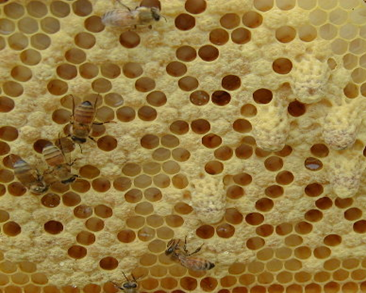
Emergency requeening cells (Nelson, 2022)

There are also situations when a colony loses its queen and is unable to rear a replacement queen. This is the result of a lack of eggs or young larvae (less than 3 days old). In this situation, some workers may start to lay eggs. The ovaries of these females will mature, and after these bees are fed royal jelly, eggs will mature. Since workers are incapable of mating, the eggs they lay will be unfertilized or drone eggs. If a population has laying workers it will slowly decline because the rearing of new workers stops with the loss of the queen (Sammataro and Avitabile 2011). A laying worker colony can be recognized by more than one egg being present in each cell, and if the eggs are on the sides of the cell walls, instead of the bottom. If eggs have not been laid as expected a laying worker colony should be suspected (Sammataro and Avitabile 2011).

It is important for beekeepers to have a good understanding of natural requeening scenarios, because, as a beekeeper, you can rear queens by simply letting the bees make their own. There are several risks associated with letting the bees make their own queen, but experienced beekeepers can successfully manage the process to allow a colony to rear a satisfactory queen. In fact many of the manipulations beekeepers undertake, such as splits, requeening, managing swarms, can be more successful with an understanding of the natural processes as done by the bees.


Connecting with ATTTA Specialists


If you’d like to connect with ATTTA specialists or learn more about our program, you can:


References
Sammataro, D., and Avitabile, A. 2011. The beekeeper's handbook. 4th ed. Ithaca, N.Y., Comstock Pub. Associates.
Winston, M.L., 1987. The biology of the honey bee. Harvard university press.


Honey Bee Biology Series: Natural Supersedure of Honey Bee Queens

Thursday, 11 May 2023

You have probably heard before that the queen is by far the most important member of a honey bee colony. Without a queen, for more than a short period, a colony is certain to die. The queen is so important because she is the only female with fully developed ovaries. Therefore, it is the role of the queen to lay a lot of eggs and to unite the colony by producing chemical scents. So, what happens if the queen is not good at doing her job? This week’s blog will explore what happens if there is an old or problematic queen in a colony, and how that colony will survive.


Honey Bee Biology Series: Natural Supersedure of Honey Bee Queens 


A supersedure is the bee’s way of replacing an existing queen without the intervention of a beekeeper when there is an old, unhealthy, or overall problematic queen. The supersedure process differs from that of swarming which is associated with reproduction, and in which one or more queens are raised and the original queen leaves the colony with a swarm. No new colony is formed when colonies supersede their queen. Instead supersede queens are raised out of need, including: an old and unproductive queen; injured or diseased queen; a reduced amount of queen mandibular pheromone (QMP) in the hive; queen has depleted spermatheca and is producing too many drones, or the queen is poorly bred. Any of the mentioned reasons can trigger a colony to supersede their queen (Hamdan 2010; Winston 1987).


Once a hive has been triggered to perform a supersedure, the workers will form queen cups from existing worker cells on the frame face, and the queen will lay eggs in the prepared cups. Like when a swarm occurs, virgin queens will develop in the queen cups (Winston 1987). The first queen to emerge from her cell will immediately sting the unhatched queens to death, or if there is more than one queen emerged the queens will fight to the death. After about 4‐7 days, the virgin queen is ready to mate, and she will commence laying eggs after 2-3 days. The original queen will be killed once the new queen starts laying eggs. During a supersedure, there may be a short in-between period where there are 2 queens in the hive laying eggs (Hamdan 2010).


Supersedure queen cells (Hamdan 2010) 

Occasionally, in spite of queen laying poorly, and therefore not producing a good brood pattern, she will not be superseded. This is likely due to her still producing an adequate amount of QMP. A high concentration of QMP will prevent supersedure by the colony (Hamdan 2010). The presence of this pheromone inhibits queen cell building, as well as the development of workers’ ovaries. Bees will evaluate the quality of their queen, in part, based on the abundance of QMP (Hamdan 2010). A young and healthy queen inhibits her replacement by producing lots of QMP, but her pheromone production will decrease with age. This is why age is considered one of the triggers, mentioned above, for supersedure. Also, it is important to note that population size also has an impact on the occurrence of a supersedure. If a colony is too large for the amount of QMP being produced by a queen supersedure may be triggered (Hamdan 2010).

A supersedure is one natural scenario where honey bees requeen their colony. Be sure to check out next week’s blog where the final requeening scenario (emergency requeening) will be explained.

Connecting with ATTTA Specialists


If you’d like to connect with ATTTA specialists or learn more about our program, you can:


References
Hamdan, K. 2010. Natural Supersedure of Queens in Honey Bee Colonies. Bee World. 87(3): 52 – 54. 

Winston, M.L., 1987. The biology of the honey bee. Harvard university press.

Honey Bee Biology Series: The Natural Conditions of Swarming

Thursday, 4 May 2023

It is well known that during the spring months honey bees are starting to swarm. During the early part of the season, honey bees swarm due to overcrowding in the hive. However, did you know that there are other causes for honey bees to swarm? Also, we can recognize the signs of a hive ready to swarm and predict when swarming will occur. This week’s blog will explain how and why swarming occurs, and also how we can predict when this event will occur. 

Honey Bee Biology Series: The Natural Conditions of Swarming

Swarming is the natural mechanism of colony reproduction. The colony divides, and leaves daughter queens to hatch and perpetuate the hive. Most often swarming is triggered by hive congestion, low potency of the queen mandibular pheromone, and minimal cell space for a queen to lay eggs. But swarming can also be triggered by a failing queen or a lack of ventilation in the hive (Winston 1987).

Once the hive has been triggered to swarm, worker bees will build swarm cells at the base of comb. Additionally, the queen lays drone eggs to carry on her genes. Next, the existing queen will lay eggs in the swarm cells or worker bees will move fertilized eggs into the cells (Winston 1987). When beekeeping, one way to recognize a hive that is ready to swarm is the presence of swarm cells. Swarm cells are found hanging at the bottom of the frame, whereas cells produced during an emergency requeening or supersedure are typically found in the middle of the frame. There are several other signs that a hive is ready to swarm, including: rapid growth of the worker bee population, drone rearing, bound broodnest, restlessness of existing queen, reduced laying, and field bees are less active (Winston 1987). 

Emerged swarm cells (Von Dietlien, 2021)

Once the hive is ready to swarm (typically when new queens have been reared in swarm cells) queen piping (tooting and quacking) occurs between the new queens and the original queen. Upon piping, workers can decide to protect the responding new queens by feeding them or they can ignore piping and let emerging queens find and kill other queens (Simpson and Cherry 1969). Recent research suggests that piping serves as information to the workers about the number of capped and released queens in order to decrease the rate of competition (Ramsey et al. 2020). Regardless of the signal function, it still indicates the presence of a virgin queen in preparation for a swarm.

When a new queen emerges two different scenarios can occur. The first scenario is that a new queen will take over the original colony, and the original queen will leave with a group of forager bees to find a new hive. The second scenario, known as an ‘afterswarm’, is where the population is still too large and the new queen also leaves the hive with a portion of the colony. This process may repeat until the population is a suitable size for the hive. 

Swarming requires a lot of preparation and the signals used can be olfactory as well as acoustic or vibrational (Rangel and Seeley 2008; Schlegel et al. 2012). Vibration signals are indicative of honey bee behaviour and overall health of the colony. They can be caused by honey bees contracting their thoracic wing muscle and pressing their vibrating bodies against the wax of the hive or another bee (Kirchner, 1993).

Automatic monitoring systems are an emerging tool for beekeepers to determine swarming preparation in a colony. The visual analysis of sound emitted by honey bees is a useful method for swarming detection. A study done by Ramsey et al. (2020) was able to successfully find a signal indicative of swarming, and was able to trigger accurate pre-swarming alarms. This work was originally done by Bencsik et al. (2011) where the honey bee swarming process was identified by analyzing the time course of hive vibrations.

Accelerometer installed in a bee hive frame to monitor swarming activity (Ramsey et al. 2020).


Overall, swarming is an important way for honey bees to spread to new locations and increase in numbers. Additionally, for a swarm to be successful requeening must occur. Next week’s blog will be exploring a different requeening scenario known as a supersedure.


Connecting with ATTTA Specialists


If you’d like to connect with ATTTA specialists or learn more about our program, you can:


References
Bencsik, M., Bencsik, J., Baxter, M., Lucian, A., Romieu, J. and Millet, M. 2011. Identification of the honey bee swarming process by analysing the time course of hive vibrations. Computers and Electronics in Agriculture. 76 (1).
Kirchner, W. 1993. Acoustical communication in honeybees. Apidologie. 24(3): 297 – 307.

Ramsey, M.T., Bencsik, M., Newton, M.I. et al. 2020. The prediction of swarming in honeybee colonies using vibrational spectra. Sci Rep.

Rangel, J., Seeley, T. 2012. Colony fissioning in honey bees: size and significance of the swarm fraction. Insectes Sociaux. 59 (4): 453 – 462.

Schlegel et al. 2012. Beeping and piping: characterization of two mechano-acoustic signals used by honey bees in swarming. Naturwissenschaften.

99(12): (2012) 1067 – 1071.

Simpson, J., Cherry, S.M. 1969. Queen confinement, queen piping and swarming in Apis mellifera colonies. Anim. Behav. 17: 271 – 278.

Winston, M.L., 1987. The biology of the honey bee. harvard university press.

Honeybee Swarm Decision Making

Thursday, 30 June 2022

A study that began at the University of Munich and inspired research at Cornell University and many others looks at how a swarm of bees chooses their new homestead in their natural setting. This decision-making process was observed in 1946 by Karl von Frisch and was further researched by Thomas D. Seeley. This important research helps us understand honeybees’ behavior and what is essential in a suitable hive location. They discovered that honeybees chose their new home via a unanimous vote by a selected party, almost like a democracy. In this blog, we will discuss how honeybees and their swarms find the best-suited home, read more to understand this decision-making process.

Honeybee Swarm Decision Making

In the summer, when a hive has become overcrowded, the existing queen and about 10,000 workers leave the hive to find a new home in an act called swarming. These venturing bees will leave the hive before knowing where their next home will be. They collectively fly away from the hive where they usually set up camp on a branch, forming heavy clusters of bees.

Among this swarm is some of the colonies’ oldest, most experienced bees that are deemed the scout bees and are given the task of spreading out and finding viable caverns, ideally in trees, to make their new hive.

What are these scouts looking for? Many factors need to be considered when a hive is choosing a new home; location and size of entrance, ample space, and stability are all critical. The ideal entrance is south-facing, small, and high above the ground, making it easy to protect and hard for predators, like bears, to approach. The space in the hive needs to be able to hold enough honey for them to survive the winter, as well as brood and the bees themselves, making the ideal size of their hive around 10 gallons (∼ 40L). Honeybees also prefer to nest in live trees compared to dead ones. The tree must be able to hold the added weight of the hive, and dead trees are more likely to fall down than live ones are.

How do the bees scout the hive? When a scout bee finds an acceptable opening, she will take many trips in and out of the space. She will spend time flying and tracking the inside of the hole and deciding if this space fulfills all the colony's requirements. If she decides it is acceptable, she will return to the swarm and report her findings in a waggle dance, similar to how they communicate where florals are for foraging.

This dance will indicate the direction, in relation to the sun, and distance of the scouted hive. Other scout bees will observe this dance and evaluate this sight themselves. Initially, multiple scout bees will all be indicating different locations. After some time, each scout will have a chance to look at many of these sights and will decide for themselves which home will be best. In the end, all scout bees will be performing the same dance indicating the best location. Once all scouts have agreed, they take off to the chosen location altogether. If two areas are similar, the decision may take longer, but ultimately the swarm will choose the best one collectively. In the rare case that two areas are exactly equal in quality, this may lead to a tug-of-war. This can be very confusing for the other swarm bees and lead to the swarm splitting, loss of worker bees, loss of the queen, and possibly the whole swarm perishing. This whole decision-making process may take days to finalize.

It is important to remember this is a life-or-death decision for a swarm. If the home chosen fails to meet the requirements, it may lead to the demise of the new colony. Therefore, it is crucial to make the right choice. The multiple opinions of the scout bees help collectively select the optimal option for survival. Honeybees work together for survival and succession. Thomas D. Seeley has done extensive research on this topic and has written three publications about his work, among them a book called Honeybee Democracy, where he details how this decision-making process works and how it has been researched over the years.

Written by Rebecca Campbell, ATTTA Summer Research Assistant rcampbell@perennia.ca


Connecting with ATTTA Specialists


If you’d like to connect with ATTTA specialists or learn more about our program, you can:


visit our website at https://www.perennia.ca/portfolio-items/honey-bees/


Email abyers@perennia.ca


Swarm Biosecurity

Thursday, 2 June 2022

Sometimes free things can be costly, as may be the case with a honey bee swarm. With swarm season upon us, it is a good time to consider what to do if you spot a swarm that isn’t from your apiary. Swarms, brought into your apiary, may present a risk for the rest of your bees. This week’s blog is on catching ‘free’ swarms and the biosecurity measures that should be considered when doing so.

Swarm Biosecurity

For honey bees, swarming is a natural reproductive process but there are also other reasons for a colony to leave a hive. In absconding, there could be an attempt to ensure the colonies health through reducing disease or pest pressure by leaving behind mites, bacteria, or fungus and relocating to a new fresh home. If a colony swarms due to hive congestion, the mother colony may still be infected. So when we find a swarm there is no immediate indication of the disease status or reason for the bees relocating. Vertical transmission of pathogens may occur between the colonies and spread to another apiary.  When a diseased or pest-ridden swarm is relocated within or near an apiary, it has the potential to impact on the health of all the colonies in that yard.

Honey bee swarm on a tree branch (Photo: Tim Howell, South Carolina Blackwater Beekeepers Association)

Where possible, understanding the background on a swarm will help identify the level of danger but usually very little information is available. A best management practice would be to assume that a caught swarm presents a high biosecurity risk and the colony should be quarantined. A quarantined area should be far enough away from other apiaries to prevent robbing and drifting. Equipment from quarantined hives should not be immediately used in other hives. All hive tools should also be disinfected by torching after working in quarantined hives.

The honeybees in the quarantined swarm can be inspected and tested for certain pests and diseases. Varroa mite testing can be done on site by using an ether roll, alcohol wash, or sticky board. Methods for testing and economic thresholds can be found in the Summer Disease and Pest Monitoring factsheet by ATTTA. Samples of adult bees can also be tested for Nosema. Atlantic beekeepers are welcome to send samples to ATTTA for nosema diagnosis! Once brood production begins inspection for diseases, such as American and European foulbrood should be undertaken.

Swarms from unknown sources can be more damaging, and costly, to your apiary than beneficial. With best management practices, such as monitoring, testing, and quarantining, the risks that come with collecting swarms can be reduced. Also, using best management practices can help reduce swarming, and the potential spread of pests and diseases to neighboring apiaries. 

Written by John MacDonald, ATTTA Seasonal Apiculturist johnmacdonald@perennia.ca


Connecting with ATTTA Specialists


If you’d like to connect with ATTTA specialists or learn more about our program, you can:


What's the Buzz with ATTTA # 6 All about swarming, wintering losses, tick ID

Thursday, 16 July 2020

Swarm Prevention Techniques

A swarm in May is worth a load of hay; a swarm in June is worth a silver spoon; but a swarm in July is not worth a fly! Some beekeepers may not agree with this and will find a place for bee swarms no matter the month. However, it is that time of year when bee colonies are building up and the tendency for swarming increases. There are techniques beekeepers can employ to reduce the risk of swarming. Check out this ATTTA fact sheet for ideas to prevent swarming. 
https://www.perennia.ca/wp-content/uploads/2018/04/08-swarm-prevention.pdf

Prince Edward Island Wintering Losses: Lowest in Years!

Previously, Prince Edward Island beekeepers lost over half (54.1%) of their colonies in the winter of 2018/19.  The preceding two years had over 40% losses reported in the Canadian Association of Professional Apiculturists (CAPA) Statement on Honey Bee Wintering Losses in Canada. Last year, in response to these high losses PEI beekeepers, along with ATTTA, organized and attended specific workshops, farm visits and general extension to improve winter preparation and fall management.  Improved fall management practices, combined with favorable winter weather, have resulted in the most successful winter for PEI beekeepers since 2010 and second best winter since these records began.  Cameron Menzies, the PEI provincial apiarist commented, ‘this improvement in winter loss is a significant accomplishment for the Island’s beekeeping industry, especially considering the high reported losses of the past.  These successes will have an impact on the number and quality of bees available for pollination and help our beekeepers in growing the pollination capacity of the Island’.  The full CAPA report on national wintering losses will be out soon but this is a great outcome for PEI beekeeping industry.

Tick Safety in the Beeyard


ATTTA has just released the newest fact sheet about tick safety. Check out the link below, also available on our website. Bishop's University developed a free app (etick) you can download on your mobile device where photos can be uploaded for tick identification. This is part of a citizen science project that invites the public to participate in the monitoring of ticks in Canada. You can find out more information about this project on etick.ca.

Connecting with ATTTA Specialists
If you’d like to connect with ATTTA specialists or learn more about our program, you can:
·       Visit our website at https://www.perennia.ca/portfolio-items/honey-bees/
·       Read The Root newsletter through Perennia at https://us4.list-manage.com/subscribe?u=642ec925a6b70139cd668d4b0&id=0e9b713521
·       Call our Truro office at (902) 896-0277
·       Email abyers@perennia.ca

Thanks for following along with our blog and keeping up with the ATTTA buzz & don't forget to subscribe!