Showing posts with label cells. Show all posts

What the Cell: The Bee-ginning

Thursday, 4 July 2024

In honey bee hives, there remains much to discover about the intricate world of the cells found in the comb. Previously on the last blog about cells, food storage and different types of food for the honey bees was discussed. The behavior of bees is purposeful, and they strategically position food and brood in their hive.  The placement and size of cells play an important role in the bees’ development. By exploring the inside of cells, we can understand brood, and the development of the bees.

What the Cell: The Bee-ginning

Within a bee colony, three castes of bees play crucial roles, each with its unique characteristics. Worker bees, the most abundant in a hive, are small, sterile, female bees that acquire various jobs over their life cycle from nursing to foraging. The cells where worker bees develop are the same size as the cells used to store food 1. These cells are around 5.20-5.40 mm 2. Drones, on the other hand, are male bees that make up about 15% of the hive's population 1. Unfertilized eggs are placed into larger drone cells, these cells are approximately 6.20-6.40 mm 2. Drone cells are located on the outer part of the hive, and their primary role is to mate with a virgin queen 3. Lastly, the queen bee, the largest in the hive, has an essential responsibly of laying eggs so the colony can grow 1. Since there is only one queen, the presence of queen cups may indicate swarming, a substandard queen, the loss of a queen, or worker bees may just make them for “practice”1. Based on if an egg is fertilized or not, the size of the cell it is placed in, and the diet the larvae is fed all determines the caste of bee 4.

Honey bees and brood (©ATTTA 2021)

Honey bees are insects that go through metamorphosis 5. All three castes within a colony which are workers, drones, and a queen, undergo distinct developmental stages before they are full grown. These stages are just slightly different depending on their role. The journey begins when the queen lays the egg. This egg development will last about three days 1. Next, the egg hatches into a larva, resembling white grubs 1.  The larva feeds for several days to grow. For worker bees and drones, the larva stage lasts approximately six days, and 4.6 for queen bees 1. Initially all bee larva are nourished with royal jelly for the first two days. However, female eggs that are continuing to receive royal jelly have the potential to develop into queens 5. After approximately five days the larva get capped with a mixture of pollen and wax 5. The capped brood then forms a silk cocoon around itself for three days before becoming a pupa 5. During the pupa stage the bee goes through many morphological changes. The legs, wings, and abdomen all form during this stage before becoming an adult bee 1. The duration of these stages varies among the bees. Drone bees have the longest development period, taking approximately 24-25 days to mature from egg to emergence 1. Worker bees typically develop within 19-22 days, and queens have the shortest developing time, emerging in roughly 15-17 days 1.

When observing the brood within a hive, the health of the colony becomes clear. A frame that is densely filled with brood, could be a sign that the hive is healthy. It suggests that the environment is stable and temperature for the developing brood is being regulated 6. This also indicates that the queen is laying eggs effectively 6. During the beekeeping season, the stored food in the cells will be consumed, and eggs will hatch. However, as long as the egg-laying pattern remains consistent, the hive’s efficiency is likely to persist. Ideally, the brood should be located at the center of the hive, with food stores on the outer frames. When examining a single frame, the brood should be positioned at the bottom, with food stored above. Honey should form an arching pattern at the top, with pollen situated between honey and brood.
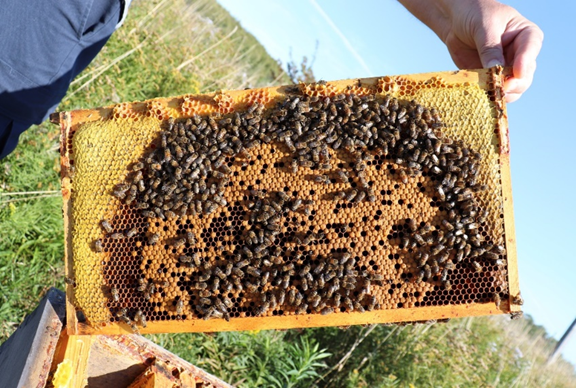
Good arching brood pattern (©ATTTA 2021)

Checking inside the hive is essential for understanding the honey bee colony’s dynamic and overall health. By examining the cells and the frames they inhabit, it should now be clearer about what would be seen inside the hive. The cells reveal the diverse foods honey bees consume, and the shapes of the cells can help identify the bee class residing there. Additionally, observing brood in a cell provides a glimpse into the bee’s life cycle. Reading the cells is important to understand many important aspects of a colony.  

 Written by Kaitlyn Newton, ATTTA Seasonal Apiculturist

References

  1. Sammataro, D. and Avitabile, A., 2021. The beekeeper’s handbook fifth addition. Cornell University Press.
  2. Zhang, L., Shao, L., Raza, M.F., Han, R. and Li, W., 2024. The Effect of Comb Cell Size on the Development of Apis mellifera Drones. Life, 14(2), p.222.
  3. Boes, K.E., 2010. Honeybee colony drone production and maintenance in accordance with environmental factors: an interplay of queen and worker decisions. Insectes sociaux, 57, pp.1-9.
  4. Wei, H., He, X.J., Liao, C.H., Wu, X.B., Jiang, W.J., Zhang, B., Zhou, L.B., Zhang, L.Z., Barron, A.B. and Zeng, Z.J., 2019. A maternal effect on queen production in honeybees. Current Biology, 29(13), pp.2208-2213.
  5. Yadav, S., Kumar, Y. and Jat, B.L., 2017. Honeybee: Diversity, castes and life cycle. Industrial entomology, pp.5-34.
  6. Camazine, S., 1991. Self-organizing pattern formation on the combs of honey bee colonies. Behavioral ecology and sociobiology, 28, pp.61-76. 

 Connecting with ATTTA Specialists

If you’d like to connect with ATTTA specialists or learn more about our program, you can:

visit our website at https://www.perennia.ca/portfolio-items/honey-bees/

Email abyers@perennia.ca


What the Cell?

Thursday, 6 June 2024

Whether you are a seasoned beekeeper with years of experience, or just starting out on your apiary journey, it is always important to revisit the basics. By refreshing your memory, or reinforcing seemingly straightforward topics, diving back into fundamentals can greatly enhance your understanding of beekeeping. In honey bee hives there are numerous cells that are built from wax by the bees. These cells serve various functions, including storing food and taking care of brood.  This week we will explore some facts about honey comb cells.

What the Cell?

Honey bees construct hexagonal cells which make up the comb found on frames in the hive. Worker cells, which contain developing female or worker bees, can have an approximate size of 5.20-5.40 mm, and drone cell, where male bees develop,  sizes can range from 6.20-6.40 mm6. The cell are constructed using beeswax that the bees produce from a secretory gland in their abdomen1. These cells are used for different purposes. Nurturing brood and storing food are both functions of the different cells.  By understanding what the different types of cells should look like, beekeepers can help to keep the hive well balanced and healthy. By recognizing these different cell types, beekeepers can also understand hive changes such as when a colony is going to swarm. 

Queen, eggs, drone, capped brood, honey, pollen (©ATTTA 2022)

Nectar, which is an aqueous solution of sugars, amino acids and minerals, is gathered from flowers by honeybees to bring back to the hive using their honey stomach2. Once the forager bee gets back to the hive, it passes on the nectar to a receiver bee, and sucrase gets added to the nectar before being placed in the cell2.  Sucrase is an enzyme that breaks down sucrose into simpler sugar molecules2. It is the job of the receiver bee to break down sucrose, but both forager and receiver bees have the enzyme sucrase7.  The water must be evaporated from the nectar to increase sugar concentration and form honey. Nectar starts at a water content as high as 80% and the bees reduce it to approximately 17-20%2. By evaporating most of the water, it also helps to store the honey long term, because fermenting organisms cannot live there2. Bees actively evaporate nectar by regurgitation and re-ingesting droplets, and passive evaporation is also done by bees using a fanning behavior3 . Once the moisture content is low, and the honey is ripe, it will be capped off with a thin layer of wax so it can be stored indefinitely4 . Honey is hygroscopic, so if the bees cap it the moisture from the environment should not re-enter the cell, which prevents fermentation8. The honey is then used for food when bees cannot forage for nectar.

Cells with capped and uncapped honey (©ATTTA 2024)

Pollen is attracted to the bees and is transferred from the anthers of flowers2. Pollen is an important source of nutrients for bees because it contains a proteins, lipids, vitamins, and minerals5. Bees collect pollen using a small amount of nectar to make the pollen stick and give it beneficial bacteria, then they put it into pollen baskets on their back legs, known as corbiculae2. When back from foraging the honeybees back push the pollen pellets off their legs into an empty cell, or one half filled with pollen. Housekeeping bees then pack the pollen and add nectar from their honey sac to start a fermentation process2. The microflora of pollen contains bacteria, yeasts and molds which all play a role in fermentation9. But primarily the process is driven by the lactic acid bacteria, which produces lactic acid playing a crucial role in preserving the bee bread10. This is how beebread is formed, and bees sometimes cap the cells with honey to preserve it since it does not last as long as honey does2.

In a well-organized hive bees exhibit remarkable precision in arranging their food and offspring.  The outer frames mostly contain food stores. Within a single frame, bees construct an arching figure where honey is stored in the upper cells, followed by a layer of pollen beneath, and finally, the lower cells are designed for brood. Typically, the brood is concentrated in the center of the hive in an area called the brood nest. This interesting aspect of bee behavior will be explored further in an upcoming blog post.

Written by Kaitlyn Newton, ATTTA Seasonal Apiculturist


References:

  1. Xu, R., Ma, B., Yang, Y., Dong, X., Li, J., Xu, X. and Fang, Y., 2024. Proteome-metabolome profiling of wax gland complex reveals functional changes in honeybee (Apis mellifera L.). iScience.

  2. Sammataro, D. and Avitabile, A., 2021. The beekeeper’s handbook fifth addition. Cornell University Press.
  3. Nicolson, S.W., Human, H. and Pirk, C.W., 2022. Honey bees save energy in honey processing by dehydrating nectar before returning to the nest. Scientific Reports, 12(1), p.16224.
  4. Fernandes, K.E., Frost, E.A., Remnant, E.J., Schell, K.R., Cokcetin, N.N. and Carter, D.A., 2022. The role of honey in the ecology of the hive: Nutrition, detoxification, longevity, and protection against hive pathogens. Frontiers in Nutrition, 9, p.954170.
  5.  Huang, Z., 2010. Honey bee nutrition. American Bee Journal, 150(8), pp.773-776.
  6.  Zhang, L., Shao, L., Raza, M.F., Han, R. and Li, W., 2024. The Effect of Comb Cell Size on the Development of Apis mellifera Drones. Life, 14(2), p.222.
  7.  Zhu, Y.C., Caren, J., Reddy, G.V., Li, W. and Yao, J., 2020. Effect of age on insecticide susceptibility and enzymatic activities of three detoxification enzymes and one invertase in honey bee workers (Apis mellifera). Comparative Biochemistry and Physiology Part C: Toxicology & Pharmacology, 238, p.108844
  8. Kubásek, J., Svobodová, K., Půta, F. and Krejčí, A.B., 2022. Honeybees control the gas permeability of brood and honey cappings. iScience, 25(11), p.105445.
  9.  Miłek, M., Mołoń, M., Kula-Maximenko, M., Sidor, E., Zaguła, G. and Dżugan, M., 2023. Chemical Composition and Bioactivity of Laboratory-Fermented Bee Pollen in Comparison with Natural Bee Bread. Biomolecules, 13(7), p.1025
  10.  Kieliszek, M., Piwowarek, K., Kot, A.M., Błażejak, S., Chlebowska-Śmigiel, A. and Wolska, I., 2018. Pollen and bee bread as new health-oriented products: A review. Trends in Food Science & Technology, 71, pp.170-180.


                                                 Connecting with ATTTA Specialists

If you’d like to connect with ATTTA specialists or learn more about our program, you can:

visit our website at https://www.perennia.ca/portfolio-items/honey-bees/

Email abyers@perennia.ca