Showing posts with label beebread. Show all posts

What the Cell?

Thursday, 6 June 2024

Whether you are a seasoned beekeeper with years of experience, or just starting out on your apiary journey, it is always important to revisit the basics. By refreshing your memory, or reinforcing seemingly straightforward topics, diving back into fundamentals can greatly enhance your understanding of beekeeping. In honey bee hives there are numerous cells that are built from wax by the bees. These cells serve various functions, including storing food and taking care of brood.  This week we will explore some facts about honey comb cells.

What the Cell?

Honey bees construct hexagonal cells which make up the comb found on frames in the hive. Worker cells, which contain developing female or worker bees, can have an approximate size of 5.20-5.40 mm, and drone cell, where male bees develop,  sizes can range from 6.20-6.40 mm6. The cell are constructed using beeswax that the bees produce from a secretory gland in their abdomen1. These cells are used for different purposes. Nurturing brood and storing food are both functions of the different cells.  By understanding what the different types of cells should look like, beekeepers can help to keep the hive well balanced and healthy. By recognizing these different cell types, beekeepers can also understand hive changes such as when a colony is going to swarm. 

Queen, eggs, drone, capped brood, honey, pollen (©ATTTA 2022)

Nectar, which is an aqueous solution of sugars, amino acids and minerals, is gathered from flowers by honeybees to bring back to the hive using their honey stomach2. Once the forager bee gets back to the hive, it passes on the nectar to a receiver bee, and sucrase gets added to the nectar before being placed in the cell2.  Sucrase is an enzyme that breaks down sucrose into simpler sugar molecules2. It is the job of the receiver bee to break down sucrose, but both forager and receiver bees have the enzyme sucrase7.  The water must be evaporated from the nectar to increase sugar concentration and form honey. Nectar starts at a water content as high as 80% and the bees reduce it to approximately 17-20%2. By evaporating most of the water, it also helps to store the honey long term, because fermenting organisms cannot live there2. Bees actively evaporate nectar by regurgitation and re-ingesting droplets, and passive evaporation is also done by bees using a fanning behavior3 . Once the moisture content is low, and the honey is ripe, it will be capped off with a thin layer of wax so it can be stored indefinitely4 . Honey is hygroscopic, so if the bees cap it the moisture from the environment should not re-enter the cell, which prevents fermentation8. The honey is then used for food when bees cannot forage for nectar.

Cells with capped and uncapped honey (©ATTTA 2024)

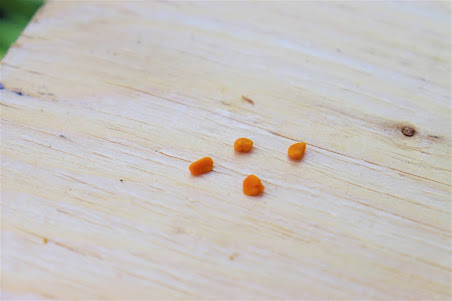
Pollen is attracted to the bees and is transferred from the anthers of flowers2. Pollen is an important source of nutrients for bees because it contains a proteins, lipids, vitamins, and minerals5. Bees collect pollen using a small amount of nectar to make the pollen stick and give it beneficial bacteria, then they put it into pollen baskets on their back legs, known as corbiculae2. When back from foraging the honeybees back push the pollen pellets off their legs into an empty cell, or one half filled with pollen. Housekeeping bees then pack the pollen and add nectar from their honey sac to start a fermentation process2. The microflora of pollen contains bacteria, yeasts and molds which all play a role in fermentation9. But primarily the process is driven by the lactic acid bacteria, which produces lactic acid playing a crucial role in preserving the bee bread10. This is how beebread is formed, and bees sometimes cap the cells with honey to preserve it since it does not last as long as honey does2.

In a well-organized hive bees exhibit remarkable precision in arranging their food and offspring.  The outer frames mostly contain food stores. Within a single frame, bees construct an arching figure where honey is stored in the upper cells, followed by a layer of pollen beneath, and finally, the lower cells are designed for brood. Typically, the brood is concentrated in the center of the hive in an area called the brood nest. This interesting aspect of bee behavior will be explored further in an upcoming blog post.

Written by Kaitlyn Newton, ATTTA Seasonal Apiculturist


References:

  1. Xu, R., Ma, B., Yang, Y., Dong, X., Li, J., Xu, X. and Fang, Y., 2024. Proteome-metabolome profiling of wax gland complex reveals functional changes in honeybee (Apis mellifera L.). iScience.

  2. Sammataro, D. and Avitabile, A., 2021. The beekeeper’s handbook fifth addition. Cornell University Press.
  3. Nicolson, S.W., Human, H. and Pirk, C.W., 2022. Honey bees save energy in honey processing by dehydrating nectar before returning to the nest. Scientific Reports, 12(1), p.16224.
  4. Fernandes, K.E., Frost, E.A., Remnant, E.J., Schell, K.R., Cokcetin, N.N. and Carter, D.A., 2022. The role of honey in the ecology of the hive: Nutrition, detoxification, longevity, and protection against hive pathogens. Frontiers in Nutrition, 9, p.954170.
  5.  Huang, Z., 2010. Honey bee nutrition. American Bee Journal, 150(8), pp.773-776.
  6.  Zhang, L., Shao, L., Raza, M.F., Han, R. and Li, W., 2024. The Effect of Comb Cell Size on the Development of Apis mellifera Drones. Life, 14(2), p.222.
  7.  Zhu, Y.C., Caren, J., Reddy, G.V., Li, W. and Yao, J., 2020. Effect of age on insecticide susceptibility and enzymatic activities of three detoxification enzymes and one invertase in honey bee workers (Apis mellifera). Comparative Biochemistry and Physiology Part C: Toxicology & Pharmacology, 238, p.108844
  8. Kubásek, J., Svobodová, K., Půta, F. and Krejčí, A.B., 2022. Honeybees control the gas permeability of brood and honey cappings. iScience, 25(11), p.105445.
  9.  Miłek, M., Mołoń, M., Kula-Maximenko, M., Sidor, E., Zaguła, G. and Dżugan, M., 2023. Chemical Composition and Bioactivity of Laboratory-Fermented Bee Pollen in Comparison with Natural Bee Bread. Biomolecules, 13(7), p.1025
  10.  Kieliszek, M., Piwowarek, K., Kot, A.M., Błażejak, S., Chlebowska-Śmigiel, A. and Wolska, I., 2018. Pollen and bee bread as new health-oriented products: A review. Trends in Food Science & Technology, 71, pp.170-180.


                                                 Connecting with ATTTA Specialists

If you’d like to connect with ATTTA specialists or learn more about our program, you can:

visit our website at https://www.perennia.ca/portfolio-items/honey-bees/

Email abyers@perennia.ca


Pollen: The Protein Source of Bees

Thursday, 4 November 2021

Natural foods and health products has gained significant interest, especially over the past decade, as the link between good nutrition and good health has also gained interest in research studies. These studies help to provide a better understanding of the potential health benefits and applications of natural products, including various hive products. So far, in our ‘Hive Products for Human Health’ mini-series, we have discussed some health-related beneficial bioactivities and applications of honey, propolis, and beeswax. This week we are moving on to pollen; keep reading to learn about potential human health benefits of the protein source of bees: pollen.

What’s the Buzz with ATTTA Podcast Episode 10 is now available! Keep reading for a sneak peek of what this episode’s discussions are all about. 

We’ve began creating weekly “ATTTA Buzz” posts to share ATTTA news, announcements, and timely reminders intended for beekeepers in Atlantic Canada, but available to all others that are interested! We will be sharing these posts from our Twitter account (@beeatlantic) and through social media pages of some beekeepers’ associations and other beekeeping groups in our maritime region. Keep an eye out for the weekly ATTTA Buzz to stay up to date with what we’ve up to, we are glad to have you following along!

Pollen: The Protein Source of Bees

Pollen is collected by foraging worker bees and brought back to the hive to be made into bee bread used to feed larvae to provide essential proteins required for successful worker and drone brood production. A developing queen does not receive pollen in her diet. The pollen that is found stored within the hive is compositionally unique from its original form when it was produced by the flower from which it was collected. When bees collect pollen from a flower, they incorporate small amounts of nectar and a saliva-like substance that contains enzymes. This makes the pollen sticky enough to be packed neatly into a secure pellet in the worker bee’s ‘pollen basket’, located on her hindlegs. The composition of pollen itself is unique depending on the floral source, geographic location, and other environmental conditions; similar to honey and beeswax, as discussed earlier in this mini-series. Since foraging worker bees also add nectar and enzyme-containing saliva to the pollen to ready it for transport, compositional variation from these additions are also incorporated into the pollen. This is important to consider when discussing the composition and potential beneficial uses and therapeutic applications of honey bee collected pollen and pollen products (i.e., bee bread).

Antimicrobial and antioxidant activities of natural and fermented bee pollen *

Bee pollen is sold as a hive product for human health and nutrition in various forms including natural pollen pellets, capsules, powder, and also bee bread pellets and other forms of pollen that has undergone fermentation processes. Even if the same pollen source was used in a particular set of products, that include both pollen pellets and bee bread, the digestibility and bioactivities of the natural pollen and the fermented pollen tend to vary. Even between fermented pasteurized pollen and fermented natural pollen, the bioactivities of the product can vary. This study aimed to evaluate the bioactivities of both natural and pasteurized pollen that has undergone either spontaneous fermentation or fermentation through bacterial activity by two lactose related bacteria: Lactocoocus lactis and Lactobacillus rhamnosus. The results of this investigation indicate effective beneficial bioactivities and dietary values of various forms of pollen, for the purpose of consumption with the goal of improving of human health, including:

  • Fermentation = greater antioxidant activity
  • Antioxidant activity of fermented natural pollen > fermented pasteurized pollen
  • Antioxidant activity of bacteria fermented pollen > spontaneously fermented pollen
  • Fermentation = greater microbial activity; other microbial compounds are also produced by bacteria through the fermentation process
  • Fermentation = greater antifungal activity

Small variations and changes in the activities of all evaluated pollen were attributed to the botanical origin of the pollen itself and the type of fermentation process performed. This study concludes these findings with the idea that highlighting the improvement of bioactivities and health-benefitting potentials of bee pollen after fermentation has the potential to “open more applications of bee pollen in the food and pharmaceutical industries.”


* Kaskaniene, V., Adaskevicitue, V., Kaskonas, P., Mickene, R, and Maruska, A. 2020. Antimicrobial and antioxidant activities of natural and fermented bee pollen, Food Bioscience. Full text available ONLINE.


What’s the Buzz with ATTTA Podcast Episode 10

Dr Andony Melathopoulos is a researcher and beekeeper with direct ties to eastern Canada.  Having spent time at Nova Scotia’s Dalhousie University (AC campus) while undertaking his doctoral studies, Andony contributed in a positive, and long lasting way to our industry.  Through his research work and enthusiastic teaching Andony left a strong impression on those he met while in Nova Scotia.  Listen to our latest podcast to learn about Andony’s beekeeping journey from eastern Canada to his position on the faculty of Oregon State University.  Find out about his current research related to pollination and honey bee health! You will encounter few beekeepers who are as interested and energetic about honey bees as this months guest, so take a few minutes to meet or reacquaint yourself with this fascinating beekeeper. Listen from your choice of podcast streaming platforms HERE.


Connecting with ATTTA Specialists


If you’d like to connect with ATTTA specialists or learn more about our program, you can: