Showing posts with label comb. Show all posts

Comb Rotation

Thursday, 23 July 2026

Honey bees consistently used comb for storage of food products, supporting brood development and as a structural component within the hive. Honey bees will remove or rebuild wax themselves after many years, but the buildup of residues, such as agrochemicals, and pathogens, can all occur within the wax after only a few years of use. Regular comb rotation every four to five years helps improve honey bee health by limiting exposure to contaminants found within wax as it ages.

Comb Rotation

Comb rotation is the regular replacement of older comb with new foundation or freshly drawn comb. Over time, comb becomes darker, heavier and more contaminated. The older the comb is, the more it will undergo structural changes that reduce cell volume and produce smaller workers with shorter lifespans 1. Replacing comb helps maintain cleaner wax and supports healthier colony development.

Dark comb is a visual indicator of age, so beekeepers should identify the darkest, oldest frames and replace them with new frames and foundation. Marking the date, year of placement, on the top bars of the frames can help beekeepers track the age of frames. By removing old comb and allowing bees to draw fresh wax, beekeepers can also reduce buildup of contaminants that accumulate over time.

Figure 1: Dark, old frames near the brood nest (ATTTA ©, 2026)

Early in the spring is the ideal time for comb rotation because colonies are expanding and brood nests are being built. Feeding 1:1 sugar water syrup to honey bees can also stimulate wax production during that time of year. This timing allows for the replacement of old comb without disrupting brood patterns. 

Beekeepers can gradually replace frames by removing one or two frames per season from the edge of the colony or by replacing darkest frames first and then replacing them with new foundation. Frames should be slowly rotated to the outside position which would be the 1st and 10th frames on standard Langstroth equipment. Removing the outside frames will ensure the brood nest is not disrupted and only the outside frames can be culled. When removing frames, beekeepers should aim to remove 20% of the comb, or 2 frames per a standard 10-frame Langstroth hive box every season. 

Figure 2: Honey bees on a frame with new wax

Comb rotation is a preventive, integrated pest management, practice that supports colony health by reducing disease, chemical residues, and structural constraints related to aged comb. Removing frames is a physical control used to eradicate the disease American foulbrood and Vairimorpha (formerly Nosema) 2.

Cultural controls are also a good management practice that beekeepers can use to minimize the risk of disease, like disinfecting comb by fumigation or irradiation can be used for treating comb infected by Vairimorpha spores 2. Details on fumigation and irradiation will be discussed further in another blog post in the future.

By replacing older frames each spring and maintaining a 4–5 year turnover cycle, beekeepers can promote cleaner wax, healthier brood development and more resilient colonies. For additional information on Comb Rotation, refer to the Atlantic Tech Transfer Team for Apiculture Comb Rotation Factsheet. 

 Written by Kaitlyn Newton, ATTTA Seasonal Apiculturist

Connecting with ATTTA Specialists

If you’d like to connect with ATTTA specialists or learn more about our program, you can:

visit our website at https://www.perennia.ca/portfolio-items/honey-bees/

Email attta@perennia.ca

References:

1.       Meng, Q., Huang, R., Yang, S., Jiang, W., Tian, Y. and Dong, K., 2025. An Overview of the Adverse Impacts of Old Combs on Honeybee Colonies and Recommended Beekeeping Management Strategies. Insects, 16(4), p.351.

2.       Pernal, S. F. and Clay, H., 2013. Honey bee diseases and pest 3rd edition. Canadian Association Professional Apiculturist, Beaverlodge, AB, Canada 68 pp.


Wax and Comb as Reservoirs for Accumulation of Agrichemicals, Pests, and Disease

Thursday, 9 July 2026

Wax is one of the most important structural components of a honey bee colony. It is the footing of what goes on inside the hive, from storing pollen and nectar to allowing bees to complete their life cycle. As comb ages through repeated brood cycles, its physical properties change. Comb darkens due to the accumulation of debris, and older comb (typically 4-5 years old) can retain substances that affect colony health. Regular comb replacement is an important management practice for maintaining healthy colonies. 

Wax and Comb as Reservoirs for Accumulation of Agrichemicals, Pests, and Disease

Beeswax is a lipid-based material composed primarily of fatty acid esters, hydrocarbons and free fatty acids 1. Wax allows lipophilic, fat‑soluble compounds, to bind to it 2. Wax also has a porous structure that allows residues to adsorb and persist within the comb 1. Contaminants such as spores, debris and agrochemical residue can become trapped in comb and remain there for long periods 3,4.  Once built, honey bees do not readily remove or metabolize wax, so contaminants accumulate over time.

Figure 1: Frame being pulled out of a hive (ATTTA ©, 2021)

Several honey bee diseases can persist in wax and brood comb. European foulbrood (EFB), caused by Melissococcus plutonius, remains viable in comb for several years 5.  The bacterium has also been shown to be present in symptomless colonies due to its persistence in wax debris, indicating ongoing contamination within a colony 6.  Experimental work has demonstrated that adult bees become colonized after ingesting approximately 10,000 bacterial cells per bee, meaning that even moderate contamination of wax debris can cause infection 10.

American foulbrood (AFB), caused by the spore-forming bacterium Paenibacillus larvae, is another disease that can persist in comb. This is because the spore stage of this bacterium is extremely resilient to the environment, surviving in wax, propolis and honey for up to 80 years 7. Honey bee larvae can become infected after ingesting as few as ten spores, so even trace contamination of brood comb can initiate disease 11

Chalkbrood caused by the fungus Ascosphaera apis also leaves long-lasting spores. These spores remain in hive material for up to 15 years 7. Spores present in comb can infect developing brood due to the durability of the spores. Experimental work has shown that approximately 1000 spores per larva are enough to establish infection, meaning that contaminated wax can easily maintain the disease when environmental conditions favour growth of the fungus 12.  

Vairimorpha (formerly Nosemaspp. also interact with hive materials. Vairimorpha spores can remain viable for up to a year in honey and fecal material, even at freezing temperatures 7,8. A study has shown that the minimum dose capable of causing a detectable infection can be as low as 1.28 spores per bee, with a median infective dose of 149 spores per bee 13. Adult bees defecate inside the hive during cold weather, so Vairimorpha spores can accumulate on comb surfaces and be ingested by other bees over time.

Figure 2: Dark comb (ATTTA ©, 2021)

Recent research has shown that wax from dead colonies can contain detectable levels of honey bee viruses, including Deformed Wing Virus and Black Queen Cell Virus for at least 30 days 9.  Freezing does not reduce viral load, and only high-dose electron beam irradiation (35-45kGy) has been shown to decrease virus levels 9. This research is still developing, and it is unknown how significant this is for transmission inside hives, but important for beekeepers to be aware of. 

Wax can also absorb agrochemicals used inside and outside of the hive. Residues from Varroa mite treatments, as well as other insecticides, fungicides and herbicides, have all been detected in comb 4. Some compounds have been found to occur at high concentrations,  including amitraz residue, a product applied by beekeepers for treating Varroa mites, ranging from 5 to 464 µg/kg, and insecticides ranging from 1 to 464 µg/kg, brought in by foragers 4. Even when agrochemicals degrade, their metabolites can remain in wax. Chronic, low-level exposure may contribute to sublethal effects on honey bee health and allow pests to develop resistance.

Comb older than 4-5 years can accumulate pathogens, viral particles and agrochemical residue because honey bees never remove or replace it themselves. Regular comb replacement is one of the most effective ways beekeepers can reduce buildup and support healthier colonies. A future blog will explore comb rotation in more detail and how beekeepers can use it to maintain cleaner, safer hives for honey bees. 

 Written by Kaitlyn Newton, ATTTA Seasonal Apiculturist

Connecting with ATTTA Specialists

If you’d like to connect with ATTTA specialists or learn more about our program, you can:

visit our website at https://www.perennia.ca/portfolio-items/honey-bees/

Email attta@perennia.ca


References:

1. Meng, Q., Huang, R., Yang, S., Jiang, W., Tian, Y. and Dong, K., 2025. An Overview of the Adverse Impacts of Old Combs on Honeybee Colonies and Recommended Beekeeping Management Strategies. Insects, 16(4), p.351.
2. Atlantic Tech Transfer Team for Apiculture, 2017. Comb Rotation. https://www.perennia.ca/wp-content/uploads/2018/04/11-comb-rotation-eng.pdf
3. Wu, J.Y., Anelli, C.M. and Sheppard, W.S., 2011. Sub-lethal effects of pesticide residues in brood comb on worker honey bee (Apis mellifera) development and longevity. PloS one, 6(2), p.e14720.
4. López, S.H., Lozano, A., Sosa, A., Hernando, M.D. and Fernández-Alba, A.R., 2016. Screening of pesticide residues in honeybee wax comb by LC-ESI-MS/MS. A pilot study. Chemosphere, 163, pp.44-53.
5. León-Door, A.P., Pérez-Ordóñez, G., Romo-Chacón, A., Rios-Velasco, C., Órnelas-Paz, J.D., Zamudio-Flores, P.B. and Acosta-Muñiz, C.H., 2020. Pathogenesis, epidemiology and variants of Melissococcus plutonius (Ex White), the causal agent of European foulbrood. Journal of Apicultural Science, 64(2), pp.173-188.
6. Budge, G.E., Barrett, B., Jones, B., Pietravalle, S., Marris, G., Chantawannakul, P., Thwaites, R., Hall, J., Cuthbertson, A.G. and Brown, M.A., 2010. The occurrence of Melissococcus plutonius in healthy colonies of Apis mellifera and the efficacy of European foulbrood control measures. Journal of invertebrate pathology105 (2), pp.164-170.
7. Sammataro, D. and Avitabile, A. 2021. A Beekeeper’s Handbook: Fifth Edition. Cornell University Press
8. MacInnis, C.I., Keddie, B.A. and Pernal, S.F., 2020. Nosema ceranae (Microspora: Nosematidae): a sweet surprise? Investigating the viability and infectivity of N. ceranae spores maintained in honey and on beeswax. Journal of Economic Entomology, 113(5), pp.2069-2078.
9. Colwell, M.J., Pernal, S.F. and Currie, R.W., 2024. Treatment of waxborne honey bee (Hymenoptera: Apidae) viruses using time, temperature, and electron-beam irradiation. Journal of Economic Entomology, 117(1), pp.34-42.
10. Sebastian Jose, M., Bezerra da Silva, M.C., Obshta, O., Masood, F., Thebeau, J.M., Biganski, S., Raza, M.F., Camill, M.P., Prieto, E.T., Edirithilake, T. and Kozii, I., 2025. Antimicrobial control and temporal dynamics of M. plutonius colonization in adult worker honey bees (Apis mellifera). PLoS One, 20(5), p.e0322770.
11. Locke, B., Low, M. and Forsgren, E., 2019. An integrated management strategy to prevent outbreaks and eliminate infection pressure of American foulbrood disease in a commercial beekeeping operation. Preventive Veterinary Medicine, 167, pp.48-52.
12. Knoblauch, T., Jensen, A.B., Mülling, C.K., Aupperle-Lellbach, H. and Genersch, E., 2024. Chalkbrood Disease Caused by Ascosphaera apis in Honey Bees (Apis mellifera)—Morphological and Histological Changes in Infected Larvae. Veterinary Sciences, 11(9), p.415.
13. McGowan, J., De la Mora, A., Goodwin, P.H., Habash, M., Hamiduzzaman, M.M., Kelly, P.G. and Guzman-Novoa, E., 2016. Viability and infectivity of fresh and cryopreserved Nosema ceranae spores. Journal of microbiological methods, 131, pp.16-22.

Wax On Wax Off

Thursday, 17 February 2022

Today we will wrap up our discussion of frames. It is clear that considerably more effort goes into preparing wax foundation frames compared to plastic. The reason that we have chosen to use wax is that, observationally, bees demonstrate a preference for such foundation and will draw out comb more readily. Quick production of wax by honey bees is useful as it is beneficial to refresh your comb periodically. We will explain this idea as we continue, now let’s begin! 

Wax On Wax Off

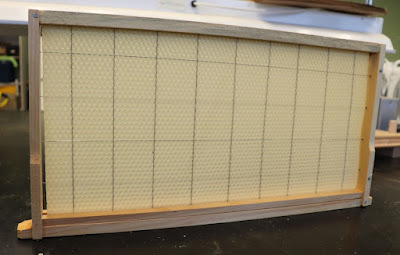
The final steps in assembling our frame are to insert the wax and embed the wire. It is suggested that if the frame will be used for honey extraction, to use foundation with vertical wires for extra strength. Insert the foundation such that it weaves through every other line of wire and the top and bottom of the sheet lay in the grooves of the top and bottom bars. Replace the wooden cleat back in its original position, flush against the wax foundation, and use a hammer or a staple gun to drive four brads perpendicularly through the cleat, securing it once again to the top bar.

Figure 1. Showing an inverted deep frame with a well-placed sheet of wax foundation.  You can observe the secured wax foundation, centered in the middle of the frame.  Both vertical and horizontal wires which support the foundation are also visible along with the wooden cleat.

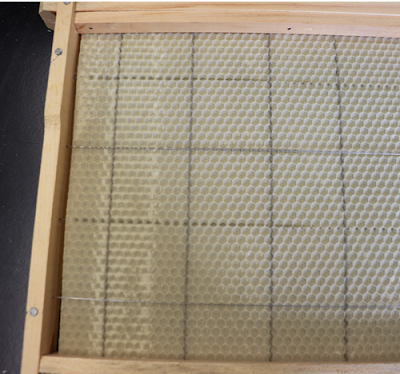
Now we will embed the wire into the wax. Bees prefer to feel wax rather than the metal wire and this will support them in producing uniform comb. There are safe and reliable tools available for embedding wire from local beekeeping supply stores. The principle is to heat the wires just enough to melt the surrounding wax and become encased.  Commonly, beekeepers use a tool which passes a DC current through the wire, heating it and melting the wax around the wire.  This is a quick, straightforward method but it is easy to overheat the wires, so be very cautious.  Wires can also be pressed into the wax with an embedding tool.  Basically, these are a spurred wheel which rolls along the wire to push it into the wax.  Some of these tools also are heated to help with the process. With the wires embedded our frame is ready to enter a hive!

Figure 2. A frame containing embedded wires.  This is a better surface for the bees to work than that shown in the previous figure!

Once in the hive, the bees will begin building comb on the new foundation. Wax production is integral to all beekeeping operations whether beeswax is an economic output or not. It is necessary for growing hive numbers and comb rotation is a valuable component of integrated pest management (Pernal and Clay 2013). The Canadian Association of Professional Apiculturists suggests that brood comb only remain in an apiary for three to five years for optimal hive health. Chemical residues leftover from miticide treatments or brought into the hive from foraging activity can persist and accumulate in wax (Murcia-Morales et al 2022). Rotating new brood comb also improves colony productivity by allowing brood to develop into larger, more productive individuals (Taha et al. 2021). Each bee that develops within a cell leaves behind developmental material which, overtime, results in smaller cells and smaller bees. Check out our Comb Rotation ATTTA Factsheet for more information!


Murcia-Morales, María, Horacio Heinzen, Piedad Parrilla-Vázquez, María del Mar Gómez-Ramos, and Amadeo R. Fernández-Alba. 2022. “Presence and Distribution of Pesticides in Apicultural Products: A Critical Appraisal.” TrAC Trends in Analytical Chemistry 146 (January): 116506. https://doi.org/10.1016/j.trac.2021.116506.

Pernal, S.F. and Clay, H. (eds). 2013. Honey bee disease and pests, 3rd Edition. Canadian Association Professional Apiculturists, Beaverlodge, AB, Canada 68 pp. 

Taha, El-Kazafy A., Osama M. Rakha, El-Said M. Elnabawy, Mohamed M. Hassan, and Dalia M.B. Shawer. 2021. “Comb Age Significantly Influences the Productivity of the Honeybee (Apis Mellifera) Colony.” Journal of King Saud University - Science 33 (4): 101436. https://doi.org/10.1016/j.jksus.2021.101436.


Connecting with ATTTA Specialists


If you’d like to connect with ATTTA specialists or learn more about our program, you can:


Comb Age Significantly Influences the Productivity of the Honey Bee (Apis mellifera) Colony

Friday, 16 April 2021

Continuing with the theme of spring hive management and also adding to Blog #41, another more recently published study investigated the effect of comb age on honey bee productivity. Keep reading to find out what interesting significant results are revealed, what suggestions are provided for comb rotation, and how these compare to the previously discussed publication on this topic.

As spring progresses, our bees are becoming more and more active! But as many beekeepers in the Atlantic region know, the bees are not the only ones that start to venture out of their winter homes in springtime. Bears are also coming out from their winter slumbers in the spring and a colony of bees sounds like a great treat to them! Luckily, The Institute of Food and Agricultural Sciences at the University of Florida has just released a comprehensive guide for building apiary bear fences! Keep reading for more details.

Comb Age Significantly Influences the Productivity of the Honey Bee (Apis mellifera) Colony *

A honey bee colony uses beeswax combs within the hive mainly for rearing brood and storing food. Over time, with repeated use for brood rearing, these combs change in both color and size. This recent publication provides insight on the topic of colony productivity in relation to comb age. The colonies used in this study were hybrid Carniolan honey bees, and combs were categorized as new combs (1-3 years old) and old combs (4-6 years old). In this study, colony productivity was quantified by:

  • Worker weight
  • Queen weight
  • Drone weight
  • Royal jelly production (mg of royal jelly/queen cell)
  • Worker and drone brood rearing

Through analyses of these productivity parameters, significant results from this study were revealed:

  • Colonies on new combs yielded newly emerged workers, queens, and drones with heavier body weights than those reared in colonies on old combs.
  • Colonies on new combs were more active in food storage, royal jelly production, and worker and drone rearing than colonies on old combs

This study suggested these results were related to the decrease in individual cell size over time – due to the accumulation of cocoons, wax, and other hive debris – allowing less space in cells on old combs for brood growth and resulting in smaller workers. The smaller population and individual size of workers reared on old comb were physically not capable of collecting pollen and nectar to the same extent as the larger population and size of workers that were reared on new comb. This study concluded that “the body sizes of individual bees were declined, and the productivity was decreased in the colonies with the old combs.” With this conclusion, this study further suggested that, “[replacing] combs after three years with new [combs] is recommended to encourage colony growth and increase productivity.” *

The results and conclusions of this study agree with those of the comb age study discussed previously in Blog #41. This study lends additional significant results related to other parameters of colony productivity to further support the regular rotational replacement of old comb with new comb. It is important to note that both of these studies were carried out in Egypt, however, still provide interesting significant results to take into consideration when managing honey bees in the Atlantic Canada region.


* Taha, E. A., Rakha, O.M., Elnabawy, E. M., Hassan, M. M. & Shawer, M. B. (2021). Comb age significantly influences the productivity of the honeybee (Apis mellifera) colony, Journal of King Saud University – Science. Full text available online.


Building Bear Fences for Your Apiary *

Many beekeepers in the Atlantic Canada region know all too well that bees and bears are not a good mix. Bears seek out bee colonies as a nice protein snack; they are after the protein-rich brood more than the honey, but the honey is a sweet bonus for them! A good way to protect bee yards from these destructive uninvited wildlife visitors is to build a proper bear fence around the apiary. There are many ways to go about implementing some sort of bear fence and many resources available. The University of Florida Institute of Food and Agricultural Sciences Extension program recently put together a step-by-step guide for building a bear fence. This guide includes:

  • Background information about bears and beekeeping
  • A list of supplies and tools for making the fence system
  • Site considerations for choosing a bear-proof yard location
  • Steps of fence installation

In the ‘Steps of Fence Installation’ section, detailed instructions and photos are provided for every step of installing an electric bear fence so the builder can be sure they achieve the intended result. The general steps of fence installation are:

  • Installing posts and wire
  • Creating a gate
  • Adding charge and ground
  • Testing the fence

Another great resource for bear and bear fencing information, especially area-specific information, is other beekeepers! A beekeeper that has kept hives in a particular location for a few years or more will likely be able to share some insight as to what the bear situation is in that area.


* Post, K. K. & Jack, C. (2021). Building Bear Fencing for Your Apiary, Entomology and Nematology Department, UF/IFAS Extension. Full text available online.


Connecting with ATTTA Specialists


If you’d like to connect with ATTTA specialists or learn more about our program, you can:


Some Biological Aspects of Honey Bee Colonies in Relation to the Age of Beeswax Combs

Thursday, 1 April 2021

New comb versus old comb…which is better for the bees? A well discussed and debated topic in the beekeeping world! In this week’s blog, we will discuss how the age of comb impacts colony function, especially relating to brood production. Keep reading to find out what a recent study observed in brood and honey production when colonies were provided with comb of varying ages, from foundation to 4-6 years old comb. 

Happy Easter long weekend everyone!

Some Biological Aspects of Honey Bee Colonies in Relation to the Age of Beeswax Combs *

Beeswax combs used in honey bee hives, like most things, change over time. But the question is, do these changes positively or negatively impact the functioning of honey bee colonies? Although older dark comb makes it easier for the beekeeper to spot eggs on a frame, recent research suggests that these older combs compromise certain aspects of colony function and productivity. This study explored the effects of comb age (foundation, 1yr old, 2yrs old, 3yrs old, and 4-6yrs old) on:

  1. Worker and drone brood production
  2. New worker and drone body weight, and
  3. Worker population

Interesting results are presented from the observations of this study:

  • Higher worker brood production & lower drone brood production in colonies on newer combs versus colonies on older combs
  • Higher newly emerged worker and drone weights in colonies on newer combs versus colonies on older combs
  • Greater reduction of worker population in colonies on foundation and in colonies on older combs versus colonies on newer drawn combs

Considering these observations in context of some of the more detailed aspects of colony function helps to provide possible explanations for the results of this study. Compared to newer combs, older combs often have a greater proportion of irregular cells as a result of transforming worker cells into drone cells. In comparison to newer combs with lower proportions of drone vs. worker cells, this accumulation of drone cells in older combs decreases the production of worker brood and increases the production of drone brood.

In addition to drone cell accumulation, as wax combs are reused for brood rearing and food storage, there is also a continuous accumulation of wax, propolis, and debris from brood development (i.e., shedding cocoons) within cells. Due to this accumulation, comb cells become smaller with age resulting in the production of workers and drones with body weights lower than workers and drones reared in cells on newer combs with less accumulations. In the specific case of drones, a decrease in drone size results in a decrease in both drone longevity and sperm quality.

In addition to a decrease in drone longevity, older combs may also reduce worker longevity if there is an accumulation of toxic contaminants in the wax. This scenario leads to a greater reduction in the worker population of colonies on older combs compared to colonies on newer combs. An accumulation of contaminants on older combs may also alter the unique cues that a colony uses for recognition promoting more frequent drifting of foragers that belong to colonies with older combs. A greater reduction in worker population is also suggested for colonies provided with foundation instead of drawn combs. This may be explained by the exhaustive physiological requirements of worker bees involved in the task of wax production and building combs from foundation. However, this effect on the worker population of colonies housed on foundation is halted once combs are built, as the results from this recent study suggest. Since all foragers are workers, honey production correlates directly to worker population size, however, is also impacted by brood production, worker lifespan, productivity of individual workers, and also the proportion of drone cells in the combs of a colony’s hive.

As is typical in honey bees and beekeeping, there are many aspects of colony function that impact how a colony responds to challenges and how these challenges affect the colony. As comb increases in age and gets to be “old comb”, the challenge of maintaining maximal and even sufficient colony function and productivity also increases. Thankfully, research studies, such as this one, provide valuable information to help beekeepers better help their bees!

* Mohammad Abd Al-Wahab Abd Al-Fattah, Yasser Yehia Ibrahim & Marwa Ibrahim Haggag (2021). Some biological aspects of honey bee colonies in relation to the age of beeswax combs, Journal of Apicultural Research (full text available online).


Wishing everyone an extra sweet Easter long weekend!


(illustration credit)


Connecting with ATTTA Specialists


If you’d like to connect with ATTTA specialists or learn more about our program, you can: