Showing posts with label pesticides. Show all posts

Wax and Comb as Reservoirs for Accumulation of Agrichemicals, Pests, and Disease

Thursday, 9 July 2026

Wax is one of the most important structural components of a honey bee colony. It is the footing of what goes on inside the hive, from storing pollen and nectar to allowing bees to complete their life cycle. As comb ages through repeated brood cycles, its physical properties change. Comb darkens due to the accumulation of debris, and older comb (typically 4-5 years old) can retain substances that affect colony health. Regular comb replacement is an important management practice for maintaining healthy colonies. 

Wax and Comb as Reservoirs for Accumulation of Agrichemicals, Pests, and Disease

Beeswax is a lipid-based material composed primarily of fatty acid esters, hydrocarbons and free fatty acids 1. Wax allows lipophilic, fat‑soluble compounds, to bind to it 2. Wax also has a porous structure that allows residues to adsorb and persist within the comb 1. Contaminants such as spores, debris and agrochemical residue can become trapped in comb and remain there for long periods 3,4.  Once built, honey bees do not readily remove or metabolize wax, so contaminants accumulate over time.

Figure 1: Frame being pulled out of a hive (ATTTA ©, 2021)

Several honey bee diseases can persist in wax and brood comb. European foulbrood (EFB), caused by Melissococcus plutonius, remains viable in comb for several years 5.  The bacterium has also been shown to be present in symptomless colonies due to its persistence in wax debris, indicating ongoing contamination within a colony 6.  Experimental work has demonstrated that adult bees become colonized after ingesting approximately 10,000 bacterial cells per bee, meaning that even moderate contamination of wax debris can cause infection 10.

American foulbrood (AFB), caused by the spore-forming bacterium Paenibacillus larvae, is another disease that can persist in comb. This is because the spore stage of this bacterium is extremely resilient to the environment, surviving in wax, propolis and honey for up to 80 years 7. Honey bee larvae can become infected after ingesting as few as ten spores, so even trace contamination of brood comb can initiate disease 11. 

Chalkbrood caused by the fungus Ascosphaera apis also leaves long-lasting spores. These spores remain in hive material for up to 15 years 7. Spores present in comb can infect developing brood due to the durability of the spores. Experimental work has shown that approximately 1000 spores per larva are enough to establish infection, meaning that contaminated wax can easily maintain the disease when environmental conditions favour growth of the fungus 12.  

Vairimorpha (formerly Nosema) spp. also interact with hive materials. Vairimorpha spores can remain viable for up to a year in honey and fecal material, even at freezing temperatures 7,8. A study has shown that the minimum dose capable of causing a detectable infection can be as low as 1.28 spores per bee, with a median infective dose of 149 spores per bee 13. Adult bees defecate inside the hive during cold weather, so Vairimorpha spores can accumulate on comb surfaces and be ingested by other bees over time.

Figure 2: Dark comb (ATTTA ©, 2021)

Recent research has shown that wax from dead colonies can contain detectable levels of honey bee viruses, including Deformed Wing Virus and Black Queen Cell Virus for at least 30 days 9.  Freezing does not reduce viral load, and only high-dose electron beam irradiation (35-45kGy) has been shown to decrease virus levels 9. This research is still developing, and it is unknown how significant this is for transmission inside hives, but important for beekeepers to be aware of. 

Wax can also absorb agrochemicals used inside and outside of the hive. Residues from Varroa mite treatments, as well as other insecticides, fungicides and herbicides, have all been detected in comb 4. Some compounds have been found to occur at high concentrations,  including amitraz residue, a product applied by beekeepers for treating Varroa mites, ranging from 5 to 464 µg/kg, and insecticides ranging from 1 to 464 µg/kg, brought in by foragers 4. Even when agrochemicals degrade, their metabolites can remain in wax. Chronic, low-level exposure may contribute to sublethal effects on honey bee health and allow pests to develop resistance.

Comb older than 4-5 years can accumulate pathogens, viral particles and agrochemical residue because honey bees never remove or replace it themselves. Regular comb replacement is one of the most effective ways beekeepers can reduce buildup and support healthier colonies. A future blog will explore comb rotation in more detail and how beekeepers can use it to maintain cleaner, safer hives for honey bees. 

 Written by Kaitlyn Newton, ATTTA Seasonal Apiculturist

Connecting with ATTTA Specialists

If you’d like to connect with ATTTA specialists or learn more about our program, you can:

visit our website at https://www.perennia.ca/portfolio-items/honey-bees/

Email attta@perennia.ca


References:

1. Meng, Q., Huang, R., Yang, S., Jiang, W., Tian, Y. and Dong, K., 2025. An Overview of the Adverse Impacts of Old Combs on Honeybee Colonies and Recommended Beekeeping Management Strategies. Insects, 16(4), p.351.
2. Atlantic Tech Transfer Team for Apiculture, 2017. Comb Rotation. https://www.perennia.ca/wp-content/uploads/2018/04/11-comb-rotation-eng.pdf
3. Wu, J.Y., Anelli, C.M. and Sheppard, W.S., 2011. Sub-lethal effects of pesticide residues in brood comb on worker honey bee (Apis mellifera) development and longevity. PloS one, 6(2), p.e14720.
4. López, S.H., Lozano, A., Sosa, A., Hernando, M.D. and Fernández-Alba, A.R., 2016. Screening of pesticide residues in honeybee wax comb by LC-ESI-MS/MS. A pilot study. Chemosphere, 163, pp.44-53.
5. León-Door, A.P., Pérez-Ordóñez, G., Romo-Chacón, A., Rios-Velasco, C., Órnelas-Paz, J.D., Zamudio-Flores, P.B. and Acosta-Muñiz, C.H., 2020. Pathogenesis, epidemiology and variants of Melissococcus plutonius (Ex White), the causal agent of European foulbrood. Journal of Apicultural Science, 64(2), pp.173-188.
6. Budge, G.E., Barrett, B., Jones, B., Pietravalle, S., Marris, G., Chantawannakul, P., Thwaites, R., Hall, J., Cuthbertson, A.G. and Brown, M.A., 2010. The occurrence of Melissococcus plutonius in healthy colonies of Apis mellifera and the efficacy of European foulbrood control measures. Journal of invertebrate pathology, 105 (2), pp.164-170.
7. Sammataro, D. and Avitabile, A. 2021. A Beekeeper’s Handbook: Fifth Edition. Cornell University Press
8. MacInnis, C.I., Keddie, B.A. and Pernal, S.F., 2020. Nosema ceranae (Microspora: Nosematidae): a sweet surprise? Investigating the viability and infectivity of N. ceranae spores maintained in honey and on beeswax. Journal of Economic Entomology, 113(5), pp.2069-2078.
9. Colwell, M.J., Pernal, S.F. and Currie, R.W., 2024. Treatment of waxborne honey bee (Hymenoptera: Apidae) viruses using time, temperature, and electron-beam irradiation. Journal of Economic Entomology, 117(1), pp.34-42.
10. Sebastian Jose, M., Bezerra da Silva, M.C., Obshta, O., Masood, F., Thebeau, J.M., Biganski, S., Raza, M.F., Camill, M.P., Prieto, E.T., Edirithilake, T. and Kozii, I., 2025. Antimicrobial control and temporal dynamics of M. plutonius colonization in adult worker honey bees (Apis mellifera). PLoS One, 20(5), p.e0322770.
11. Locke, B., Low, M. and Forsgren, E., 2019. An integrated management strategy to prevent outbreaks and eliminate infection pressure of American foulbrood disease in a commercial beekeeping operation. Preventive Veterinary Medicine, 167, pp.48-52.
12. Knoblauch, T., Jensen, A.B., Mülling, C.K., Aupperle-Lellbach, H. and Genersch, E., 2024. Chalkbrood Disease Caused by Ascosphaera apis in Honey Bees (Apis mellifera)—Morphological and Histological Changes in Infected Larvae. Veterinary Sciences, 11(9), p.415.
13. McGowan, J., De la Mora, A., Goodwin, P.H., Habash, M., Hamiduzzaman, M.M., Kelly, P.G. and Guzman-Novoa, E., 2016. Viability and infectivity of fresh and cryopreserved Nosema ceranae spores. Journal of microbiological methods, 131, pp.16-22.
Practices to Protect Pollinators from Pesticides

Thursday, 13 June 2024

Pollination is here and with that, both beekeepers and blueberry growers need to consider how they can best protect honey bees, and other pollinators from the numerous pesticides used on wild blueberry fields. Recently, ATTTA and Pollinator Partnership Canada have published a best management practice guide “Protecting Pollinators from Pesticides – Wild Blueberry”1. We encourage you to read and engage with this guide found at https://www.perennia.ca/portfolio-items/honey-bees/. In this week’s blog we will cover the highlights of the various practices to protect pollinators from pesticides, but for a more in-depth understanding please read the guide in its entirety.

Practices to Protect Pollinators from Pesticides

The first approach for beekeepers and blueberry growers to protect pollinators, is the use of integrated pest management. The use of integrated pest management can help minimize the amount of pesticide use on wild blueberry fields2. The grower should monitor for the presence of various fungus, insect, and plant pests of wild blueberries, and only provide treatment when needed2. By minimizing the amount of product being used this lowers the risk of pollinators being exposed to harmful chemicals. An IPM approach has the added value of also saving the farmer time and money on product application2.

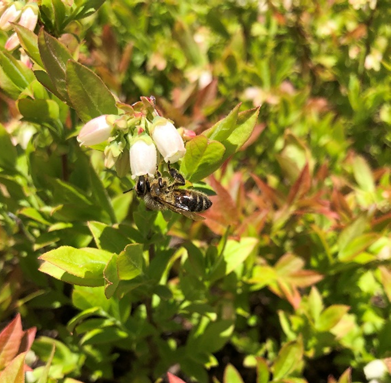
Honey bee on wild blueberry flower (ATTTA©2021)

Probably the most important component for protecting pollinators from pesticides is clear communication between growers and beekeepers. Both beekeepers and growers will benefit from having clear guidelines for each of their roles in the pollination process. If receiving or providing pollination services, it is recommended that a pollination contract is used. Examples of pollination contracts can be found within "Best Management Practices Guide for Honey Bee Pollination of Wild Blueberries in Atlantic Canada”3 at https://www.perennia.ca/portfolio-items/honey-bees/. Modify any template contracts as needed, but it is encouraged to include information on: the timing of arrival/departure of hives (needs to be in sync with wild blueberry bloom); responsibility of beekeeper to provide standard pollinating units; details of grower's responsibility to protect bees from any pesticide poisoning; designation of responsibility for periodically checking and caring for bees; designation of responsibility for providing hive protection (electric fencing); clear description of the pest management practices being used on the blueberry field before and during placement of hives; and details of hive placement location on the field.

Beekeepers and blueberry growers can both work to support pollinators through habitat development. Maintaining and creating habitat around blueberry fields can support honey bees and native pollinators4. Leaving non-invasive weeds, wildflowers, and other habitat patches around wild blueberries increases pollination and fruit production5. The presence of these native wild flowers will provide a diversity of pollen sources and will not deter honey bees and other pollinating insects from foraging for nectar on wild blueberry plants6. There are several things growers can do to help develop these habitats, such as delay flail or bush mowing areas around fields until after pollination and preserve wildflower diversity currently surrounding fields. On fields that border cultivated land, growers can create floral strips.

The use of pesticides is an integral part of wild blueberry production. There are several practices beekeepers and blueberry growers can follow to help minimize the impact of these products on pollinators. The first thing growers can do is select the least toxic pesticide to bees. Bees foraging on fields can be directly exposed to toxic products or exposed indirectly through ingesting pollen and nectar containing the product or contact with contaminated soil7. Generally, insecticides are more toxic to bees than herbicides or fungicides since insecticides are formulated to kill insects. The risk associated with a particular pesticide to bees is not only based on the toxicity, but also the residual toxicity. If a product is found to be toxic for greater than 8 hours than it is a higher risk to bees. For questions regarding a specific product’s risk to bees refer to the “Supplement Document for Protecting Pollinators from Pesticides” at https://www.perennia.ca/portfolio-items/honey-bees/.

Whenever applying a pesticide is essential to follow all label directions. When reviewing the label look for precautionary and advisory statements that state “toxic to bees”.

Best Management Practices Guide – Protecting Pollinators from Pesticides (ATTTA©2024)

Finally, growers and beekeepers need to minimize any potential exposure of bees to pesticides. Growers should avoid applying pesticides when bees are flying or clustered outside their hives; avoid applying pesticides to any blooming flowers around the field; place hives outside the range of pesticide application and consider developing a no spray buffer zone to protect hives; minimize pesticide drift when spraying; and look for nests of native bees around the field to avoid spraying near the area.

Protecting honey bees and other pollinators from pesticides is crucial for successful pollination. It is in the beekeeper’s and grower’s best interest to have conversations around pesticide use, and how they can work together to protect these vital insects.

References
  1. Orr, J., Byers, A., Morandin, L.A., Medeiros, S.J. and K. Law. 2023. Practices to Protect Pollinators from Pesticides: Wild Blueberry. Pollinator Partnership Canda and Atlantic Tech Transfer Team for Apiculture.
  2. Brodt, S., Zalom, F., Krebill-Prather, R., Bentley, W., Pickel, C., Connell, J., Wilhoit, L. and Gibbs, M., 2005. Almond growers rely on pest control advisers for integrated pest management. California agriculture, 59(4).
  3. Bennett, A. and A. Byers. 2023. Best Management Practices Guide for Honey Bee Pollination of Wild Blueberries in Atlantic Canada. Atlantic Tech Transfer Team for Apiculture.
  4. Park, M.G., Blitzer, E.J., Gibbs, J., Losey, J.E. and Danforth, B.N., 2015. Negative effects of pesticides on wild bee communities can be buffered by landscape context. Proceedings of the Royal Society B: Biological Sciences, 282(1809), p.20150299.
  5. Blaauw, B.R. and Isaacs, R., 2014. Flower plantings increase wild bee abundance and the pollination services provided to a pollination‐dependent crop. Journal of Applied Ecology, 51(4), pp.890-898.
  6. Girard, M., Chagnon, M. and Fournier, V., 2012. Pollen diversity collected by honey bees in the vicinity of Vaccinium spp. crops and its importance for colony development. Botany, 90(7), pp.545-555.
  7. Willis Chan, D.S., Prosser, R.S., Rodríguez-Gil, J.L. and Raine, N.E., 2019. Assessment of risk to hoary squash bees (Peponapis pruinosa) and other ground-nesting bees from systemic insecticides in agricultural soil. Scientific Reports, 9(1), p.11870.

Connecting with ATTTA Specialists

If you’d like to connect with ATTTA specialists or learn more about our program, you can:

visit our website at https://www.perennia.ca/portfolio-items/honey-bees/

Email abyers@perennia.ca


What You Need to Know About Agrochemical Product Information

Thursday, 6 July 2023

Protecting pollinators from pesticides is crucial to a successful and prosperous pollination industry. Agrochemical use is necessary in modern cropping systems and required to maintain honey bee health. Understanding more about the correct use of these compounds and how to mitigate risks for pollinators is important for both beekeepers and fruit producers. This week we will look at one example product to gain further insight into label and product information to help understand associated risks and the precautions you should take.

What You Need to Know About Agrochemical Product Information

Health Canada’s Pest Management Regulatory Agency is responsible for pesticide regulation. Pesticides are stringently regulated in Canada to ensure they pose minimal risk to human health and the environment.

Manufactures are required to provide information on various aspects of their product. We will use Merivon®, a common fungicide for blueberry crops, as an example of the types of information a manufacturer must provide. This product may be used during blueberry bloom and therefore has potential considerations for honey bees and other pollinating insects.

Pesticides must be registered for specific crops and uses. Merivon is registered for use on blueberry crops to control Anthracnose, gray mold, Phomopsis Twig Blight, and Septoria Leaf Spot. All products will receive a registration number, with our example Merivon, having the registered number of 33951.  They will have a product name (Merivon Fungicide), and a registrant name (BASF CANADA INC.). The manufacturer must provide all information on all active ingredients. For Merivon the active ingredients are Pyrcolstrobin and Fluxapyroxad.


Merivon Fungicide BASF©

Manufacturers must also provide a Safety Data Sheet (SDS) for their product. The SDS has numerous requirements, including hazard identification for human health and the environment. Merivon is classified as acute oral toxicity, acute inhalation toxicity, skin corrosion/irritation, reproductive toxicity, specific organ toxicity, and hazardous to the aquatic environment. The SDS includes information on First-Aid measures, fire fighting measures, accidental release measures, handling and storage, personal protection measures, physical and chemical properties, stability and reactivity, ecological information, disposal information, transport information, and regulatory information. Anyone using this product should familiarize themselves with the label instructions and the SDS.

The SDS also provides information on toxicology. The toxicological information provides specific values about the degree of toxicity for different routes of exposure. For example, the LD50 of Merivon for oral exposure to a female rat ranges between 50 and 300 mg/kg. For context, the LD50 of Arsenic for oral exposure to a rat is 763 mg/kg, which means it is relatively less toxic than Merivon in this comparison. The LD50 of Merivon for dermal exposure to a female rat is greater than 5000 mg/kg. The LC50 of Merivon for inhalation exposure to a female rat is 2.81 mg/L. The LD50 is calculated per kilogram of body weight and meant to only indicate comparable toxicity to other animals.

By way of further explanation, the median lethal dose (LD50) is the amount of a substance that kills 50% of the test population, usually modelled using rats. The lethal concentration (LC50) is the concentration of a chemical that kills 50% of the test population. These terms are often used interchangeably, but the LD is the lethal amount (or dose) of a solid substance, and the LC is the lethal concentration of a liquid substance. It is also important to understand that these measurements are time dependent. An LD50 or LC50 is determined within a certain time period (typically 4 hours since exposure). The LD50 or LC50 also differ depending on the method of exposure, whether it be topical, oral or inhalation exposure to the chemical. The values are determined through lab-based experiments, where a specific sample size is required for the experiment to have statistical significance.

According to use recommendations, Merivon has low toxicity to bees. Under a shared framework supported by PMRA, the US Environmental Protection Agency states that if the LD50 of the pesticide is greater than 11 micrograms per bee it is relatively nontoxic, and no bee caution statement is required on the label. Generally, fungicides are not considered to have toxic effects on bees but ongoing research suggests there is still uncertainty as to the real-world consequences of exposure to these pesticides (Rondeau and Raine, 2022).

When using pesticides there is a lot of important information on the labels that must be understood and followed so that the treatment is effective, but also so no harm is done to plants and animals, and their environment. In Canada, it is an offence under the Pest Control Products Act to use any product in a way that is inconsistent with the directions on the label.  Pesticides can pose a threat to honey bees and other pollinators. Therefore, all precautions and directions on pesticide labels must be followed to avoid impacts of pesticides to bees.

We are excited to announce that more information about protecting pollinators from pesticides with be available soon! To be published: “PRACTICES TO PROTECT POLLINATORS FROM PESTICIDES – WILD BLUEBERRY”.


Connecting with ATTTA Specialists


If you’d like to connect with ATTTA specialists or learn more about our program, you can:


References

Rondeau, S. and Raine, N.E., (2022) Fungicides and bees: a review of exposure and risk. Environment International, 165, p.107311.


Note: Any named product mentioned in this article is not an intended endorsement or discrimination of that product.  Specific examples are used for information and explanation purposes only.  Further information on these products is available through the manufacturer.