Showing posts with label wild blueberry pollination. Show all posts

Wild Blueberry Phenology in the Crop Year - Ecodormancy

Thursday, 25 July 2024

Wild blueberries are managed on a two-year production cycle, meaning that the plants need to grow for two years for a harvestable crop. During this time, wild blueberry floral buds need to go through three dormancy stages before flowering. Please see previous blogs for more detailed information on the first two dormancy stages, para- and endo- dormancy. Once the blueberry buds have met their para- and endo-dormancy requirements they can enter ecodormancy, which is normally late winter to early spring. Once ecodormancy requirements have been met, then the buds will flower. Wild blueberry producers currently use ecodormancy requirements, based on growing degree days (GDD), to try and predict when the buds will open, and pollinators are needed in the fields. Knowing the requirements that are needed for ecodormancy could help with predicting wild blueberry bloom and allow for more precise placement of managed pollinators for more efficient use of this limited resource.

Wild Blueberry Phenology in the Crop Year - Ecodormancy

Ecodormancy is the second winter dormancy stage of floral buds, where the reaction leading to growth control is driven by external environmental cues, such as warm temperatures5. Ecodormant buds will not flower normally, meaning that only some of the buds will open when placed in growth adequate conditions, and the ones that do open will take longer to do so. Ecodormancy will prevent the floral buds from opening until the growing conditions are adequate for flowers, therefore protecting them from fluctuating conditions in the spring. Ecodormancy release relies on an accumulation of warm temperatures and the most common way of measuring the accumulation of warm temperatures is with GDDs5.

Ecodormant wild blueberry floral buds in early Spring (© John MacDonald 2024)

GDDs are a measure of accumulated daily heat units during which the plant has potential to be physiologically active and is measured using daily mean temperatures1. Accumulations of heat units for ecodormancy begin when endodormancy is released. Currently, there are limited experimental results for when endodormancy is released for wild blueberries. Therefore, GDD accumulations for ecodormancy begin at a selected calendar date3, which is currently April 1st for wild blueberries. Most GDD models include a base and upper temperature threshold, specific to different organisms, at which development may be delayed due to unfavorable growing conditions3. GDD models can be used to predict many crop phenological events, such as pest life cycles for applications of pesticides and floral bloom for placement of pollinators.

GDD models have been created in Nova Scotia to predict phenology of weeds, such as yellow toadflax (Linaria vulgaris), spreading dogbane (Apocynum androsaemifolium), and red sorrel (Rumex acetosella)2,9,10. GDD models have also been created for predicting flowering in highbush and lowbush blueberries4,6. More specifically, wild blueberry ramet emergence, tip-dieback, and flowering prediction models have been created in Nova Scotia8. The existing model for wild blueberry flowering, however, requires revisions to include early flowering wild blueberry genets and the timing of endodormancy release.

Wild blueberry field during ecodormancy in early Spring (© John MacDonald 2024)

Perennia Food and Agriculture Corporation, Nova Scotia’s technical food development agency, currently has an application called Farm Weather on the Farm Data Tools Website.  This tool will easily calculate GDD accumulations at weather stations, including 55 on wild blueberry fields, throughout Nova Scotia. Please make an account on Farm Data Tools and check out this very useful resource (Farm Data Tools – Farm Data Tools).

The placement of pollinators on wild blueberry fields during bloom can be difficult to plan. Learning more about the phenology stages of wild blueberries, such as endo- and eco-dormancy requirements, may help to create predictive models for the placement of pollinators. These models, based on GDD, could allow more efficient use of managed pollinators, improve wild blueberry production, and support honey bee health.

Written by John MacDonald, ATTTA Seasonal Apiculturist


Connecting with ATTTA Specialists

If you’d like to connect with ATTTA specialists or learn more about our program, you can:

visit our website at https://www.perennia.ca/portfolio-items/honey-bees/

Email abyers@perennia.ca


References:

1. Baskerville, G.L. and Emin, P. (1969) ‘Rapid Estimation of Heat Accumulation from Maximum and Minimum Temperatures’, Ecology, 50(3), pp. 514–517. Available at: https://doi.org/10.2307/1933912.

2. Blatt, S., De Clerck-Floate, R. and White, S.N. (2022) ‘Development of a growing degree-day model to estimate Linaria vulgaris shoot emergence and prospects for improving biological control efforts’, Invasive Plant Science and Management, 15(1), pp. 9–15. Available at: https://doi.org/10.1017/inp.2022.6.

3. Carlson, J.D. and Hancock, J.F. (1991) ‘A Methodology for Determining Suitable Heat-unit Requirements for Harvest of Highbush Blueberry’, Journal of the American Society for Horticultural Science, 116(5), pp. 774–779. Available at: https://doi.org/10.21273/JASHS.116.5.774.

4. Kirk, A.K. and Isaacs, R. (2012) ‘Predicting Flower Phenology and Viability of Highbush Blueberry’, HortScience, 47(9), pp. 1291–1296. Available at: https://doi.org/10.21273/HORTSCI.47.9.1291.

5. Lang, G.A. et al. (1987) ‘Endo-, Para-, and Ecodormancy: Physiological Terminology and Classification for Dormancy Research’, 22.

6. NeSmith, D.S. and Bridges, D.C. (1992) ‘Modeling Chilling Influence on Cumulative Flowering: A Case Study Using `Tifblue Rabbiteye Blueberry’, Journal of the American Society for Horticultural Science, 117(5), pp. 698–702. Available at: https://doi.org/10.21273/JASHS.117.5.698.

7. Rieger, M. (2006) Introduction to Fruit Crops. Haworth Food & Agricultural Products Press.

8. White, S.N., Boyd, N.S. and Van Acker, R.C. (2012) ‘Growing Degree-day Models for Predicting Lowbush Blueberry (Vaccinium angustifolium Ait.) Ramet Emergence, Tip Dieback, and Flowering in Nova Scotia, Canada’, HortScience, 47(8), pp. 1014–1021. Available at: https://doi.org/10.21273/HORTSCI.47.8.1014.

9. White, S.N., Boyd, N.S. and Van Acker, R.C. (2015) ‘Temperature Thresholds and Growing-Degree-Day Models for Red Sorrel (Rumex acetosella) Ramet Sprouting, Emergence, and Flowering in Wild Blueberry’, Weed Science, 63(1), pp. 254–263. Available at: https://doi.org/10.1614/WS-D-14-00048.1.

10. Wu, L. et al. (2013) ‘Spreading Dogbane (Apocynum androsaemifolium) Development in Wild Blueberry Fields’, Weed Science, 61(3), pp. 422–427. Available at: https://doi.org/10.1614/WS-D-12-00156.1.

Wild Blueberry Phenology in the Crop Year - Endodormancy

Thursday, 27 June 2024

Successful pollination of wild blueberry crops is dependent on managed pollinators. Studying phenology stages throughout the life cycle of wild blueberry crops could help with efficiencies around the use of these pollinators. Time between emergence and tip dieback in the sprout year will determine what the stem can support in the crop year.  Evaluation of these phenology stages could support a prediction model, using sprout year data, for the numbers of pollinators required in the crop year. Wild blueberry phenology stages in the crop year include two winter dormancy periods, known as endodormancy and ecodormancy, as well as flowering, fruit set, and harvest. With a better understanding of the dormancy periods of wild blueberries, a prediction model for timing of bloom and pollinator placement may be determined earlier in the crop year to help with pollinator efficiencies.

Wild Blueberry Phenology in the Crop Year - Endodormancy

Endodormancy is the first of two winter dormancy periods that are needed for wild blueberry buds to resume normal growth in the spring, and it is driven by internal cues within the plant [5]. Wild blueberry buds become endodormant to withstand cold temperatures and dehydration and prevent buds from opening throughout the winter when growth conditions are not adequate. Endodormancy is initiated by cold temperatures late in the summer and short daylength helps to accelerate this process. Cold temperatures in the fall also help acclimatize the buds to withstand freezing temperatures throughout the winter [1,6]

Endodormant wild blueberry plants (©John MacDonald 2024)

There are many changes happening internally when the buds go endodormant, including but not limited to the bound-to-free water status and hormone levels. The water goes from a free state to a bound state with macromolecules when the buds go endodormant. Also, the two most important hormones that are related to dormancy are abscisic acid (ABA) and gibberellin (GA). There is an increase in ABA within the plant during the initiation of endodormancy, which suggests that ABA plays an important role in endodormancy initiation. There is an increase in GA and decrease in ABA during endodormancy release, suggesting that GA plays an important role in endodormancy release [7].

The release of dormancy is regulated by the accumulation of cold temperatures, which is known as the chilling requirement. This can be calculated as chilling hours, which is an accumulation of temperatures between a lower and upper threshold (e.g., between 0 and 7°C) [3]. In contrast, chilling unit models are created to consider the reduced efficacy of temperatures below or above an optimum value and hence account for the reduced or negative effects of certain temperatures. The chilling requirement of wild blueberries is estimated at 1000 hours of temperatures less than 0°C [9,12], but limited results are available to confirm this assumption.

Endodormant buds will have a delayed and reduced growth rate compared to non-dormant buds when placed in growth adequate conditions, therefore dormancy must be satisfied to have adequate flowering and fruit set [10]. Knowing the chilling requirement for endodormancy release can give insight into the timing and intensity of bloom. The state of dormancy in wild blueberry floral buds can be determined by sampling floral buds throughout the winter, while the buds are receiving more chilling hours, and evaluating them in a greenhouse or laboratory.

One way dormancy release can be evaluated is a change in water status or hormone levels using intricate laboratory techniques. Another simpler and cheaper method that will yield similar results is known as forcing buds in a greenhouse. This is done by observing the rate of buds opening after a determined amount of time [4,8,11] or observing the number of buds opening after a determined amount of time [2,7]. Dormancy release is considered to have occurred when plants exposed to more chilling hours exhibit similar rates of buds opening.

Endodormant wild blueberry plants (©John MacDonald 2024)

After endodormancy is released, we then have ecodormancy, flowering, and fruit set. Currently wild blueberry producers and beekeepers use April 1st as an approximation of when endodormancy is released and ecodormancy starts in the Maritimes. This is inaccurate as the accumulation of chilling hours or units will vary from year to year, based on endodormancy requirements. Therefore, determining when endodormancy is released in wild blueberries will give a better approximation as to when flowers will open and help with efficiencies in placing pollinators for optimal fruit set.

Check back in the following weeks for part two of Wild Blueberry Phenology in the Crop Year – Ecodormancy and Flowering.

Written by John MacDonald, ATTTA Seasonal Apiculturist


Connecting with ATTTA Specialists

If you’d like to connect with ATTTA specialists or learn more about our program, you can:

visit our website at https://www.perennia.ca/portfolio-items/honey-bees/

Email abyers@perennia.ca


References:

[1] Deslauriers, A. et al. (2021) ‘Cold acclimation and deacclimation in wild blueberry: Direct and indirect influence of environmental factors and non-structural carbohydrates’, Agricultural and Forest Meteorology, 301–302, p. 108349. Available at: https://doi.org/10.1016/j.agrformet.2021.108349.

[2] Ferlito, F. et al. (2021) ‘Assessment of chilling requirement and threshold temperature of a low chill pear (Pyrus communis L.) germplasm in the Mediterranean area’, Horticulturae, 7(3), p. 45. Available at: https://doi.org/10.3390/horticulturae7030045.

[3] Fraisse, C.W. and Whidden, A. (2010) ‘Chill accumulation monitoring and forecasting’, Electronic Data Information Source, 2010(AE452). Available at: https://doi.org/10.32473/edis-ae452-2010.

[4] Guak, S. and Neilsen, D. (2013) ‘Chill unit models for predicting dormancy completion of floral buds in apple and sweet cherry’, Horticulture, Environment, and Biotechnology, 54(1), pp. 29–36. Available at: https://doi.org/10.1007/s13580-013-0140-9.

[5] Lang, G.A. et al. (1987) ‘Endo-, para-, and ecodormancy: physiological terminology and classification for dormancy research’, HortScience, 22(3), pp. 371–377.

[6] Li, C., Junttila, O. and Palva, E.T. (2004) ‘Environmental regulation and physiological basis of freezing tolerance in woody plants’, Acta Physiologiae Plantarum, 26(2), pp. 213–222. Available at: https://doi.org/10.1007/s11738-004-0010-2.

[7] Li, Y. et al. (2022) ‘Comparative transcriptomic analysis provides insight into the key regulatory pathways and differentially expressed genes in blueberry flower bud endo- and ecodormancy release’, Horticulturae, 8(2), p. 176. Available at: https://doi.org/10.3390/horticulturae8020176.

[8] Norvell, D.J. and Moore, J.N. (1982) ‘An evaluation of chilling models for estimating rest requirements of highbush blueberries (Vaccinium corymbosum L.)’, Journal of the American Society for Horticultural Science, 107(1), pp. 54–56. Available at: https://doi.org/10.21273/JASHS.107.1.54.

[9] Rieger, M. (2006) Introduction to fruit crops. Haworth Food & Agricultural Products Press.

[10] Schuchovski, C. and Biasi, L.A. (2021) ‘Dormancy of floral buds of rabbiteye blueberry in a mild winter climate’, Brazilian Archives of Biology and Technology, 64, p. e21190755. Available at: https://doi.org/10.1590/1678-4324-2021190755.

[11] Spiers, J.M., Marshall, D.A. and Braswell, J.H. (2004) ‘Chilling requirement studies in blueberries’, Small Fruits Review, 3(3–4), pp. 325–330. Available at: https://doi.org/10.1300/J301v03n03_09.

[12] Yarborough, D.E. (2012) ‘Establishment and management of the cultivated lowbush blueberry (Vaccinium angustifolium)’, International Journal of Fruit Science, 12(1–3), pp. 14–22. Available at: https://doi.org/10.1080/15538362.2011.619130.


Practices to Protect Pollinators from Pesticides

Thursday, 13 June 2024

Pollination is here and with that, both beekeepers and blueberry growers need to consider how they can best protect honey bees, and other pollinators from the numerous pesticides used on wild blueberry fields. Recently, ATTTA and Pollinator Partnership Canada have published a best management practice guide “Protecting Pollinators from Pesticides – Wild Blueberry”1. We encourage you to read and engage with this guide found at https://www.perennia.ca/portfolio-items/honey-bees/. In this week’s blog we will cover the highlights of the various practices to protect pollinators from pesticides, but for a more in-depth understanding please read the guide in its entirety.

Practices to Protect Pollinators from Pesticides

The first approach for beekeepers and blueberry growers to protect pollinators, is the use of integrated pest management. The use of integrated pest management can help minimize the amount of pesticide use on wild blueberry fields2. The grower should monitor for the presence of various fungus, insect, and plant pests of wild blueberries, and only provide treatment when needed2. By minimizing the amount of product being used this lowers the risk of pollinators being exposed to harmful chemicals. An IPM approach has the added value of also saving the farmer time and money on product application2.

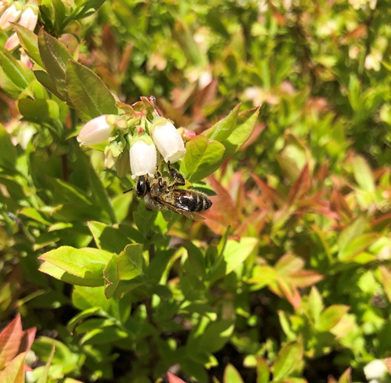
Honey bee on wild blueberry flower (ATTTA©2021)

Probably the most important component for protecting pollinators from pesticides is clear communication between growers and beekeepers. Both beekeepers and growers will benefit from having clear guidelines for each of their roles in the pollination process. If receiving or providing pollination services, it is recommended that a pollination contract is used. Examples of pollination contracts can be found within "Best Management Practices Guide for Honey Bee Pollination of Wild Blueberries in Atlantic Canada”3 at https://www.perennia.ca/portfolio-items/honey-bees/. Modify any template contracts as needed, but it is encouraged to include information on: the timing of arrival/departure of hives (needs to be in sync with wild blueberry bloom); responsibility of beekeeper to provide standard pollinating units; details of grower's responsibility to protect bees from any pesticide poisoning; designation of responsibility for periodically checking and caring for bees; designation of responsibility for providing hive protection (electric fencing); clear description of the pest management practices being used on the blueberry field before and during placement of hives; and details of hive placement location on the field.

Beekeepers and blueberry growers can both work to support pollinators through habitat development. Maintaining and creating habitat around blueberry fields can support honey bees and native pollinators4. Leaving non-invasive weeds, wildflowers, and other habitat patches around wild blueberries increases pollination and fruit production5. The presence of these native wild flowers will provide a diversity of pollen sources and will not deter honey bees and other pollinating insects from foraging for nectar on wild blueberry plants6. There are several things growers can do to help develop these habitats, such as delay flail or bush mowing areas around fields until after pollination and preserve wildflower diversity currently surrounding fields. On fields that border cultivated land, growers can create floral strips.

The use of pesticides is an integral part of wild blueberry production. There are several practices beekeepers and blueberry growers can follow to help minimize the impact of these products on pollinators. The first thing growers can do is select the least toxic pesticide to bees. Bees foraging on fields can be directly exposed to toxic products or exposed indirectly through ingesting pollen and nectar containing the product or contact with contaminated soil7. Generally, insecticides are more toxic to bees than herbicides or fungicides since insecticides are formulated to kill insects. The risk associated with a particular pesticide to bees is not only based on the toxicity, but also the residual toxicity. If a product is found to be toxic for greater than 8 hours than it is a higher risk to bees. For questions regarding a specific product’s risk to bees refer to the “Supplement Document for Protecting Pollinators from Pesticides” at https://www.perennia.ca/portfolio-items/honey-bees/.

Whenever applying a pesticide is essential to follow all label directions. When reviewing the label look for precautionary and advisory statements that state “toxic to bees”.

Best Management Practices Guide – Protecting Pollinators from Pesticides (ATTTA©2024)

Finally, growers and beekeepers need to minimize any potential exposure of bees to pesticides. Growers should avoid applying pesticides when bees are flying or clustered outside their hives; avoid applying pesticides to any blooming flowers around the field; place hives outside the range of pesticide application and consider developing a no spray buffer zone to protect hives; minimize pesticide drift when spraying; and look for nests of native bees around the field to avoid spraying near the area.

Protecting honey bees and other pollinators from pesticides is crucial for successful pollination. It is in the beekeeper’s and grower’s best interest to have conversations around pesticide use, and how they can work together to protect these vital insects.

References
  1. Orr, J., Byers, A., Morandin, L.A., Medeiros, S.J. and K. Law. 2023. Practices to Protect Pollinators from Pesticides: Wild Blueberry. Pollinator Partnership Canda and Atlantic Tech Transfer Team for Apiculture.
  2. Brodt, S., Zalom, F., Krebill-Prather, R., Bentley, W., Pickel, C., Connell, J., Wilhoit, L. and Gibbs, M., 2005. Almond growers rely on pest control advisers for integrated pest management. California agriculture, 59(4).
  3. Bennett, A. and A. Byers. 2023. Best Management Practices Guide for Honey Bee Pollination of Wild Blueberries in Atlantic Canada. Atlantic Tech Transfer Team for Apiculture.
  4. Park, M.G., Blitzer, E.J., Gibbs, J., Losey, J.E. and Danforth, B.N., 2015. Negative effects of pesticides on wild bee communities can be buffered by landscape context. Proceedings of the Royal Society B: Biological Sciences, 282(1809), p.20150299.
  5. Blaauw, B.R. and Isaacs, R., 2014. Flower plantings increase wild bee abundance and the pollination services provided to a pollination‐dependent crop. Journal of Applied Ecology, 51(4), pp.890-898.
  6. Girard, M., Chagnon, M. and Fournier, V., 2012. Pollen diversity collected by honey bees in the vicinity of Vaccinium spp. crops and its importance for colony development. Botany, 90(7), pp.545-555.
  7. Willis Chan, D.S., Prosser, R.S., Rodríguez-Gil, J.L. and Raine, N.E., 2019. Assessment of risk to hoary squash bees (Peponapis pruinosa) and other ground-nesting bees from systemic insecticides in agricultural soil. Scientific Reports, 9(1), p.11870.

Connecting with ATTTA Specialists

If you’d like to connect with ATTTA specialists or learn more about our program, you can:

visit our website at https://www.perennia.ca/portfolio-items/honey-bees/

Email abyers@perennia.ca


A New Year for Beekeeping!

Thursday, 5 January 2023

With a reputation for delicious wildflower honey and a prolific wild blueberry industry, Atlantic Canada has bountiful opportunities for beekeepers! Whether you are continuing on your beekeeping journey in the new year or just getting started, membership with your provincial beekeeper association can be a valuable tool.

A New Year for Beekeeping!

All Atlantic beekeeper associations are open for 2023 membership renewal and registration! Membership to each group is unique, but all present a community of beekeepers with a breadth of knowledge. Associations typically come together a few times during the year for small workshops and a culminating annual convention. These meetings provide interesting educational and networking opportunities! For example, involvement in your provincial association is a great way to connect with a mentor or start a pollination relationship with a wild blueberry producer. Associations are also an excellent platform for broadening your beekeeping education. For example, annual meetings typically include guest speakers presenting on relevant new research or offering insight into their own beekeeping experiences. 

©ATTTA

Provincial associations can provide useful services and tools, as well. For example, members may organize as a group to place bulk orders on new queen bees for the spring or sugar syrup for fall feeding. Some groups offer access to a shared tools such as a honey extractor. Get involved with your association to find out what resources are available for you. 

Follow the links below to learn more about how to join or renew your provincial beekeepers association membership for the 2023 beekeeping season!

New Brunswick Beekeepers Association

Newfoundland and Labrador Beekeepers Association

Nova Scotia Beekeepers’ Association

Prince Edward Island Beekeepers Association


ATTTA Winter Workshop

All members of the Atlantic provincial beekeepers associations are invited to attend ATTTA’s second winter workshop on January 24th. This is a free, virtual event held from 7pm to 8:30pm where we will discuss how to prepare for wild blueberry pollination services!


Connecting with ATTTA Specialists


If you’d like to connect with ATTTA specialists or learn more about our program, you can: