Showing posts with label native pollinators. Show all posts

Review: Protecting Pollinator Session

Thursday, 20 February 2025

Last week the Atlantic Tech Transfer Team for Apiculture (ATTTA), in partnership with the Nova Scotia Department of Agriculture (NSDA) and the Resilient Agriculture Landscape Program (RALP) hosted a session on protecting pollinators from environmental stressors in Masstown, NS (with a virtual option to join). To learn more about this important event read this week’s blog.

Review: Protecting Pollinator Session

The ATTTA team is involved in an ongoing initiative to educate and support beekeepers and blueberry growers to protect both managed and wild pollinators from environmental stressors, and to provide suitable habitat for pollinators. Last year, ATTTA published a guide on protecting pollinators from pesticides on wild blueberry fields (https://www.perennia.ca/wp-content/uploads/2024/03/P2C_WildBlueberry_Guide_ENG-FINAL.pdf). It was agreed that publishing this guide would be the starting point for a series of industry education opportunities around protecting both managed and wild pollinators. To meet this initiative, ATTTA worked with the NSDA to organize this event that occurred last week in Nova Scotia. The session was well attended with approximately 30 in-person industry representatives and an additional 60 participants online.

The event consisted of two excellent guest speakers. Professor Nigel Raine (Rebanks Family Chair in Pollinator Conservation, School of Environmental Sciences, University of Guelph) is a global leader in the fields of behaviour ecology and conservation of pollinators, and has spent most of the last decade working on the impacts of environmental stressors (such as pesticide exposure) on wild bees. His work combines internationally excellent research, and engagement with policymakers and other conservation stakeholder groups. 

Professor Nigel Raine (University of Guelph) presenting at the Protecting Pollinators session (2025).

Professor Raine discussed the global decline in insect biodiversity, which includes the decline of pollinating species. Currently, 4% of bees are at risk of extinction. The world is losing their biodiversity of pollinators due to the impacts of habitat loss, pathogens, pesticides, invasive species, climate change, and the interactions of these factors. Climate change is impacting the geographic range of pollinators, where with increasing temperatures various species are moving northward. Additionally, climate change is affecting the timing and range of flowering plants, which impacts the forage available to pollinators. Professor Raine discussed what society can do to help maintain the biodiversity and abundance of pollinators. For example, society can plant species of plants that will provide ground nests for wild bees and that will provide forage for pollinators. It is essential that humans work to protect pollinators for our own food security considering that 75% of major food crops depend on pollinators.

The second speaker of the session was Dr. Nancy McLean. Dr. McLean (Associate Professor and Assistant Dean, Dalhousie University Faculty of Agriculture, Department of Plant, Food, and Environmental Sciences) is trained in agronomy and plant genetics. She has worked at the Dalhousie Faculty of Agriculture since 1986, and teaches several courses that cover her research interests of forage crop management, cover crops, and plant-pollinator interactions.

Dr. Nancy McLean (Dalhousie University) presenting at the protecting pollinators session (2025), and highlighting her recommendation for a pollinator seed mix.

Dr. McLean discussed plant-pollinator interactions. She explained how some bees are generalists (pollinating a variety of species) and some are specialists. Dr. McLean discussed buzz pollination, which is a technique used by some bees (ex. bumble bees) where the rapid vibrations of an insect’s wings causes the plant to release pollen. Mclean explained that pollen quality differs between various plant species. For bees, plants that produce pollen with greater that 20% crude protein are considered an excellent source of pollen. When considering what species to plant for pollinators it is important to consider the amount of protein available within the pollen, the amount and quality of nectar produced by the plant, and the bloom period of the plant. It is important that pollinators have forage available throughout the season, which requires a variety of plants with varying bloom periods. Dr. McLean has done considerable research on good seed mixes for pollinators, considering factors such as pollen and nectar quality, bloom period, cost, presence of weeds in farm land, and multi-purpose (riparian zones). Dr. McLean’s recommended seed mix consists of timothy, alsike clover, red clover, sweet clover, birdsfoot trefoil, and phacelia.

The event also consisted of a small tradeshow. There was representation from the Nova Scotia Beekeepers’ Association, Veseys Seeds, Halifax Seed Company, and Dalhousie Extended Learning. Executive members of the Wild Blueberry Producers Association of Nova Scotia were also in attendance. Thank you to all presenters, tradeshow representatives, industry representatives, and to all those who attended the event. We look forward to continuing the discussion and education on protecting pollinators.

Connecting with ATTTA Specialists

If you’d like to connect with ATTTA specialists or learn more about our program, you can:

visit our website at https://www.perennia.ca/portfolio-items/honey-bees/

Email attta@perennia.ca
Practices to Protect Pollinators from Pesticides

Thursday, 13 June 2024

Pollination is here and with that, both beekeepers and blueberry growers need to consider how they can best protect honey bees, and other pollinators from the numerous pesticides used on wild blueberry fields. Recently, ATTTA and Pollinator Partnership Canada have published a best management practice guide “Protecting Pollinators from Pesticides – Wild Blueberry”1. We encourage you to read and engage with this guide found at https://www.perennia.ca/portfolio-items/honey-bees/. In this week’s blog we will cover the highlights of the various practices to protect pollinators from pesticides, but for a more in-depth understanding please read the guide in its entirety.

Practices to Protect Pollinators from Pesticides

The first approach for beekeepers and blueberry growers to protect pollinators, is the use of integrated pest management. The use of integrated pest management can help minimize the amount of pesticide use on wild blueberry fields2. The grower should monitor for the presence of various fungus, insect, and plant pests of wild blueberries, and only provide treatment when needed2. By minimizing the amount of product being used this lowers the risk of pollinators being exposed to harmful chemicals. An IPM approach has the added value of also saving the farmer time and money on product application2.

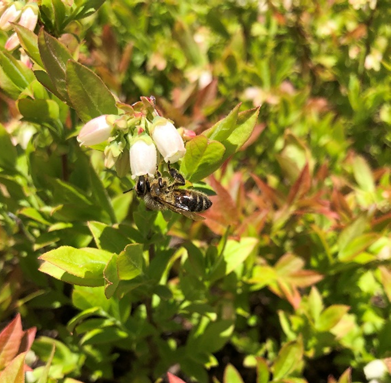
Honey bee on wild blueberry flower (ATTTA©2021)

Probably the most important component for protecting pollinators from pesticides is clear communication between growers and beekeepers. Both beekeepers and growers will benefit from having clear guidelines for each of their roles in the pollination process. If receiving or providing pollination services, it is recommended that a pollination contract is used. Examples of pollination contracts can be found within "Best Management Practices Guide for Honey Bee Pollination of Wild Blueberries in Atlantic Canada”3 at https://www.perennia.ca/portfolio-items/honey-bees/. Modify any template contracts as needed, but it is encouraged to include information on: the timing of arrival/departure of hives (needs to be in sync with wild blueberry bloom); responsibility of beekeeper to provide standard pollinating units; details of grower's responsibility to protect bees from any pesticide poisoning; designation of responsibility for periodically checking and caring for bees; designation of responsibility for providing hive protection (electric fencing); clear description of the pest management practices being used on the blueberry field before and during placement of hives; and details of hive placement location on the field.

Beekeepers and blueberry growers can both work to support pollinators through habitat development. Maintaining and creating habitat around blueberry fields can support honey bees and native pollinators4. Leaving non-invasive weeds, wildflowers, and other habitat patches around wild blueberries increases pollination and fruit production5. The presence of these native wild flowers will provide a diversity of pollen sources and will not deter honey bees and other pollinating insects from foraging for nectar on wild blueberry plants6. There are several things growers can do to help develop these habitats, such as delay flail or bush mowing areas around fields until after pollination and preserve wildflower diversity currently surrounding fields. On fields that border cultivated land, growers can create floral strips.

The use of pesticides is an integral part of wild blueberry production. There are several practices beekeepers and blueberry growers can follow to help minimize the impact of these products on pollinators. The first thing growers can do is select the least toxic pesticide to bees. Bees foraging on fields can be directly exposed to toxic products or exposed indirectly through ingesting pollen and nectar containing the product or contact with contaminated soil7. Generally, insecticides are more toxic to bees than herbicides or fungicides since insecticides are formulated to kill insects. The risk associated with a particular pesticide to bees is not only based on the toxicity, but also the residual toxicity. If a product is found to be toxic for greater than 8 hours than it is a higher risk to bees. For questions regarding a specific product’s risk to bees refer to the “Supplement Document for Protecting Pollinators from Pesticides” at https://www.perennia.ca/portfolio-items/honey-bees/.

Whenever applying a pesticide is essential to follow all label directions. When reviewing the label look for precautionary and advisory statements that state “toxic to bees”.

Best Management Practices Guide – Protecting Pollinators from Pesticides (ATTTA©2024)

Finally, growers and beekeepers need to minimize any potential exposure of bees to pesticides. Growers should avoid applying pesticides when bees are flying or clustered outside their hives; avoid applying pesticides to any blooming flowers around the field; place hives outside the range of pesticide application and consider developing a no spray buffer zone to protect hives; minimize pesticide drift when spraying; and look for nests of native bees around the field to avoid spraying near the area.

Protecting honey bees and other pollinators from pesticides is crucial for successful pollination. It is in the beekeeper’s and grower’s best interest to have conversations around pesticide use, and how they can work together to protect these vital insects.

References
  1. Orr, J., Byers, A., Morandin, L.A., Medeiros, S.J. and K. Law. 2023. Practices to Protect Pollinators from Pesticides: Wild Blueberry. Pollinator Partnership Canda and Atlantic Tech Transfer Team for Apiculture.
  2. Brodt, S., Zalom, F., Krebill-Prather, R., Bentley, W., Pickel, C., Connell, J., Wilhoit, L. and Gibbs, M., 2005. Almond growers rely on pest control advisers for integrated pest management. California agriculture, 59(4).
  3. Bennett, A. and A. Byers. 2023. Best Management Practices Guide for Honey Bee Pollination of Wild Blueberries in Atlantic Canada. Atlantic Tech Transfer Team for Apiculture.
  4. Park, M.G., Blitzer, E.J., Gibbs, J., Losey, J.E. and Danforth, B.N., 2015. Negative effects of pesticides on wild bee communities can be buffered by landscape context. Proceedings of the Royal Society B: Biological Sciences, 282(1809), p.20150299.
  5. Blaauw, B.R. and Isaacs, R., 2014. Flower plantings increase wild bee abundance and the pollination services provided to a pollination‐dependent crop. Journal of Applied Ecology, 51(4), pp.890-898.
  6. Girard, M., Chagnon, M. and Fournier, V., 2012. Pollen diversity collected by honey bees in the vicinity of Vaccinium spp. crops and its importance for colony development. Botany, 90(7), pp.545-555.
  7. Willis Chan, D.S., Prosser, R.S., Rodríguez-Gil, J.L. and Raine, N.E., 2019. Assessment of risk to hoary squash bees (Peponapis pruinosa) and other ground-nesting bees from systemic insecticides in agricultural soil. Scientific Reports, 9(1), p.11870.

Connecting with ATTTA Specialists

If you’d like to connect with ATTTA specialists or learn more about our program, you can:

visit our website at https://www.perennia.ca/portfolio-items/honey-bees/

Email abyers@perennia.ca


Get to Know Your Bumble Bees

Thursday, 18 April 2024

In Atlantic Canada, commercially managed bees, such as honey bees, are the main insects used for pollination, but native bees also play an important role in wild blueberry pollination. Some of the native pollinators involved in pollination include bumble bees, andrenid bees, halictid bees and mason bees(1). Bumble bees (genus Bombus) use floral sonication or buzz pollination while foraging, which involves vibrating the flower to allow pollen to be released from the anthers. Wild blueberries have coevolved with bumble bees to allow the release of pollen using this method(2). Given the symbiotic relationship bumble bees have with wild blueberries, and their suitability for Atlantic Canada’s climate, bumble bees are very efficient pollinators in the Maritimes. Read this week’s blog to learn about the multiple species of wild bumble bees that contribute to blueberry pollination in the Maritimes, and key features to identify them.

Get to Know Your Bumble Bees

Eastern Canada has a large diversity of bumble bees, with over 18 known species found in our region, and over 40 species found throughout Canada. That being said, some are found foraging around blueberry fields in Atlantic Canada more often than others, and those are the species being highlighted with the information provided.

Bombus impatiens, the common eastern bumble bee, is the most encountered bumble bee across eastern Canada. The species is highly adaptable and can live in country, suburbs, and urban cities3. Their adaptability makes them a great pollinator species, leading to an increase in their commercial use. When identifying the common eastern bumble bee, queens have bigger bodies measuring 17–23 mm. Workers have bodies that are 8.5–16 mm, and males have bodies that are 12–18 mm(3). Queens and workers are both black with a yellow thorax and yellow first abdominal segment. Drones slightly differ in their coloring, where they have a yellow face and head(4).

Bombus impatiens ©ATTTA (2023)

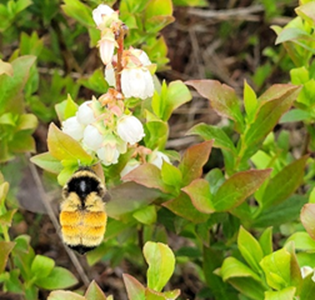
Bombus ternarius, commonly known as the orange-belted bumble bee or tricolored bumblebee, is a yellow, orange, and black bumble bee. The species is also common throughout eastern Canada(5). Bombus ternarius is a small, fairly slender bumble bee. The queen is 17–19 mm long. The workers are 8–13 mm, and drones are 9.5–13 mm in length. The queens and the workers have black heads, with a few pale-yellow hairs. The anterior and posterior thorax and the first and forth abdominal segments are yellow. Abdominal segments 2 and 3 are orange, and the terminal segments are black(6,7). The drone has a yellow head with a few black hairs(6,7).

Bombus ternarius ©ATTTA (2023)

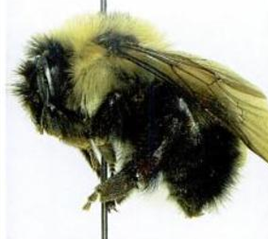
Bombus bimaculatus, the two-spotted bumble bee, can be found throughout Atlantic Canada. The bee's common name comes from the two yellow spots on its abdomen(8). Queens and workers have a black face with a triangular patch of yellow hairs on the vertex. Their thorax is yellow except for a shining area on the disc that is bordered by black hairs(9).  Drone faces have intermixed black and yellow hairs(9).

Bombus bimaculatus ©Sheffield and Palmier (2023)

Bombus vagans, the half-black bumble bee, is a small bumblebee with a wide distribution in North America(10), and present throughout eastern Canada. The head, thorax and first two segments of the abdomen are yellow while the rest of the abdomen is black, hence the name “half-black”(11). The face has a mixture of yellow and black hairs, and the thorax is covered in shaggy yellow hair except for a smooth central portion which is bare and shiny(11).

Bombus vagans ©Koch et al. (2012)

Bombus rufocinctus, the red-belted bumble bee, is another species found in Atlantic Canada. The queen is 16–18 mm long. She is black with scattered gray and yellowish hairs on the head. Her abdomen has many bright yellow hairs and areas of reddish hairs(12). The worker is 11–12 mm long. She is similar to the queen, but she may have longer hair. The male is 12–13 mm long. He is mostly black with more yellow on the head and abdomen(12).

Bombus rufocinctus ©Ron Payne (Idaho Official Government Website)

A final species to mention is Bombus terricola, the yellow-banded bumblebee, which is native to southern Canada. It was at one time a common species but has declined in numbers since the late 1990s(13). The Xerces Society for Insect Conservation has placed Bombus terricola on their "Red List" of endangered bees. The yellow-banded bumblebee is black and yellow and has a characteristic fringe of short yellow-brown hairs on its fifth abdominal segment(13). The queen is about 18 mm long. The worker is similar in appearance to the queen but smaller at a length of 9–14 mm(13). The male is intermediate in size, being 13–17 mm long(13).

Bombus terricola ©COSEWIC (2015)

It is important to remember the role native pollinators have when it comes to wild blueberry pollination. The background pollination provided by bumble bees and other native pollinators is not insignificant, so, as an industry, there are important steps and considerations for protecting these native pollinators that, in turn, will benefit the industry.

References

  1. Sheffield, C.S., Kevan, P.G. and Smith, R.F., 2003. Bee species of Nova Scotia, Canada, with new records and notes on bionomics and floral relations (Hymenoptera: Apoidea). Journal of the Kansas Entomological Society, pp.357-384.
  2. De Luca, P.A. and Vallejo-Marín, M., 2013. What's the ‘buzz’ about? The ecology and evolutionary significance of buzz-pollination. Current opinion in plant biology, 16(4), pp.429-435.
  3. Williams, P.H., Thorp, R.W., Richardson, L.L. and Colla, S.R., 2014. Bumble bees of North America: an identification guide (Vol. 89). Princeton University Press.
  4. Plath, O.E., 1934. Bumblebees and their ways. Bumblebees and their Ways.
  5. Eaton, E.R. and Kaufman, K., 2007. Kaufman field guide to insects of North America. Houghton Mifflin Harcourt.
  6. Richards, O.W., 1946, September. Observations on Bombus agrorum (Fabricius)(Hymen., Bomhidae). In Proceedings of the Royal Entomological Society of London. Series A, General Entomology (Vol. 21, No. 7‐9, pp. 66-71). Oxford, UK: Blackwell Publishing Ltd.
  7. Cumber, R.A., 1949. The biology of humble-bees, with special reference to the production of the worker caste. The Royal Entomological Society of London.
  8. Devore, B. 2009. Pollinators. Department of Natural Resources: 12.
  9. Medler, J.T. and Carney, D.W., 1963. Bumblebees of Wisconsin.
  10. Hatfield, R., Colla, S., Jepsen, S., Richardson, L.L., Thorp, R.W. and Jordan, S.F., 2014. IUCN Assessments for North American Bombus spp. for the North American IUCN Bumble Bee Specialist Group. The Xerces Society for Invertebrate Conservation. Available online: https://xerces. org/sites/default/files/publications/14-065. pdf (accessed on 18 August 2020).
  11. Colla, S., Richardson, L. and Williams, P., 2011. Bumble bees of the eastern United States. USDA Pollinator Partnership.
  12. Owen, R.E. and Plowright, R.C., 1988. Inheritance of metasomal pile colour variation in the bumble bee Bombus rufocinctus Cresson (Hymenoptera: Apidae). Canadian journal of zoology, 66(5), pp.1172-1178.
  13. Hatfield, R.G. and Jepsen, S.A.R.I.N.A., 2021. A conservation conundrum: protecting bumble bees under the California Endangered Species Act. California Fish Wildlife J, 107, pp.98-106.

Connecting with ATTTA Specialists

If you’d like to connect with ATTTA specialists or learn more about our program, you can:

visit our website at https://www.perennia.ca/portfolio-items/honey-bees/

Email abyers@perennia.ca